Advent weekday
Liturgical Color: Violet
Rosary Mysteries: Joyful Mysteries

Daily Readings
First Reading: Isaiah 4:2-6
Jerusalem Purified
2 On that day,
The branch of the LORD will be beauty and glory,
and the fruit of the land will be honor and splendor
for the survivors of Israel.
3 Everyone who remains in Zion,
everyone left in Jerusalem
Will be called holy:
everyone inscribed for life in Jerusalem.
4When the Lord washes away
the filth of the daughters of Zion,
And purges Jerusalem’s blood from her midst
with a blast of judgment, a searing blast,
5 Then will the LORD create,
over the whole site of Mount Zion
and over her place of assembly,
A smoking cloud by day
and a light of flaming fire by night.
6 For over all, his glory will be shelter and protection:
shade from the parching heat of day,
refuge and cover from storm and rain.
2 [In die illa,
erit germen Domini in magnificentia et gloria,
et fructus terræ sublimis, et exsultatio
his qui salvati fuerint de Israël.
3 Et erit: omnis qui relictus fuerit in Sion,
et residuus in Jerusalem,
Sanctus vocabitur,
omnis qui scriptus est in vita in Jerusalem.
4 Si abluerit Dominus sordes filiarum Sion,
et sanguinem Jerusalem laverit de medio ejus,
in spiritu judicii, et spiritu ardoris.
5 Et creabit Dominus super omnem locum montis Sion,
et ubi invocatus est,
nubem per diem et fumum,
et splendorem ignis flammantis in nocte:
super omnem enim gloriam protectio.
6 Et tabernaculum erit in umbraculum,
diei ab æstu,
et in securitatem et absconsionem
a turbine et a pluvia.]
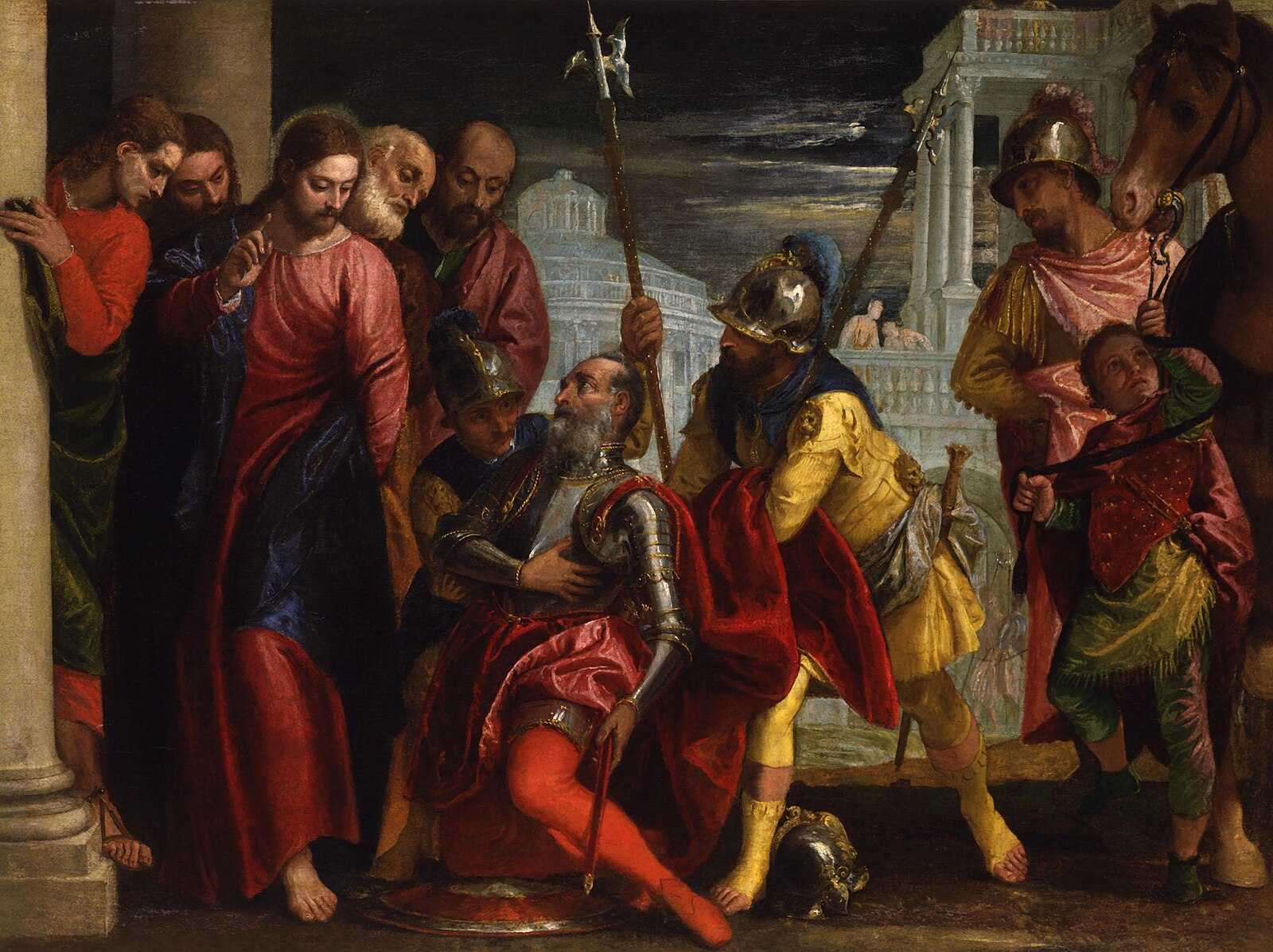
Gospel: Matthew 8: 5-11
The Healing of a Centurion’s Servant
5 When he entered Capernaum, a centurion approached him and appealed to him,
6 saying, “Lord, my servant is lying at home paralyzed, suffering dreadfully.”
7 He said to him, “I will come and cure him.”
8 The centurion said in reply, “Lord, I am not worthy to have you enter under my roof; only say the word and my servant will be healed.
9 For I too am a person subject to authority, with soldiers subject to me. And I say to one, ‘Go,’ and he goes; and to another, ‘Come here,’ and he comes; and to my slave, ‘Do this,’ and he does it.”
10 When Jesus heard this, he was amazed and said to those following him, “Amen, I say to you, in no one in Israel have I found such faith.
11 I say to you, many will come from the east and the west, and will recline with Abraham, Isaac, and Jacob at the banquet in the kingdom of heaven,
5 Cum autem introisset Capharnaum, accessit ad eum centurio, rogans eum,
6 et dicens: Domine, puer meus jacet in domo paralyticus, et male torquetur.
7 Et ait illi Jesus: Ego veniam, et curabo eum.
8 Et respondens centurio, ait: Domine, non sum dignus ut intres sub tectum meum: sed tantum dic verbo, et sanabitur puer meus.
9 Nam et ego homo sum sub potestate constitutus, habens sub me milites, et dico huic: Vade, et vadit: et alii: Veni, et venit: et servo meo: Fac hoc, et facit.
10 Audiens autem Jesus miratus est, et sequentibus se dixit: Amen dico vobis, non inveni tantam fidem in Israël.
11 Dico autem vobis, quod multi ab oriente et occidente venient, et recumbent cum Abraham, et Isaac, et Jacob in regno cælorum:

A Daily Question from the Summa Theologica
Whether God reprobates any man? (Article 3 of 8 of Question 23. OF PREDESTINATION from the Treatise on The One God)
Objection 1: It seems that God reprobates no man. For nobody reprobates what he loves. But God loves every man, according to (Wis. 11:25): “Thou lovest all things that are, and Thou hatest none of the things Thou hast made.” Therefore God reprobates no man.
Objection 2: Further, if God reprobates any man, it would be necessary for reprobation to have the same relation to the reprobates as predestination has to the predestined. But predestination is the cause of the salvation of the predestined. Therefore reprobation will likewise be the cause of the loss of the reprobate. But this false. For it is said (Osee 13:9): “Destruction is thy own, O Israel; Thy help is only in Me.” God does not, then, reprobate any man.
Objection 3: Further, to no one ought anything be imputed which he cannot avoid. But if God reprobates anyone, that one must perish. For it is said (Eccles. 7:14): “Consider the works of God, that no man can correct whom He hath despised.” Therefore it could not be imputed to any man, were he to perish. But this is false. Therefore God does not reprobate anyone.
On the contrary, It is said (Mal. 1:2, 3): “I have loved Jacob, but have hated Esau.”
I answer that, God does reprobate some. For it was said above (A[1]) that predestination is a part of providence. To providence, however, it belongs to permit certain defects in those things which are subject to providence, as was said above (Q[22], A[2]). Thus, as men are ordained to eternal life through the providence of God, it likewise is part of that providence to permit some to fall away from that end; this is called reprobation. Thus, as predestination is a part of providence, in regard to those ordained to eternal salvation, so reprobation is a part of providence in regard to those who turn aside from that end. Hence reprobation implies not only foreknowledge, but also something more, as does providence, as was said above (Q[22], A[1]). Therefore, as predestination includes the will to confer grace and glory; so also reprobation includes the will to permit a person to fall into sin, and to impose the punishment of damnation on account of that sin.
Reply to Objection 1: God loves all men and all creatures, inasmuch as He wishes them all some good; but He does not wish every good to them all. So far, therefore, as He does not wish this particular good—namely, eternal life—He is said to hate or reprobated them.
Reply to Objection 2: Reprobation differs in its causality from predestination. This latter is the cause both of what is expected in the future life by the predestined—namely, glory—and of what is received in this life—namely, grace. Reprobation, however, is not the cause of what is in the present—namely, sin; but it is the cause of abandonment by God. It is the cause, however, of what is assigned in the future—namely, eternal punishment. But guilt proceeds from the free-will of the person who is reprobated and deserted by grace. In this way, the word of the prophet is true—namely, “Destruction is thy own, O Israel.”
Reply to Objection 3: Reprobation by God does not take anything away from the power of the person reprobated. Hence, when it is said that the reprobated cannot obtain grace, this must not be understood as implying absolute impossibility: but only conditional impossibility: as was said above (Q[19], A[3]), that the predestined must necessarily be saved; yet a conditional necessity, which does not do away with the liberty of choice. Whence, although anyone reprobated by God cannot acquire grace, nevertheless that he falls into this or that particular sin comes from the use of his free-will. Hence it is rightly imputed to him as guilt.
Continue reading the rest of the articles on Sacred Texts Archive website.
Scripture texts in this work are taken from the New American Bible, revised edition © 2010, 1991, 1986, 1970 Confraternity of Christian Doctrine, Washington, D.C.