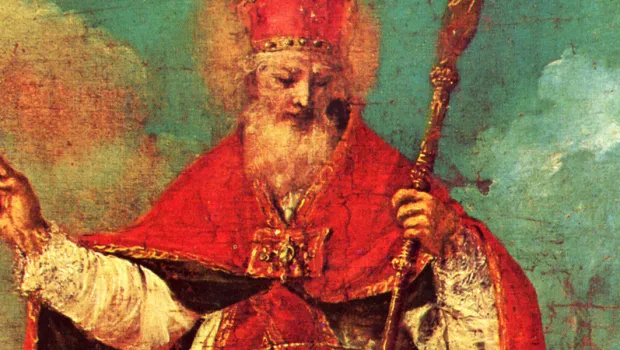
Optional Memorial of Saint Nicholas, Bishop
Liturgical Color: Violet or White
Rosary Mysteries: Joyful Mysteries
“The giver of every good and perfect gift has called upon us to mimic God’s giving, by grace, through faith, and this is not of ourselves.”
Saint Nicholas
est. March 15, 270 – December 6, 343
Patron of children and sailors

Daily Readings
First Reading: Isaiah 30:19-21, 23-26
19 Yes, people of Zion, dwelling in Jerusalem,
you shall no longer weep;
He will be most gracious to you when you cry out;
as soon as he hears he will answer you.
20 The Lord will give you bread in adversity
and water in affliction.
No longer will your Teacher hide himself,
but with your own eyes you shall see your Teacher,
21 And your ears shall hear a word behind you:
“This is the way; walk in it,”
when you would turn to the right or the left.
23 He will give rain for the seed
you sow in the ground,
And the bread that the soil produces
will be rich and abundant.
On that day your cattle will graze
in broad meadows;
24 The oxen and the donkeys that till the ground
will eat silage tossed to them
with shovel and pitchfork.
25 Upon every high mountain and lofty hill
there will be streams of running water.
On the day of the great slaughter,
when the towers fall,
26 The light of the moon will be like the light of the sun,
and the light of the sun will be seven times greater,
like the light of seven days,
On the day the LORD binds up the wounds of his people
and heals the bruises left by his blows.
19 Populus enim Sion habitabit in Jerusalem:
plorans nequaquam plorabis:
miserans miserebitur tui, ad vocem clamoris tui:
statim ut audierit, respondebit tibi.
20 Et dabit vobis Dominus
panem arctum, et aquam brevem;
et non faciet avolare a te ultra doctorem tuum;
et erunt oculi tui videntes præceptorem tuum.
21 Et aures tuæ audient verbum post tergum monentis:
Hæc est via; ambulate in ea,
et non declinetis neque ad dexteram, neque ad sinistram.
23 Et dabitur pluvia semini tuo,
ubicumque seminaveris in terra,
et panis frugum terræ
erit uberrimus et pinguis;
pascetur in possessione tua in die illo agnus spatiose,
24 et tauri tui, et pulli asinorum,
qui operantur terram,
commistum migma comedent
sicut in area ventilatum est.
25 Et erunt super omnem montem excelsum,
et super omnem collem elevatum,
rivi currentium aquarum,
in die interfectionis multorum,
cum ceciderint turres:
26 et erit lux lunæ sicut lux solis,
et lux solis erit septempliciter
sicut lux septem dierum,
in die qua alligaverit Dominus vulnus populi sui,
et percussuram plagæ ejus sanaverit.
Gospel: Matthew 9:35- 10:1, 5a, 6-8
The Compassion of Jesus
35 Jesus went around to all the towns and villages, teaching in their synagogues, proclaiming the gospel of the kingdom, and curing every disease and illness.
36 At the sight of the crowds, his heart was moved with pity for them because they were troubled and abandoned, like sheep without a shepherd.
37 Then he said to his disciples, “The harvest is abundant but the laborers are few;
38 so ask the master of the harvest to send out laborers for his harvest.”
The Mission of the Twelve
1 Then he summoned his twelve disciples and gave them authority over unclean spirits to drive them out and to cure every disease and every illness.
The Commissioning of the Twelve
5 Jesus sent out these twelve after instructing them thus, “Do not go into pagan territory or enter a Samaritan town.
6 Go rather to the lost sheep of the house of Israel.
7 As you go, make this proclamation: ‘The kingdom of heaven is at hand.’
8 Cure the sick, raise the dead, cleanse lepers, drive out demons. Without cost you have received; without cost you are to give.
35 Et circuibat Jesus omnes civitates, et castella, docens in synagogis eorum, et prædicans Evangelium regni, et curans omnem languorem, et omnem infirmitatem.
36 Videns autem turbas, misertus est eis: quia erant vexati, et jacentes sicut oves non habentes pastorem.
37 Tunc dicit discipulis suis: Messis quidem multa, operarii autem pauci.
38 Rogate ergo Dominum messis, ut mittat operarios in messem suam.
1 Et convocatis duodecim discipulis suis, dedit illis potestatem spirituum immundorum, ut ejicerent eos, et curarent omnem languorem, et omnem infirmitatem.
5 Hos duodecim misit Jesus, præcipiens eis, dicens: In viam gentium ne abieritis, et in civitates Samaritanorum ne intraveritis:
6 sed potius ite ad oves quæ perierunt domus Israël.
7 Euntes autem prædicate, dicentes: Quia appropinquavit regnum cælorum.
8 Infirmos curate, mortuos suscitate, leprosos mundate, dæmones ejicite: gratis accepistis, gratis date.

A Daily Question from the Summa Theologica
Whether predestination can be furthered by the prayers of the saints? (Article 8 of 8 of Question 23. OF PREDESTINATION from the Treatise on The One God)
Objection 1: It seems that predestination cannot be furthered by the prayers of the saints. For nothing eternal can be preceded by anything temporal; and in consequence nothing temporal can help towards making something else eternal. But predestination is eternal. Therefore, since the prayers of the saints are temporal, they cannot so help as to cause anyone to become predestined. Predestination therefore is not furthered by the prayers of the saints.
Objection 2: Further, as there is no need of advice except on account of defective knowledge, so there is not need of help except through defective power. But neither of these things can be said of God when He predestines. Whence it is said: “Who hath helped the Spirit of the Lord? [*Vulg.: ‘Who hath known the mind of the Lord?’] Or who hath been His counsellor?” (Rom. 11:34). Therefore predestination cannot be furthered by the prayers of the saints.
Objection 3: Further, if a thing can be helped, it can also be hindered. But predestination cannot be hindered by anything. Therefore it cannot be furthered by anything.
On the contrary, It is said that “Isaac besought the Lord for his wife because she was barren; and He heard him and made Rebecca to conceive” (Gn. 25:21). But from that conception Jacob was born, and he was predestined. Now his predestination would not have happened if he had never been born. Therefore predestination can be furthered by the prayers of the saints.
I answer that, Concerning this question, there were different errors. Some, regarding the certainty of divine predestination, said that prayers were superfluous, as also anything else done to attain salvation; because whether these things were done or not, the predestined would attain, and the reprobate would not attain, eternal salvation. But against this opinion are all the warnings of Holy Scripture, exhorting us to prayer and other good works.
Others declared that the divine predestination was altered through prayer. This is stated to have the opinion of the Egyptians, who thought that the divine ordination, which they called fate, could be frustrated by certain sacrifices and prayers. Against this also is the authority of Scripture. For it is said: “But the triumpher in Israel will not spare and will not be moved to repentance” (1 Kings 15:29); and that “the gifts and the calling of God are without repentance” (Rom. 11:29).
Wherefore we must say otherwise that in predestination two things are to be considered—namely, the divine ordination; and its effect. As regards the former, in no possible way can predestination be furthered by the prayers of the saints. For it is not due to their prayers that anyone is predestined by God. As regards the latter, predestination is said to be helped by the prayers of the saints, and by other good works; because providence, of which predestination is a part, does not do away with secondary causes but so provides effects, that the order of secondary causes falls also under providence. So, as natural effects are provided by God in such a way that natural causes are directed to bring about those natural effects, without which those effects would not happen; so the salvation of a person is predestined by God in such a way, that whatever helps that person towards salvation falls under the order of predestination; whether it be one’s own prayers or those of another; or other good works, and such like, without which one would not attain to salvation. Whence, the predestined must strive after good works and prayer; because through these means predestination is most certainly fulfilled. For this reason it is said: “Labor more that by good works you may make sure your calling and election” (2 Pet. 1:10).
Reply to Objection 1: This argument shows that predestination is not furthered by the prayers of the saints, as regards the preordination.
Reply to Objection 2: One is said to be helped by another in two ways; in one way, inasmuch as he receives power from him: and to be helped thus belongs to the weak; but this cannot be said of God, and thus we are to understand, “Who hath helped the Spirit of the Lord?” In another way one is said to be helped by a person through whom he carries out his work, as a master through a servant. In this way God is helped by us; inasmuch as we execute His orders, according to 1 Cor. 3:9: “We are God’s co-adjutors.” Nor is this on account of any defect in the power of God, but because He employs intermediary causes, in order that the beauty of order may be preserved in the universe; and also that He may communicate to creatures the dignity of causality.
Reply to Objection 3: Secondary causes cannot escape the order of the first universal cause, as has been said above (Q[19], A[6]), indeed, they execute that order. And therefore predestination can be furthered by creatures, but it cannot be impeded by them.
Continue reading the rest of the articles on Sacred Texts Archive website.
Scripture texts in this work are taken from the New American Bible, revised edition © 2010, 1991, 1986, 1970 Confraternity of Christian Doctrine, Washington, D.C.