Date: December 9-12, 1531
Place: Mexico
Important Person(s): Saint Juan Diego
Approved by the vatican
Pilgramage Site: Basilica of Our Lady of Guadalupe, Mexico City
Feast Day: December 12
Additional Resources: Nican Mopohua by Antonio Valeriano
On Tepeyac Hill, which is what is now known as Mexico City, the Blessed Mother appeared to Saint Juan Diego four times between December 9, 1531 to December 12, 1531.
The Conversion of the Aztecs
Prior to the arrival of the Spanish, the Aztecs had a polytheistic religion and a pantheon of deities from conquered kingdoms. Many of their religious ceremonies involved human sacrifices and cannibalism. When the Spanish conquered the Aztecs in 1521, they attempted to convert the Aztecs to Catholicism by destroying temples, suppressing public worship, and putting the children under the tutelage of monks. When Franciscan friars arrived in 1524, they encouraged the Aztecs to convert through religious syncretism, like building churches in the same places as the destroyed temples. Although the Aztecs willingly accepted some aspects of Christianity, like baptism, some remained reluctant to embrace the faith as a whole and let go of their old traditions.
Saint Juan Diego
Juan Diego, previously called Cuauhtlatoatzin before his baptism in ~1524-1525, was a member of the Chichimeca people. The Informaciones Guadalupanas of 1666 states that he appeared to be a pious man throughout his life. When his wife died in 1529, he moved in with his uncle, Juan Bernardino. From his uncle’s home, he would walk around three and a half hours to the Mass and catechetical education every Saturday and Sunday without shoes.
First Apparition
Our Lady of Guadalupe appeared to St. Juan Diego for the first time in Mexico on December 9, 1531 while he was walking to Mass one morning. She requested that he build a shrine to her on the top of Tepeyac Hill. When St. Juan told the bishop, Don Brother Juan de Zumarraga, a Franciscan priest, what Our Lady had asked of him, the bishop was hesistant to believe the story.
“Dear Juan, dearest Juan Diego.”
The words of the Blessed Mother according to Nican Mopohua, by Antonio Valeriano circa 1560
“Listen my son, my youngest son, Juanito, where are you going?”
“Know, know for sure my dearest and youngest son, that I am truly the ever perfect Holy Virgin Mary, who has the honor to be the Mother of the one true God for whom we all live, the Creator of people, the Lord of all around us and of what is close to us, the Lord of Heaven, the Lord of Earth.
I want very much that they build my sacred little house here, in which I will show Him, I will exalt Him on making Him manifest , I will give Him to all people in all my personal love, Him that is my compassionate gaze, Him that is my help, Him that is my salvation.
Because truly I am honored to be your compassionate mother, yours and that of all the people that live together in this land, and also of all the other various lineages of men; those who love me, those who cry to me, those who seek me, those who trust in me. Because there truly will I hear their cry, their sadness, to remedy, to cure all their various troubles, their miseries, their pains.
And to bring about what my compassionate and merciful gaze would achieve, go to the palace of the Bishop of Mexico, and tell him how I have sent you, so that you may reveal to him how I very much want him to build me a house here, to erect my temple on the plain; tell him everything, all you have seen and marveled at, and what you have heard.
[A]nd know for sure that I will appreciate it very much and reward it, that because of it I will enrich you, I will glorify you; and because of it you will deserve very much how I reward your fatigue, your service in going to petition the matter for which I am sending you. Now, my dearest son, you have heard my breath, my word; go, do what you are responsible for doing.”
Second Apparition
Our Lady appeared to St. Juan Diego for the second time after his meeting with the bishop. She instructed him to ask again.
“Listen my youngest son, know for sure that I have no lack of servants, of messengers, to whom I can give the task of carrying my breath, my word, so that they carry out my will; but it is necessary that you, personally, go and plead, that by your intercession, my wish, my will, become a reality. And I beg you, my youngest son, and I strictly order you, to go again tomorrow to see the Bishop. And in my name, make him know, make him hear my wish, my will, so that he will bring into being, he will build my sacred house that I ask of him. And carefully tell him again how I, personally, the ever Virgin Holy Mary, I, who am the Mother of God, sent you as my messenger.”
The words of the Blessed Mother according to Nican Mopohua, by Antonio Valeriano circa 1560
Third Apparition
St. Juan Diego went back to the bishop as instructed. The bishop requested a sign. When Our Lady appeared to St. Juan Diego later that day, he told her what the bishop requested. The following day, St. Juan Diego’s uncle fell very ill.
“That’s fine, my little son, you will come back here tomorrow so that you may take the Bishop the sign he has asked you for; with that he will believe you, and he will no longer have any doubts about all this, nor will he be suspicious of you; and know, my little son, that I will reward the care, the work and the fatigue that you have put into this for me; so go now; I will be waiting for you here tomorrow.”
The words of the Blessed Mother according to Nican Mopohua, by Antonio Valeriano circa 1560
Fourth Apparition
On December 12, 1531, Our Lady appeared again and instructed St. Juan Diego to collect roses from the hill and bring them to the bishop. Despite it being winter, St. Juan Diego found Castilian roses, native to Spain, the homeland of the bishop, exactly where she told him.
“My youngest son, what’s going on? Where are you going? Where are you headed?”
“Listen, put it into your heart, my youngest son, that what frightened you, what afflicted you is nothing; do not let it disturb your face, your heart; do not fear this sickness or any other sickness, nor any sharp or hurtful thing. Am I not here, I who have the honor to be your mother? Are you not in my shadow and under my protection? Am I not the source of your joy? Are you not in the hollow of my mantle, in the crossing of my arms? Do you need anything more?
Let nothing else worry you, disturb you; don’t grieve your uncle’s illness, because he will not die of it for now, you may be certain that he is already healed.
Go up, my youngest son, to the top of the hill, to where you saw me and I told you what to do; there you will see spread out several kinds of flowers: cut them, gather them, put them all together: then come right down; bring them here, into my presence.”“My youngest son, these different kinds of flowers are the proof, the sign that you will take to the
The words of the Blessed Mother according to Nican Mopohua, by Antonio Valeriano circa 1560
Bishop; you will tell him from me that in them he is to see my wish and that therefore he is to carry out my wish, my will; and you, you who are my messenger, in you I place my absolute trust. And I strictly order you that only alone, in the Bishop’s presence, will you open you tilma and show him what you are carrying; and
you will tell him everything exactly, you will tell him that I ordered you to climb to the top of the little hill to cut the flowers, and everything you saw and admired; so that you can convince the Governing Priest, so that he will then do what is his responsibility, to build my little sacred house that I have asked for.”
The Roses and the Tilma
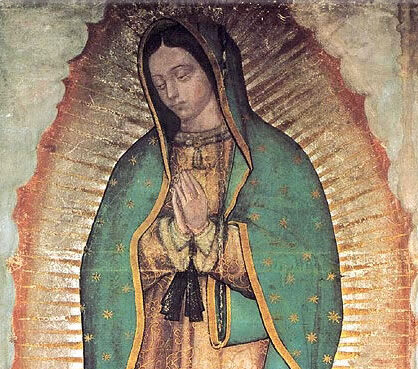
When St. Juan Diego met with the bishop, he opened his tilma to drop the roses. On the inside of the tilma, an image of Our Lady was imprinted. When the bishop and everyone else present saw it, they knelt in awe. The bishop begged Our Lady for forgiveness. He placed the tilma in a private chapel and gave the order for the shrine to be built. When St. Juan Diego returned to Juan Bernardino, he found him cured. Our Lady had also visited Juan Bernardino and directed that the image on the tilma should be named “THE PERFECT VIRGIN, SAINT MARY OF GUADALUPE”.

Image of Our Lady imprinted on the inside of St. Juan Diego's tilma
Our Lady appears as a pregnant mestiza (both Aztec and Spanish) woman. Her hair parted in the middle indicates that she is a virgin and the ribbon around her waist shows that she is pregnant. Her mantle indicates that she is the Queen of Heaven. Her joined hands show that she is praying to God. For more information on the symbolism, check out the following website.: https://ourladyofguadalupechurch.org/about/our-patroness/
The Shrine
The Old Basilica was completed in 1709. However, due to unsafe conditions, the New Basilica was built nearby in 1974.


For more information on the apparitions, consider reading Nican Mopohua, written by Antonio Valeriano around 1560.
Sources:
https://www.kofc.org/en/resources/our-lady-of-guadalupe/nican-mopohua.pdf
https://www.vatican.va/news_services/liturgy/saints/ns_lit_doc_20020731_juan-diego_en.html
https://www.sancta.org/nican.html
https://www.sjsu.edu/people/jennifer.rycenga/courses/RelS191F12/s1/WhyAztecsConvert.pdf
https://ourladyofguadalupechurch.org/about/our-patroness/
https://www.britannica.com/topic/Basilica-of-Guadalupe