Date: 750 AD
Place: Church of Francis, Lanciano, Italy
Important Person: a Basilian monk
Click here to check out the work of Saint Carlo Acutis on the Miracle of Lanciano!

This Eucharistic miracle occurred around 750 AD in Lanciano, Italy at a Mass presided over by a Basilian monk, who had begun doubting the doctrine of transubstantiation..
The Miracle
During the Consecration, in front of the priest and the entire congregation, the bread was transformed into flesh and the wine into blood. The wine coagulated into five globules, which is believed to correspond to the five wounds of Christ. At the time of the miracle, the flesh and blood had not shown any signs of decomposition and appeared to be fresh.
The priest then contacted his bishop, who then met with other bishops to discuss the incident. They determined it to be miraculous and the flesh and blood were eventually put in the altar for conservation.
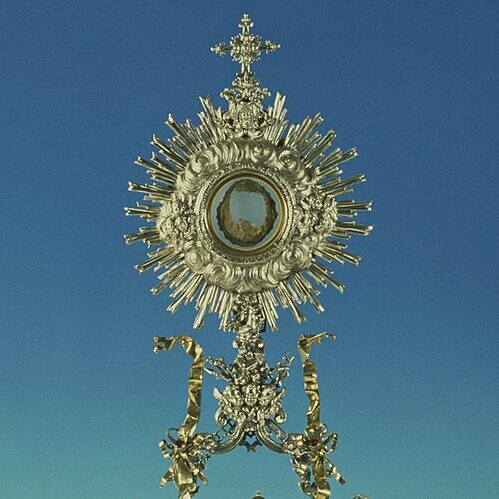
The Basilian monks retained guardianship of the miracle until 1175, when they left the church. The Benedictines then took up the charge with a papal decree from Pope Alexander III. In 1253, custody of the church passed to the Franciscans with approval from Pope Innocent IV and Pope Alexander IV until 1809 with Napolean Bonaparte’s suppression of religious houses. However, the Franciscans were recalled in 1953 and have retained custody of the church. In 1902, the flesh and blood were moved to a 17th century silver monstrance on the main altar.
The details of the miracle have been passed down through the centuries until 1636 when the first living document was originated.
“Around the year of our Lord 700, in this church then under the title of St. Legontian’s, of the monks of St. Basil, a monk doubted if in the consecrated Host there was really the Body of our Lord, and in the consecrated wine, His Blood. He celebrated Mass, said the words of consecration, and saw the Host turned to Flesh and the wine to Blood. He showed it all to bystanders and it was announced to all people. The Flesh is still in one piece and the Blood is divided in five unequal parts, which, when weighed together, are equal in weight to each separate piece. This can be seen today in the same way in the Chapel built by Giovanni Francesco Valsecca at his own expenses in the year of our Lord 1636”.
Marble inscription in the Church of St. Francis written in 1636
Scientific Studies
In 1574, a bishop examined the five clots and found that each globule weighed exactly the same as all five together. However, these results could not be replicated in the following studies in 1636, 1777, and 1886.
In November 1970, the Franciscans of Lanciano, with Rome’s permission, requested that Doctor Odoardo Linoli, a professor of human anatomy and pathological histology, chemistry, and clinical microsopy, with the assistance of Doctor Ruggero Bertelli, a professor of human anatomy, to conduct a study to test the validity of the miracle. The study was completed in March 1971.
The study confirmed that the flesh was tissue from a human myocardium from the left ventricle, which is part of the heart muscle. They also confirmed that the blood was actually blood of the AB type, which corresponds to the blood type found on other relics like the Shroud of Turin and is common in the Middle Eastern population. Doctor Ruggero Bertelli studied the host again in 1981, and the findings were confirmed.
Myths
The World Health Organization denies appointing a commission to study the miracle.
Devotions
In 1975, Pope Paul VI recognized the miracle as worthy of veneration. Lanciano is now a popular pilgrimage site. The relics are preserved in the Church of St. Francis, which was built over the original church.

Sources:
https://www.miracolieucaristici.org/en/liste/scheda_b.html?nat=italia&wh=lanciano&ct=Lanciano,%20750%20D.C.
https://www.keepingfaith.me/resources/common/pdfs/The%20Eucharistic%20Miracle%20of%20Lanciano%20-%20Historical,%20Theological,%20Scientific%20and%20Photographic%20Documentation.pdf
https://www.ewtn.com/catholicism/library/physician-tells-of-eucharistic-miracle-of-lanciano-1866
https://www.shroud.com/pdfs/ssi07part8.pdf
https://www.catholic.com/encyclopedia/suppression-of-monasteries