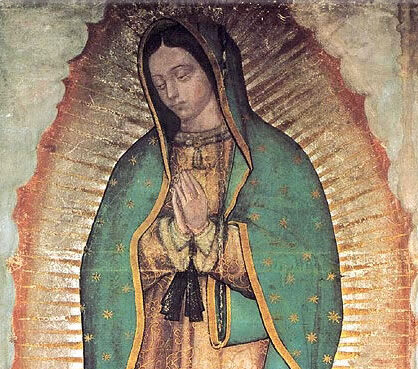
Feast of Our Lady of Guadalupe
Liturgical Color: White
Rosary Mysteries: Sorrowful Mysteries
“Am I not here, I who am your Mother? Are you not under my shadow and protection?”
Our Lady of Guadalupe
Patroness of the Americas
Click here to check out a summary on the apparitions of Our Lady of Guadalupe.

Daily Readings
First Reading: Revelation 11:19a; 12:1-6a, 10ab
19 Then God’s temple in heaven was opened, and the ark of his covenant could be seen in the temple. There were flashes of lightning, rumblings, and peals of thunder, an earthquake, and a violent hailstorm.
1 A great sign appeared in the sky, a woman clothed with the sun, with the moon under her feet, and on her head a crown of twelve stars.
2 She was with child and wailed aloud in pain as she labored to give birth.
3 Then another sign appeared in the sky; it was a huge red dragon, with seven heads and ten horns, and on its heads were seven diadems.
4 Its tail swept away a third of the stars in the sky and hurled them down to the earth. Then the dragon stood before the woman about to give birth, to devour her child when she gave birth.
5 She gave birth to a son, a male child, destined to rule all the nations with an iron rod. Her child was caught up to God and his throne.
6 The woman herself fled into the desert where she had a place prepared by God, that there she might be taken care of for twelve hundred and sixty days.
10 Then I heard a loud voice in heaven say:
“Now have salvation and power come,
and the kingdom of our God
and the authority of his Anointed.
For the accuser of our brothers is cast out,
who accuses them before our God day and night.
19 Et apertum est templum Dei in cælo: et visa est arca testamenti ejus in templo ejus, et facta sunt fulgura, et voces, et terræmotus, et grando magna.
1 Et signum magnum apparuit in cælo: mulier amicta sole, et luna sub pedibus ejus, et in capite ejus corona stellarum duodecim:
2 et in utero habens, clamabat parturiens, et cruciabatur ut pariat.
3 Et visum est aliud signum in cælo: et ecce draco magnus rufus habens capita septem, et cornua decem: et in capitibus ejus diademata septem,
4 et cauda ejus trahebat tertiam partem stellarum cæli, et misit eas in terram: et draco stetit ante mulierem, quæ erat paritura, ut cum peperisset, filium ejus devoraret.
5 Et peperit filium masculum, qui recturus erat omnes gentes in virga ferrea: et raptus est filius ejus ad Deum, et ad thronum ejus,
6 et mulier fugit in solitudinem ubi habebat locum paratum a Deo, ut ibi pascant eam diebus mille ducentis sexaginta.
10 Et audivi vocem magnam in cælo dicentem: Nunc facta est salus, et virtus, et regnum Dei nostri, et potestas Christi ejus: quia projectus est accusator fratrum nostrorum, qui accusabat illos ante conspectum Dei nostri die ac nocte.
Gospel: Luke 1:26-38 or Luke 1:39-47
Announcement of the Birth of Jesus
26 In the sixth month, the angel Gabriel was sent from God to a town of Galilee called Nazareth,
27 to a virgin betrothed to a man named Joseph, of the house of David, and the virgin’s name was Mary.
28 And coming to her, he said, “Hail, favored one! The Lord is with you.”
29 But she was greatly troubled at what was said and pondered what sort of greeting this might be.
30 Then the angel said to her, “Do not be afraid, Mary, for you have found favor with God.
31 Behold, you will conceive in your womb and bear a son, and you shall name him Jesus.
32 He will be great and will be called Son of the Most High, and the Lord God will give him the throne of David his father,
33 and he will rule over the house of Jacob forever, and of his kingdom there will be no end.”
34 But Mary said to the angel, “How can this be, since I have no relations with a man?”
35 And the angel said to her in reply, “The holy Spirit will come upon you, and the power of the Most High will overshadow you. Therefore the child to be born will be called holy, the Son of God.
36 And behold, Elizabeth, your relative, has also conceived a son in her old age, and this is the sixth month for her who was called barren;
37 for nothing will be impossible for God.”
38 Mary said, “Behold, I am the handmaid of the Lord. May it be done to me according to your word.” Then the angel departed from her.
Mary Visits Elizabeth.
39 During those days Mary set out and traveled to the hill country in haste to a town of Judah,
40 where she entered the house of Zechariah and greeted Elizabeth.
41 When Elizabeth heard Mary’s greeting, the infant leaped in her womb, and Elizabeth, filled with the holy Spirit,
42 cried out in a loud voice and said, “Most blessed are you among women, and blessed is the fruit of your womb.
43 And how does this happen to me, that the mother of my Lord should come to me?
44 For at the moment the sound of your greeting reached my ears, the infant in my womb leaped for joy.
45 Blessed are you who believed that what was spoken to you by the Lord would be fulfilled.”
The Canticle of Mary
46 And Mary said:
“My soul proclaims the greatness of the Lord;
47 my spirit rejoices in God my savior.
26 In mense autem sexto, missus est angelus Gabriel a Deo in civitatem Galilææ, cui nomen Nazareth,
27 ad virginem desponsatam viro, cui nomen erat Joseph, de domo David: et nomen virginis Maria.
28 Et ingressus angelus ad eam dixit: Ave gratia plena: Dominus tecum: benedicta tu in mulieribus.
29 Quæ cum audisset, turbata est in sermone ejus, et cogitabat qualis esset ista salutatio.
30 Et ait angelus ei: Ne timeas, Maria: invenisti enim gratiam apud Deum.
31 Ecce concipies in utero, et paries filium, et vocabis nomen ejus Jesum:
32 hic erit magnus, et Filius Altissimi vocabitur, et dabit illi Dominus Deus sedem David patris ejus: et regnabit in domo Jacob in æternum,
33 et regni ejus non erit finis.
34 Dixit autem Maria ad angelum: Quomodo fiet istud, quoniam virum non cognosco?
35 Et respondens angelus dixit ei: Spiritus Sanctus superveniet in te, et virtus Altissimi obumbrabit tibi. Ideoque et quod nascetur ex te sanctum, vocabitur Filius Dei.
36 Et ecce Elisabeth cognata tua, et ipsa concepit filium in senectute sua: et hic mensis sextus est illi, quæ vocatur sterilis:
37 quia non erit impossibile apud Deum omne verbum.
38 Dixit autem Maria: Ecce ancilla Domini: fiat mihi secundum verbum tuum. Et discessit ab illa angelus.
39 Exsurgens autem Maria in diebus illis, abiit in montana cum festinatione, in civitatem Juda:
40 et intravit in domum Zachariæ, et salutavit Elisabeth.
41 Et factum est, ut audivit salutationem Mariæ Elisabeth, exsultavit infans in utero ejus: et repleta est Spiritu Sancto Elisabeth:
42 et exclamavit voce magna, et dixit: Benedicta tu inter mulieres, et benedictus fructus ventris tui.
43 Et unde hoc mihi, ut veniat mater Domini mei ad me?
44 Ecce enim ut facta est vox salutationis tuæ in auribus meis, exsultavit in gaudio infans in utero meo.
45 Et beata, quæ credidisti, quoniam perficientur ea, quæ dicta sunt tibi a Domino.
46 Et ait Maria: [Magnificat anima mea Dominum:
47 et exsultavit spiritus meus in Deo salutari meo.

A Daily Question from the Summa Theologica
Whether after Christ, it was proper to the Blessed Virgin to be sanctified in the womb?(Article 6 of 6 of Question 27. Of the Sanctification of the Blessed Virgin from the Treatise on the Incarnation)
Objection 1: It would seem that it was proper for the Blessed Virgin, after Christ, to be sanctified in the womb. For it has been said (A[4]) that the Blessed Virgin was sanctified in the womb, in order that she might be worthy to be the mother of God. But this is proper to her. Therefore she alone was sanctified in the womb.
Objection 2: Further, some men seem to have been more closely connected with Christ than Jeremias and John the Baptist, who are said to have been sanctified in the womb. For Christ is specially called the Son of David and of Abraham, by reason of the promise specially made to them concerning Christ. Isaias also prophesied of Christ in the most express terms. And the apostles were in converse with Christ Himself. And yet these are not mentioned as having been sanctified in the womb. Therefore it was not befitting that either Jeremias or John the Baptist should be sanctified in the womb.
Objection 3: Further, Job says of himself (Job 31:18): “From my infancy mercy grew up with me; and it came out with me from [my mother’s] womb.” Nevertheless we do not for this reason say that he was sanctified in the womb. Neither therefore are we bound to say that Jeremias and John the Baptist were sanctified in the womb.
On the contrary, It is written of Jeremias (Jer. 1:5): “Before thou camest forth out of the womb I sanctified thee.” And of John the Baptist it is written (Lk. 1:15): “He shall be filled with the Holy Ghost, even from his mother’s womb.”
I answer that, Augustine (Ep. ad Dardan.) seems to speak dubiously of their (Jeremias’ and John the Baptist’s) sanctification in the womb. For the leaping of John in the womb “might,” as he says, “signify the great truth,” viz. that the woman was the mother of God, “which was to be made known to his elders, though as yet unknown to the infant. Hence in the Gospel it is written, not that the infant in her womb believed, but that it ‘leaped’: and our eyes are witness that not only infants leap but also cattle. But this was unwonted because it was in the womb. And therefore, just as other miracles are wont to be done, this was done divinely, in the infant; not humanly by the infant. Perhaps also in this child the use of reason and will was so far accelerated that while yet in his mother’s womb he was able to acknowledge, believe, and consent, whereas in other children we have to wait for these things till they grow older: this again I count as a miraculous result of the divine power.”
But since it is expressly said (of John) in the Gospel that “he shall be filled with the Holy Ghost, even from his mother’s womb”; and of Jeremias, “Before thou camest forth out of the womb, I sanctified thee”; it seems that we must needs assert that they were sanctified in the womb, although, while in the womb, they had not the use of reason (which is the point discussed by Augustine); just as neither do children enjoy the use of free will as soon as they are sanctified by baptism.
Nor are we to believe that any others, not mentioned by Scripture, were sanctified in the womb. For such privileges of grace, which are bestowed on some, outside the common law, are ordered for the salvation of others, according to 1 Cor. 12:7: “The manifestation of the Spirit is given to every man unto profit,” which would not result from the sanctification of anyone unless it were made known to the Church.
And although it is not possible to assign a reason for God’s judgments, for instance, why He bestows such a grace on one and not on another, yet there seems to be a certain fittingness in both of these being sanctified in the womb, by their foreshadowing the sanctification which was to be effected through Christ. First, as to His Passion, according to Heb. 13:12: “Jesus, that He might sanctify the people by His own blood, suffered without the gate”: which Passion Jeremias foretold openly by words and by symbols, and most clearly foreshadowed by his own sufferings. Secondly, as to His Baptism (1 Cor. 6:11): “But you are washed, but you are sanctified”; to which Baptism John prepared men by his baptism.
Reply to Objection 1: The blessed Virgin, who was chosen by God to be His Mother, received a fuller grace of sanctification than John the Baptist and Jeremias, who were chosen to foreshadow in a special way the sanctification effected by Christ. A sign of this is that it was granted to the Blessed Virgin thence-forward never to sin either mortally or venially: whereas to the others who were thus sanctified it was granted thenceforward not to sin mortally, through the protection of God’s grace.
Reply to Objection 2: In other respects these saints might be more closely united to Christ than Jeremias and John the Baptist. But the latter were most closely united to Him by clearly foreshadowing His sanctification, as explained above.
Reply to Objection 3: The mercy of which Job speaks is not the infused virtue; but a certain natural inclination to the act of that virtue.
Continue reading the rest of the articles on Sacred Texts Archive website.
Scripture texts in this work are taken from the New American Bible, revised edition © 2010, 1991, 1986, 1970 Confraternity of Christian Doctrine, Washington, D.C.