Advent Weekday
Liturgical Color: Violet
Rosary Mysteries: Sorrowful Mysteries

Daily Readings
First Reading: Judges 13:2-7, 24-25a
2 There was a certain man from Zorah, of the clan of the Danites, whose name was Manoah. His wife was barren and had borne no children.
3 An angel of the LORD appeared to the woman and said to her: Though you are barren and have had no children, you will conceive and bear a son.
4 Now, then, be careful to drink no wine or beer and to eat nothing unclean,
5 for you will conceive and bear a son. No razor shall touch his head, for the boy is to be a nazirite for God from the womb. It is he who will begin to save Israel from the power of the Philistines.
6 The woman went and told her husband, “A man of God came to me; he had the appearance of an angel of God, fearsome indeed. I did not ask him where he came from, nor did he tell me his name.
7 But he said to me, ‘You will conceive and bear a son. So drink no wine or beer, and eat nothing unclean. For the boy shall be a nazirite for God from the womb, until the day of his death.’”
24 The woman bore a son and named him Samson, and when the boy grew up the LORD blessed him.
25 The spirit of the LORD came upon him for the first time in Mahaneh-dan, between Zorah and Eshtaol.
2 Erat autem quidam vir de Saraa, et de stirpe Dan, nomine Manue, habens uxorem sterilem.
3 Cui apparuit angelus Domini, et dixit ad eam: Sterilis es et absque liberis: sed concipies, et paries filium.
4 Cave ergo ne bibas vinum ac siceram, nec immundum quidquam comedas:
5 quia concipies, et paries filium, cujus non tanget caput novacula: erit enim nazaræus Dei ab infantia sua et ex matris utero, et ipse incipiet liberare Israël de manu Philisthinorum.
6 Quæ cum venisset ad maritum suum, dixit ei: Vir Dei venit ad me, habens vultum angelicum, terribilis nimis. Quem cum interrogassem quis esset, et unde venisset, et quo nomine vocaretur, noluit mihi dicere:
7 sed hoc respondit: Ecce concipies et paries filium: cave ne vinum bibas, nec siceram, et ne aliquo vescaris immundo: erit enim puer nazaræus Dei ab infantia sua, ex utero matris suæ usque ad diem mortis suæ.
24 Peperit itaque filium, et vocavit nomen ejus Samson. Crevitque puer, et benedixit ei Dominus.
25 Cœpitque spiritus Domini esse cum eo in castris Dan inter Saraa et Esthaol.
Gospel: Luke 1:5-25
II. THE INFANCY NARRATIVE
Announcement of the Birth of John
5 In the days of Herod, King of Judea, there was a priest named Zechariah of the priestly division of Abijah; his wife was from the daughters of Aaron, and her name was Elizabeth.
6 Both were righteous in the eyes of God, observing all the commandments and ordinances of the Lord blamelessly.
7 But they had no child, because Elizabeth was barren and both were advanced in years.
8 Once when he was serving as priest in his division’s turn before God,
9 according to the practice of the priestly service, he was chosen by lot to enter the sanctuary of the Lord to burn incense.
10 Then, when the whole assembly of the people was praying outside at the hour of the incense offering,
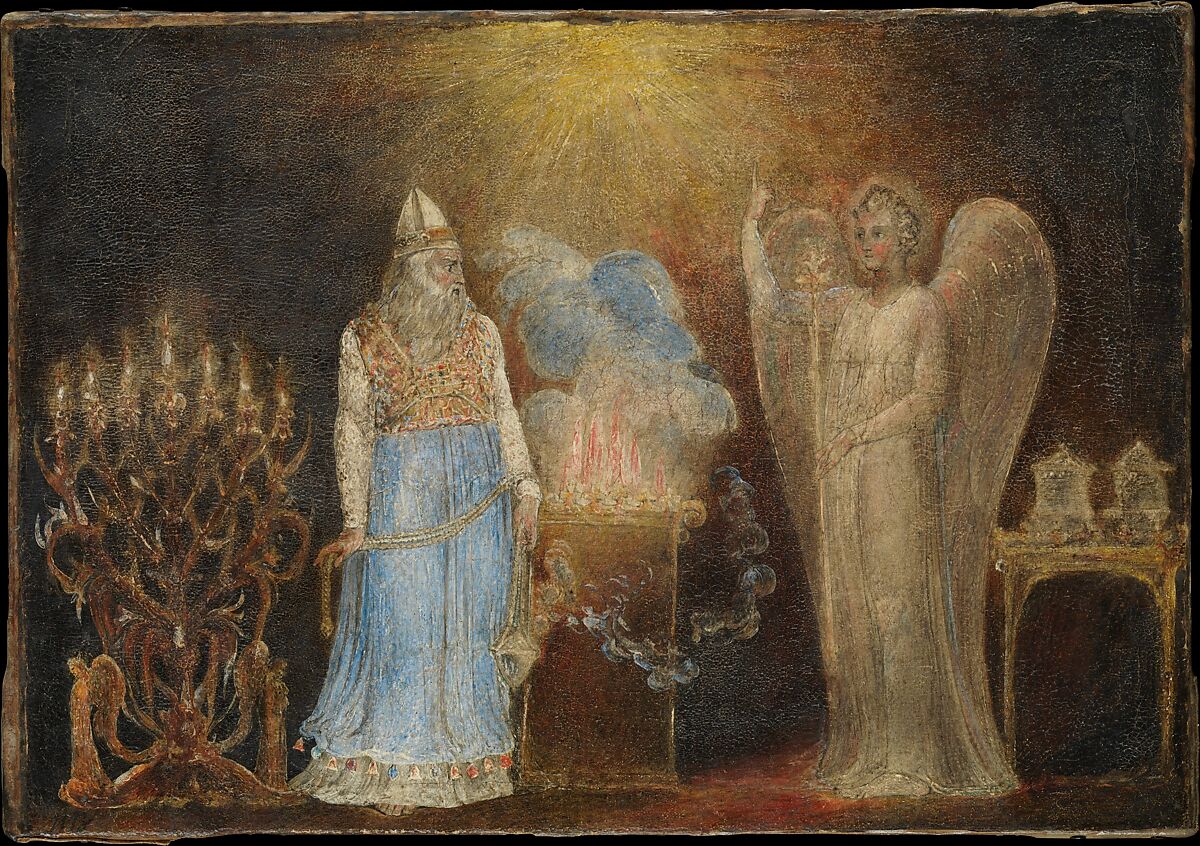
11 the angel of the Lord appeared to him, standing at the right of the altar of incense.
12 Zechariah was troubled by what he saw, and fear came upon him.
13 But the angel said to him, “Do not be afraid, Zechariah, because your prayer has been heard. Your wife Elizabeth will bear you a son, and you shall name him John.
14 And you will have joy and gladness, and many will rejoice at his birth,
15 for he will be great in the sight of [the] Lord. He will drink neither wine nor strong drink. He will be filled with the holy Spirit even from his mother’s womb,
16 and he will turn many of the children of Israel to the Lord their God.
17 He will go before him in the spirit and power of Elijah to turn the hearts of fathers toward children and the disobedient to the understanding of the righteous, to prepare a people fit for the Lord.”
18 Then Zechariah said to the angel, “How shall I know this? For I am an old man, and my wife is advanced in years.”
19 And the angel said to him in reply, “I am Gabriel, who stand before God. I was sent to speak to you and to announce to you this good news.
20 But now you will be speechless and unable to talk until the day these things take place, because you did not believe my words, which will be fulfilled at their proper time.”
21 Meanwhile the people were waiting for Zechariah and were amazed that he stayed so long in the sanctuary.
22 But when he came out, he was unable to speak to them, and they realized that he had seen a vision in the sanctuary. He was gesturing to them but remained mute.
23 Then, when his days of ministry were completed, he went home.
24 After this time his wife Elizabeth conceived, and she went into seclusion for five months, saying,
25 “So has the Lord done for me at a time when he has seen fit to take away my disgrace before others.”
5 Fuit in diebus Herodis, regis Judææ, sacerdos quidam nomine Zacharias de vice Abia, et uxor illius de filiabus Aaron, et nomen ejus Elisabeth.
6 Erant autem justi ambo ante Deum, incedentes in omnibus mandatis et justificationibus Domini sine querela.
7 Et non erat illis filius, eo quod esset Elisabeth sterilis, et ambo processissent in diebus suis.
8 Factum est autem, cum sacerdotio fungeretur in ordine vicis suæ ante Deum,
9 secundum consuetudinem sacerdotii, sorte exiit ut incensum poneret, ingressus in templum Domini:
10 et omnis multitudo populi erat orans foris hora incensi.
11 Apparuit autem illi angelus Domini, stans a dextris altaris incensi.
12 Et Zacharias turbatus est videns, et timor irruit super eum.
13 Ait autem ad illum angelus: Ne timeas, Zacharia, quoniam exaudita est deprecatio tua: et uxor tua Elisabeth pariet tibi filium, et vocabis nomen ejus Joannem:
14 et erit gaudium tibi, et exsultatio, et multi in nativitate ejus gaudebunt:
15 erit enim magnus coram Domino: et vinum et siceram non bibet, et Spiritu Sancto replebitur adhuc ex utero matris suæ:
16 et multos filiorum Israël convertet ad Dominum Deum ipsorum:
17 et ipse præcedet ante illum in spiritu et virtute Eliæ: ut convertat corda patrum in filios, et incredulos ad prudentiam justorum, parare Domino plebem perfectam.
18 Et dixit Zacharias ad angelum: Unde hoc sciam? ego enim sum senex, et uxor mea processit in diebus suis.
19 Et respondens angelus dixit ei: Ego sum Gabriel, qui asto ante Deum: et missus sum loqui ad te, et hæc tibi evangelizare.
20 Et ecce eris tacens, et non poteris loqui usque in diem quo hæc fiant, pro eo quod non credidisti verbis meis, quæ implebuntur in tempore suo.
21 Et erat plebs exspectans Zachariam: et mirabantur quod tardaret ipse in templo.
22 Egressus autem non poterat loqui ad illos, et cognoverunt quod visionem vidisset in templo. Et ipse erat innuens illis, et permansit mutus.
23 Et factum est, ut impleti sunt dies officii ejus, abiit in domum suam:
24 post hos autem dies concepit Elisabeth uxor ejus, et occultabat se mensibus quinque, dicens:
25 Quia sic fecit mihi Dominus in diebus, quibus respexit auferre opprobrium meum inter homines.

A Daily Question from the Summa Theologica
Whether those who had been baptized with John’s baptism had to be baptized with the baptism of Christ? (Article 6 of 6 of Question 38. Of the Baptism of John from the Treatise on the Incarnation)
Objection 1: It would seem that those who had been baptized with John’s baptism had not to be baptized with the baptism of Christ. For John was not less than the apostles, since of him is it written (Mat. 11:11): “There hath not risen among them that are born of women a greater than John the Baptist.” But those who were baptized by the apostles were not baptized again, but only received the imposition of hands; for it is written (Acts 8:16, 17) that some were “only baptized” by Philip “in the name of the Lord Jesus”: then the apostles—namely, Peter and John—“laid their hands upon them, and they received the Holy Ghost.” Therefore it seems that those who had been baptized by John had not to be baptized with the baptism of Christ.
Objection 2: Further, the apostles were baptized with John’s baptism, since some of them were his disciples, as is clear from Jn. 1:37. But the apostles do not seem to have been baptized with the baptism of Christ: for it is written (Jn. 4:2) that “Jesus did not baptize, but His disciples.” Therefore it seems that those who had been baptized with John’s baptism had not to be baptized with the baptism of Christ.
Objection 3: Further, he who is baptized is less than he who baptizes. But we are not told that John himself was baptized with the baptism of Christ. Therefore much less did those who had been baptized by John need to receive the baptism of Christ.
Objection 4: Further, it is written (Acts 19:1-5) that “Paul . . . found certain disciples; and he said to them: Have you received the Holy Ghost since ye believed? But they said to him: We have not so much as heard whether there be a Holy Ghost. And he said: In what then were you baptized? Who said: In John’s baptism.” Wherefore “they were” again “baptized in the name of our [Vulg.: ‘the’] Lord Jesus Christ.” Hence it seems that they needed to be baptized again, because they did not know of the Holy Ghost: as Jerome says on Joel 2:28 and in an epistle (lxix De Viro unius uxoris), and likewise Ambrose (De Spiritu Sancto). But some were baptized with John’s baptism who had full knowledge of the Trinity. Therefore these had no need to be baptized again with Christ’s baptism.
Objection 5: Further, on Rom. 10:8, “This is the word of faith, which we preach,” the gloss of Augustine says: “Whence this virtue in the water, that it touches the body and cleanses the heart, save by the efficacy of the word, not because it is uttered, but because it is believed?” Whence it is clear that the virtue of baptism depends on faith. But the form of John’s baptism signified the faith in which we are baptized; for Paul says (Acts 19:4): “John baptized the people with the baptism of penance, saying: That they should believe in Him who was to come after him—that is to say, in Jesus.” Therefore it seems that those who had been baptized with John’s baptism had no need to be baptized again with the baptism of Christ.
On the contrary, Augustine says (Super Joan., Tract. v): “Those who were baptized with John’s baptism needed to be baptized with the baptism of our Lord.”
I answer that, According to the opinion of the Master (Sent. iv, D, 2), “those who had been baptized by John without knowing of the existence of the Holy Ghost, and who based their hopes on his baptism, were afterwards baptized with the baptism of Christ: but those who did not base their hope on John’s baptism, and who believed in the Father, Son, and Holy Ghost, were not baptized afterwards, but received the Holy Ghost by the imposition of hands made over them by the apostles.”
And this, indeed, is true as to the first part, and is confirmed by many authorities. But as to the second part, the assertion is altogether unreasonable. First, because John’s baptism neither conferred grace nor imprinted a character, but was merely “in water,” as he says himself (Mat. 3:11). Wherefore the faith or hope which the person baptized had in Christ could not supply this defect. Secondly, because, when in a sacrament, that is omitted which belongs of necessity to the sacrament, not only must the omission be supplied, but the whole must be entirely renewed. Now, it belongs of necessity to Christ’s baptism that it be given not only in water, but also in the Holy Ghost, according to Jn. 3:5: “Unless a man be born of water and the Holy Ghost, he cannot enter into the kingdom of God.” Wherefore in the case of those who had been baptized with John’s baptism in water only, not merely had the omission to be supplied by giving them the Holy Ghost by the imposition of hands, but they had to be baptized wholly anew “in water and the Holy Ghost.”
Reply to Objection 1: As Augustine says (Super Joan., Tract. v): “After John, baptism was administered, and the reason why was because he gave not Christ’s baptism, but his own . . . That which Peter gave . . . and if any were given by Judas, that was Christ’s. And therefore if Judas baptized anyone, yet were they not rebaptized . . . For the baptism corresponds with him by whose authority it is given, not with him by whose ministry it is given.” For the same reason those who were baptized by the deacon Philip, who gave the baptism of Christ, were not baptized again, but received the imposition of hands by the apostles, just as those who are baptized by priests are confirmed by bishops.
Reply to Objection 2: As Augustine says to Seleucianus (Ep. cclxv), “we deem that Christ’s disciples were baptized either with John’s baptism, as some maintain, or with Christ’s baptism, which is more probable. For He would not fail to administer baptism so as to have baptized servants through whom He baptized others, since He did not fail in His humble service to wash their feet.”
Reply to Objection 3: As Chrysostom says (Hom. iv in Matth. [*From the supposititious Opus Imperfectum]): “Since, when John said, ‘I ought to be baptized by Thee,’ Christ answered, ‘Suffer it to be so now’: it follows that afterwards Christ did baptize John.” Moreover, he asserts that “this is distinctly set down in some of the apocryphal books.” At any rate, it is certain, as Jerome says on Mat. 3:13, that, “as Christ was baptized in water by John, so had John to be baptized in the Spirit by Christ.”
Reply to Objection 4: The reason why these persons were baptized after being baptized by John was not only because they knew not of the Holy Ghost, but also because they had not received the baptism of Christ.
Reply to Objection 5: As Augustine says (Contra Faust. xix), our sacraments are signs of present grace, whereas the sacraments of the Old Law were signs of future grace. Wherefore the very fact that John baptized in the name of one who was to come, shows that he did not give the baptism of Christ, which is a sacrament of the New Law.
Continue reading the rest of the articles on Sacred Texts Archive website.
Scripture texts in this work are taken from the New American Bible, revised edition © 2010, 1991, 1986, 1970 Confraternity of Christian Doctrine, Washington, D.C.