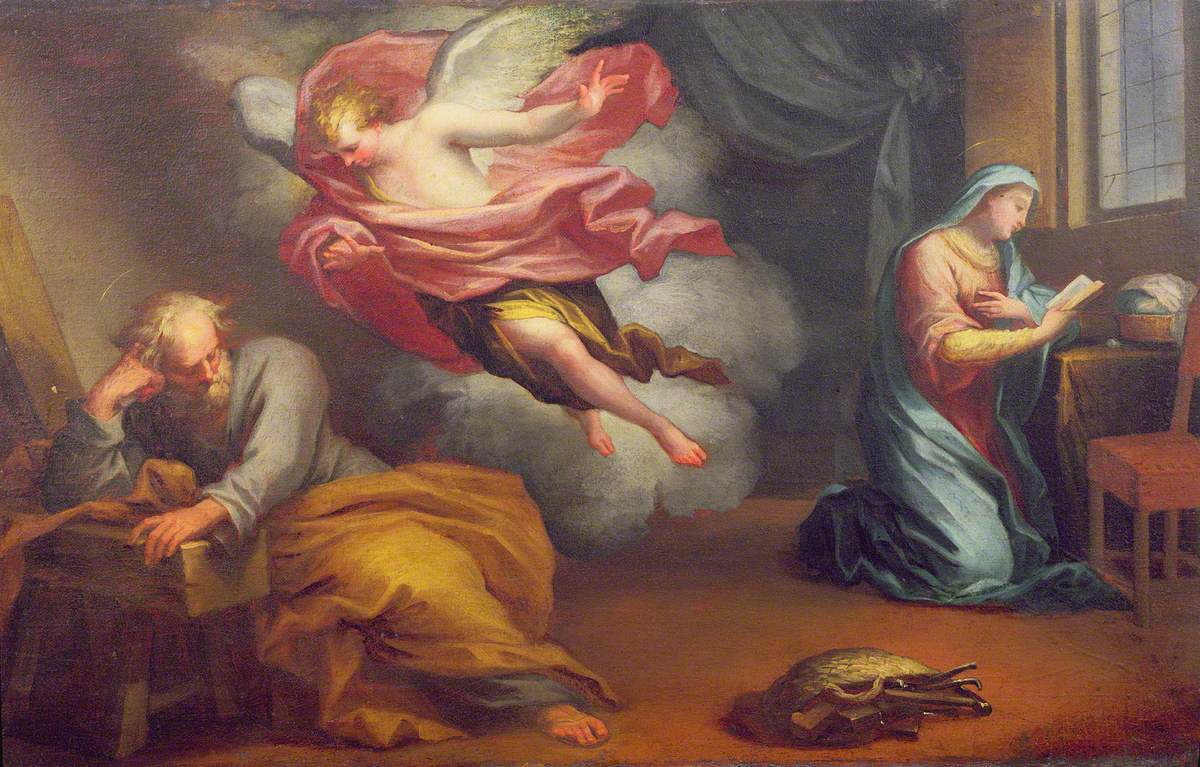
Fourth Sunday of Advent
Liturgical Color: Violet
Rosary Mysteries: Glorious Mysteries

Daily Readings
First Reading: Isaiah 7:10-14
10 And the Lord spoke again to Achaz, saying:
11 Ask thee a sign of the Lord thy God either unto the depth of hell, or unto the height above.
12 And Achaz said: I will not ask, and I will not tempt the Lord.
13 And he said: Hear ye therefore, O house of David: Is it a small thing for you to be grievous to men, that you are grievous to my God also?
14 Therefore the Lord himself shall give you a sign. Behold a virgin shall conceive, and bear a son, and his name shall be called Emmanuel.
10 Et adjecit Dominus loqui ad Achaz, dicens:
11 Pete tibi signum a Domino Deo tuo, in profundum inferni, sive in excelsum supra.
12 Et dixit Achaz: Non petam, et non tentabo Dominum.
13 Et dixit: [Audite ergo, domus David.
Numquid parum vobis est molestos esse hominibus,
quia molesti estis et Deo meo?
14 Propter hoc dabit Dominus ipse vobis signum:
ecce virgo concipiet, et pariet filium,
et vocabitur nomen ejus Emmanuel.
Second Reading: Romans 1:1-7
1 Paul, a servant of Jesus Christ, called to be an apostle, separated unto the gospel of God,
2 Which he had promised before, by his prophets, in the holy scriptures,
3 Concerning his Son, who was made to him of the seed of David, according to the flesh,
4 Who was predestinated the Son of God in power, according to the spirit of sanctification, by the resurrection of our Lord Jesus Christ from the dead;
5 By whom we have received grace and apostleship for obedience to the faith, in all nations, for his name;
6 Among whom are you also the called of Jesus Christ:
7 To all that are at Rome, the beloved of God, called to be saints. Grace to you, and peace from God our Father, and from the Lord Jesus Christ.
1 Paulus, servus Jesu Christi, vocatus Apostolus, segregatus in Evangelium Dei,
2 quod ante promiserat per prophetas suos in Scripturis sanctis
3 de Filio suo, qui factus est ei ex semine David secundum carnem,
4 qui prædestinatus est Filius Dei in virtute secundum spiritum sanctificationis ex resurrectione mortuorum Jesu Christi Domini nostri:
5 per quem accepimus gratiam, et apostolatum ad obediendum fidei in omnibus gentibus pro nomine ejus,
6 in quibus estis et vos vocati Jesu Christi:
7 omnibus qui sunt Romæ, dilectis Dei, vocatis sanctis. Gratia vobis, et pax a Deo Patre nostro, et Domino Jesu Christo.
Gospel: Matthew 1:18-24
18 Now the generation of Christ was in this wise. When as his mother Mary was espoused to Joseph, before they came together, she was found with child, of the Holy Ghost.
19 Whereupon Joseph her husband, being a just man, and not willing publicly to expose her, was minded to put her away privately.
20 But while he thought on these things, behold the angel of the Lord appeared to him in his sleep, saying: Joseph, son of David, fear not to take unto thee Mary thy wife, for that which is conceived in her, is of the Holy Ghost.
21 And she shall bring forth a son: and thou shalt call his name JESUS. For he shall save his people from their sins.
22 Now all this was done that it might be fulfilled which the Lord spoke by the prophet, saying:
23 Behold a virgin shall be with child, and bring forth a son, and they shall call his name Emmanuel, which being interpreted is, God with us.
24 And Joseph rising up from sleep, did as the angel of the Lord had commanded him, and took unto him his wife.
18 Christi autem generatio sic erat: cum esset desponsata mater ejus Maria Joseph, antequam convenirent inventa est in utero habens de Spiritu Sancto.
19 Joseph autem vir ejus cum esset justus, et nollet eam traducere, voluit occulte dimittere eam.
20 Hæc autem eo cogitante, ecce angelus Domini apparuit in somnis ei, dicens: Joseph, fili David, noli timere accipere Mariam conjugem tuam: quod enim in ea natum est, de Spiritu Sancto est.
21 Pariet autem filium: et vocabis nomen ejus Jesum: ipse enim salvum faciet populum suum a peccatis eorum.
22 Hoc autem totum factum est, ut adimpleretur quod dictum est a Domino per prophetam dicentem:
23 Ecce virgo in utero habebit, et pariet filium: et vocabunt nomen ejus Emmanuel, quod est interpretatum Nobiscum Deus.
24 Exsurgens autem Joseph a somno, fecit sicut præcepit ei angelus Domini, et accepit conjugem suam.

A Daily Question from the Summa Theologica
Whether nativity regards the nature rather than the person? (Article 1 of 8 of Question 35. Of Christ’s Nativity from the Treatise on the Incarnation)
Objection 1: It would seem that nativity regards the nature rather than the person. For Augustine [*Fulgentius] says (De Fide ad Petrum): “The eternal Divine Nature could not be conceived and born of human nature, except in a true human nature.” Consequently it becomes the Divine Nature to be conceived and born by reason of the human nature. Much more, therefore, does it regard human nature itself.
Objection 2: Further, according to the Philosopher (Metaph. v), “nature” is so denominated from “nativity.” But things are denominated from one another by reason of some likeness. Therefore it seems that nativity regards the nature rather than the person.
Objection 3: Further, properly speaking, that is born which begins to exist by nativity. But Christ’s Person did not begin to exist by His nativity, whereas His human nature did. Therefore it seems that the nativity properly regards the nature, and not the person.
On the contrary, Damascene says (De Fide Orth. iii): “Nativity regards the hypostasis, not the nature.”
I answer that, Nativity can be attributed to someone in two ways: first, as to its subject; secondly, as to its terminus. To him that is born it is attributed as to its subject: and this, properly speaking, is the hypostasis, not the nature. For since to be born is to be generated; as a thing is generated in order for it to be, so is a thing born in order for it to be. Now, to be, properly speaking, belongs to that which subsists; since a form that does not subsist is said to be only inasmuch as by it something is: and whereas person or hypostasis designates something as subsisting, nature designates form, whereby something subsists. Consequently, nativity is attributed to the person or hypostasis as to the proper subject of being born, but not to the nature.
But to the nature nativity is attributed as to its terminus. For the terminus of generation and of every nativity is the form. Now, nature designates something as a form: wherefore nativity is said to be “the road to nature,” as the Philosopher states (Phys. ii): for the purpose of nature is terminated in the form or nature of the species.
Reply to Objection 1: On account of the identity of nature and hypostasis in God, nature fs sometimes put instead of person or hypostasis. And in this sense Augustine says that the Divine Nature was conceived and born, inasmuch as the Person of the Son was conceived and born in the human nature.
Reply to Objection 2: No movement or change is denominated from the subject moved, but from the terminus of the movement, whence the subject has its species. For this reason nativity is not denominated from the person born, but from nature, which is the terminus of nativity.
Reply to Objection 3: Nature, properly speaking, does not begin to exist: rather is it the person that begins to exist in some nature. Because, as stated above, nature designates that by which something is; whereas person designates something as having subsistent being.
Continue reading the rest of the articles on Sacred Texts Archive website.