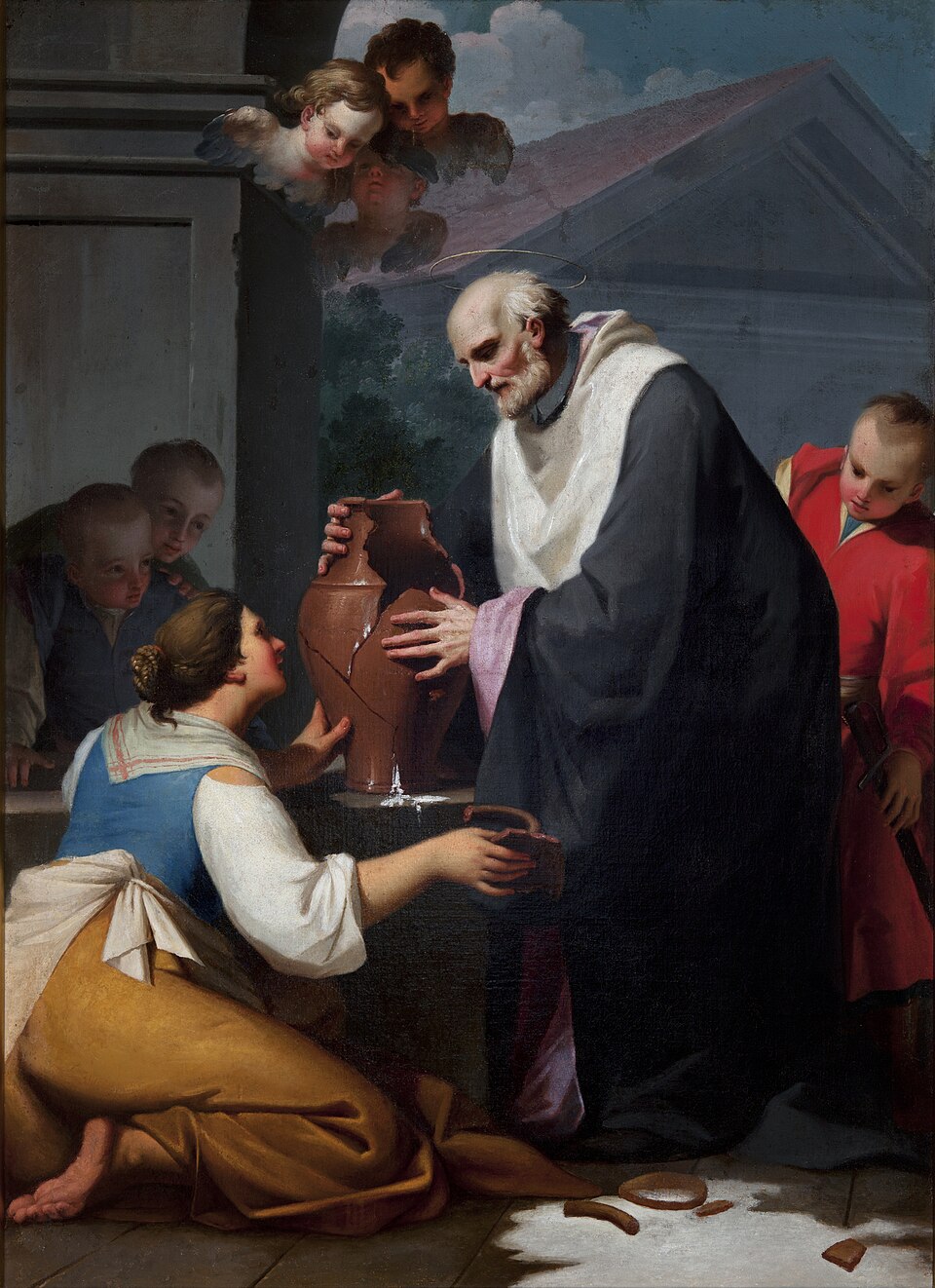
Optional Memorial of Saint John of Kanty, Priest
Liturgical Color: Violet
Rosary Mysteries: Sorrowful Mysteries
“Fight all error, but do it with good humour, patience, kindness, and love. Harshness will damage your own soul and spoil the best cause.”
Saint John of Kanty
est. June 23/24, 1390 – December 24, 1473
Patron of Lithuania, Poland, teachers, students, priests, and pilgrims

Daily Readings
First Reading: Malachi 3: 1-4
1 Behold I send my angel, and he shall prepare the way before my face. And presently the Lord, whom you seek, and the angel of the testament, whom you desire, shall come to his temple. Behold he cometh, saith the Lord of hosts.
2 And who shall be able to think of the day of his coming? and who shall stand to see him? for he is like a refining fire, and like the fuller’s herb:
3 And he shall sit refining and cleansing the silver, and he shall purify the sons of Levi, and shall refine them as gold, and as silver, and they shall offer sacrifices to the Lord in justice.
4 And the sacrifice of Juda and of Jerusalem shall please the Lord, as in the days of old, and in the ancient years.
1 Ecce ego mitto angelum meum, et præparabit viam ante faciem meam: et statim veniet ad templum suum Dominator quem vos quæritis, et angelus testamenti quem vos vultis. Ecce venit, dicit Dominus exercituum.
2 Et quis poterit cogitare diem adventus ejus, et quis stabit ad videndum eum? ipse enim quasi ignis conflans, et quasi herba fullonum:
3 et sedebit conflans, et emundans argentum: et purgabit filios Levi, et colabit eos quasi aurum et quasi argentum, et erunt Domino offerentes sacrificia in justitia.
4 Et placebit Domino sacrificium Juda et Jerusalem, sicut dies sæculi, et sicut anni antiqui.
Gospel: Luke 1:57-66
57 Now Elizabeth’s full time of being delivered was come, and she brought forth a son.
58 And her neighbours and kinsfolks heard that the Lord had shewed his great mercy towards her, and they congratulated with her.
59 And it came to pass, that on the eighth day they came to circumcise the child, and they called him by his father’s name Zachary.
60 And his mother answering, said: Not so; but he shall be called John.
61 And they said to her: There is none of thy kindred that is called by this name.
62 And they made signs to his father, how he would have him called.
63 And demanding a writing table, he wrote, saying: John is his name. And they all wondered.
64 And immediately his mouth was opened, and his tongue loosed, and he spoke, blessing God.
65 And fear came upon all their neighbours; and all these things were noised abroad over all the hill country of Judea.
66 And all they that had heard them laid them up in their heart, saying: What an one, think ye, shall this child be? For the hand of the Lord was with him.
57 Elisabeth autem impletum est tempus pariendi, et peperit filium.
58 Et audierunt vicini et cognati ejus quia magnificavit Dominus misericordiam suam cum illa, et congratulabantur ei.
59 Et factum est in die octavo, venerunt circumcidere puerum, et vocabant eum nomine patris sui Zachariam.
60 Et respondens mater ejus, dixit: Nequaquam, sed vocabitur Joannes.
61 Et dixerunt ad illam: Quia nemo est in cognatione tua, qui vocetur hoc nomine.
62 Innuebant autem patri ejus, quem vellet vocari eum.
63 Et postulans pugillarem scripsit, dicens: Joannes est nomen ejus. Et mirati sunt universi.
64 Apertum est autem illico os ejus, et lingua ejus, et loquebatur benedicens Deum.
65 Et factus est timor super omnes vicinos eorum: et super omnia montana Judææ divulgabantur omnia verba hæc:
66 et posuerunt omnes qui audierant in corde suo, dicentes: Quis, putas, puer iste erit? etenim manus Domini erat cum illo.

A Daily Question from the Summa Theologica
Whether the Blessed Virgin can be called Christ’s Mother in respect of His temporal nativity?(Article 3 of 8 of Question 35. Of Christ’s Nativity from the Treatise on the Incarnation)
Objection 1: It would seem that the Blessed Virgin cannot be called Christ’s Mother in respect of His temporal nativity. For, as stated above (Q[32], A[4]), the Blessed Virgin Mary did not cooperate actively in begetting Christ, but merely supplied the matter. But this does not seem sufficient to make her His Mother: otherwise wood might be called the mother of the bed or bench. Therefore it seems that the Blessed Virgin cannot be called the Mother of Christ.
Objection 2: Further, Christ was born miraculously of the Blessed Virgin. But a miraculous begetting does not suffice for motherhood or sonship: for we do not speak of Eve as being the daughter of Adam. Therefore neither should Christ be called the Son of the Blessed Virgin.
Objection 3: Further, motherhood seems to imply partial separation of the semen. But, as Damascene says (De Fide Orth. iii), “Christ’s body was formed, not by a seminal process, but by the operation of the Holy Ghost.” Therefore it seems that the Blessed Virgin should not be called the Mother of Christ.
On the contrary, It is written (Mat. 1:18): “The generation of Christ was in this wise. When His Mother Mary was espoused to Joseph,” etc.
I answer that, The Blessed Virgin Mary is in truth and by nature the Mother of Christ. For, as we have said above (Q[5], A[2]; Q[31], A[5]), Christ’s body was not brought down from heaven, as the heretic Valentine maintained, but was taken from the Virgin Mother, and formed from her purest blood. And this is all that is required for motherhood, as has been made clear above (Q[31], A[5]; Q[32], A[4]). Therefore the Blessed Virgin is truly Christ’s Mother.
Reply to Objection 1: As stated above (Q[32], A[3]), not every generation implies fatherhood or motherhood and sonship, but only the generation of living things. Consequently when inanimate things are made from some matter, the relationship of motherhood and sonship does not follow from this, but only in the generation of living things, which is properly called nativity.
Reply to Objection 2: As Damascene says (De Fide Orth. iii): “The temporal nativity by which Christ was born for our salvation is, in a way, natural, since a Man was born of a woman, and after the due lapse of time from His conception: but it is also supernatural, because He was begotten, not of seed, but of the Holy Ghost and the Blessed Virgin, above the law of conception.” Thus, then, on the part of the mother, this nativity was natural, but on the part of the operation of the Holy Ghost it was supernatural. Therefore the Blessed Virgin is the true and natural Mother of Christ.
Reply to Objection 3: As stated above (Q[31], A[5], ad 3; Q[32], A[4]), the resolution of the woman’s semen is not necessary for conception; neither, therefore, is it required for motherhood.
Continue reading the rest of the articles on Sacred Texts Archive website.