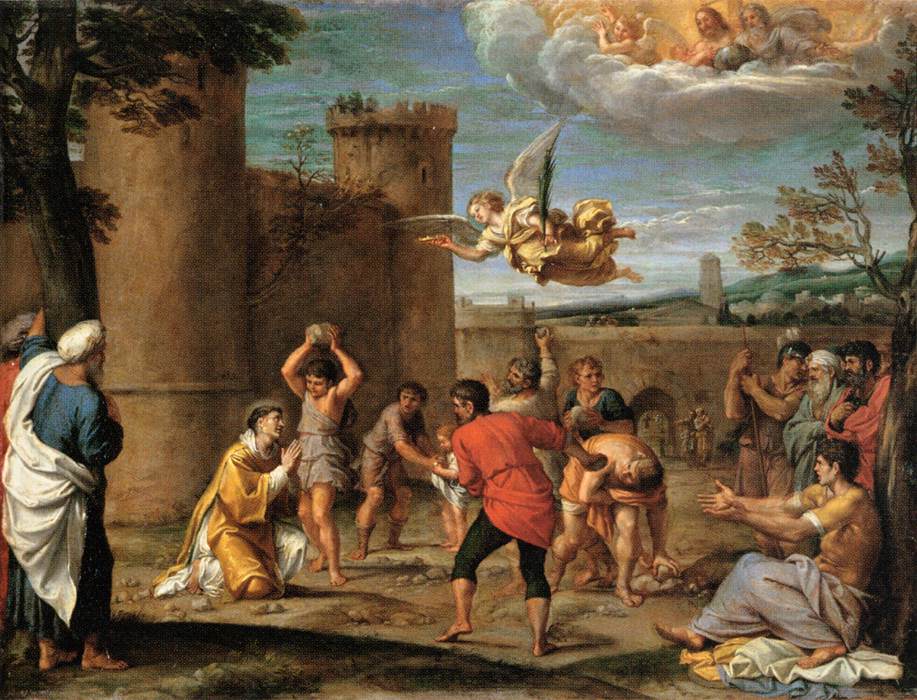
Feast of Saint Stephen, The First Martyr
Liturgical Color: Red
Rosary Mysteries: Sorrowful Mysteries
“Lord, lay not this sin to their charge. And when he had said this, he fell asleep in the Lord.”
Saint Stephen
Patron of deacons, stonemasons, bricklayers, and altar servers

Daily Readings
First Reading: Acts 6: 8-10; 7: 54-59
8 And Stephen, full of grace and fortitude, did great wonders and signs among the people.
9 Now there arose some of that which is called the synagogue of the Libertines, and of the Cyrenians, and of the Alexandrians, and of them that were of Cilicia and Asia, disputing with Stephen.
10 And they were not able to resist the wisdom and the spirit that spoke.
54 Now hearing these things, they were cut to the heart, and they gnashed with their teeth at him.
55 But he, being full of the Holy Ghost, looking up steadfastly to heaven, saw the glory of God, and Jesus standing on the right hand of God. And he said: Behold, I see the heavens opened, and the Son of man standing on the right hand of God.
56 And they crying out with a loud voice, stopped their ears, and with one accord ran violently upon him.
57 And casting him forth without the city, they stoned him; and the witnesses laid down their garments at the feet of a young man, whose name was Saul.
58 And they stoned Stephen, invoking, and saying: Lord Jesus, receive my spirit.
59 And falling on his knees, he cried with a loud voice, saying: Lord, lay not this sin to their charge. And when he had said this, he fell asleep in the Lord. And Saul was consenting to his death.
8 Stephanus autem plenus gratia et fortitudine, faciebat prodigia et signa magna in populo.
9 Surrexerunt autem quidam de synagoga quæ appellatur Libertinorum, et Cyrenensium, et Alexandrinorum, et eorum qui erant a Cilicia, et Asia, disputantes cum Stephano:
10 et non poterant resistere sapientiæ, et Spiritui qui loquebatur.
54 Audientes autem hæc, dissecabantur cordibus suis, et stridebant dentibus in eum.
55 Cum autem esset plenus Spiritu Sancto, intendens in cælum, vidit gloriam Dei, et Jesum stantem a dextris Dei. Et ait: Ecce video cælos apertos, et Filium hominis stantem a dextris Dei.
56 Exclamantes autem voce magna continuerunt aures suas, et impetum fecerunt unanimiter in eum.
57 Et ejicientes eum extra civitatem, lapidabant: et testes deposuerunt vestimenta sua secus pedes adolescentis qui vocabatur Saulus.
58 Et lapidabant Stephanum invocantem, et dicentem: Domine Jesu, suscipe spiritum meum.
59 Positis autem genibus, clamavit voce magna, dicens: Domine, ne statuas illis hoc peccatum. Et cum hoc dixisset, obdormivit in Domino. Saulus autem erat consentiens neci ejus.
Gospel: Matthew 10:17-22
17 But beware of men. For they will deliver you up in councils, and they will scourge you in their synagogues.
18 And you shall be brought before governors, and before kings for my sake, for a testimony to them and to the Gentiles:
19 But when they shall deliver you up, take no thought how or what to speak: for it shall be given you in that hour what to speak.
20 For it is not you that speak, but the Spirit of your Father that speaketh in you.
21 The brother also shall deliver up the brother to death, and the father the son: and the children shall rise up against their parents, and shall put them to death.
22 And you shall be hated by all men for my name’s sake: but he that shall persevere unto the end, he shall be saved.
17 Cavete autem ab hominibus. Tradent enim vos in conciliis, et in synagogis suis flagellabunt vos:
18 et ad præsides, et ad reges ducemini propter me in testimonium illis, et gentibus.
19 Cum autem tradent vos, nolite cogitare quomodo, aut quid loquamini: dabitur enim vobis in illa hora, quid loquamini:
20 non enim vos estis qui loquimini, sed Spiritus Patris vestri, qui loquitur in vobis.
21 Tradet autem frater fratrem in mortem, et pater filium: et insurgent filii in parentes, et morte eos afficient:
22 et eritis odio omnibus propter nomen meum: qui autem perseveraverit usque in finem, hic salvus erit.

A Daily Question from the Summa Theologica
Whether Christ was born without His Mother suffering? (Article 6 of 8 of Question 35. Of Christ’s Nativity from the Treatise on the Incarnation)
Objection 1: It would seem that Christ was not born without His Mother suffering. For just as man’s death was a result of the sin of our first parents, according to Gn. 2:17: “In what day soever ye shall eat, ye shall [Vulg.: ‘thou shalt eat of it, thou shalt] die”; so were the pains of childbirth, according to Gn. 3:16: “In sorrow shalt thou bring forth children.” But Christ was willing to undergo death. Therefore for the same reason it seems that His birth should have been with pain.
Objection 2: Further, the end is proportionate to the beginning. But Christ ended His life in pain, according to Is. 53:4: “Surely . . . He hath carried our sorrows.” Therefore it seems that His nativity was not without the pains of childbirth.
Objection 3: Further, in the book on the birth of our Saviour [*Protevangelium Jacobi xix, xx] it is related that midwives were present at Christ’s birth; and they would be wanted by reason of the mother’s suffering pain. Therefore it seems that the Blessed Virgin suffered pain in giving birth to her Child.
On the contrary, Augustine says (Serm. de Nativ. [*Supposititious]), addressing himself to the Virgin-Mother: “In conceiving thou wast all pure, in giving birth thou wast without pain.”
I answer that, The pains of childbirth are caused by the infant opening the passage from the womb. Now it has been said above (Q[28], A[2], Replies to objections), that Christ came forth from the closed womb of His Mother, and, consequently, without opening the passage. Consequently there was no pain in that birth, as neither was there any corruption; on the contrary, there was much joy therein for that God-Man “was born into the world,” according toIsa. 35:1, 2: “Like the lily, it shall bud forth and blossom, and shall rejoice with joy and praise.”
Reply to Objection 1: The pains of childbirth in the woman follow from the mingling of the sexes. Wherefore (Gn. 3:16) after the words, “in sorrow shalt thou bring forth children,” the following are added: “and thou shalt be under thy husband’s power.” But, as Augustine says (Serm. de Assumpt. B. Virg., [*Supposititious]), from this sentence we must exclude the Virgin-Mother of God; who, “because she conceived Christ without the defilement of sin, and without the stain of sexual mingling, therefore did she bring Him forth without pain, without violation of her virginal integrity, without detriment to the purity of her maidenhood.” Christ, indeed, suffered death, but through His own spontaneous desire, in order to atone for us, not as a necessary result of that sentence, for He was not a debtor unto death.
Reply to Objection 2: As “by His death” Christ “destroyed our death” [*Preface of the Mass in Paschal-time], so by His pains He freed us from our pains; and so He wished to die a painful death. But the mother’s pains in childbirth did not concern Christ, who came to atone for our sins. And therefore there was no need for His Mother to suffer in giving birth.
Reply to Objection 3: We are told (Lk. 2:7) that the Blessed Virgin herself “wrapped up in swaddling clothes” the Child whom she had brought forth, “and laid Him in a manger.” Consequently the narrative of this book, which is apocryphal, is untrue. Wherefore Jerome says (Adv. Helvid. iv): “No midwife was there, no officious women interfered. She was both mother and midwife. ‘With swaddling clothes,’ says he, ‘she wrapped up the child, and laid Him in a manger.’” These words prove the falseness of the apocryphal ravings.
Continue reading the rest of the articles on Sacred Texts Archive website.