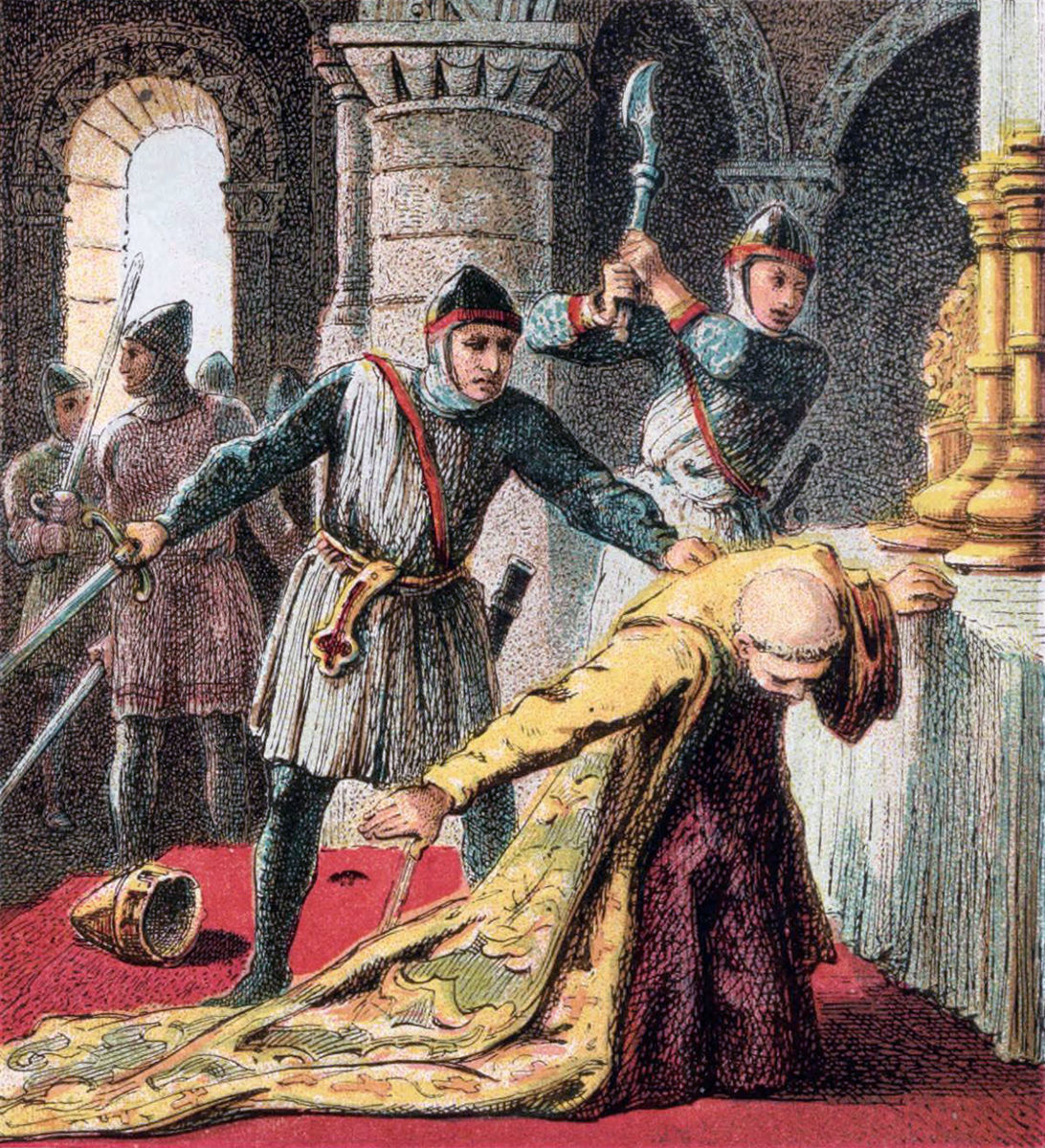
Optional Memorial of Saint Thomas Becket, Bishop and Martyr
Liturgical Color: White
Rosary Mysteries: Joyful Mysteries
Remember the sufferings of Christ, the storms that were weathered… the crown that came from those sufferings which gave new radiance to the faith… All saints give testimony to the truth that without real effort, no one ever wins the crown.
Saint Thomas Becket
est. December 21, 1118 – December 29, 1170
Patron of diocesan clergy

Daily Readings
First Reading: 1 John 2: 3-11
3 And by this we know that we have known him, if we keep his commandments.
4 He who saith that he knoweth him, and keepeth not his commandments, is a liar, and the truth is not in him.
5 But he that keepeth his word, in him in very deed the charity of God is perfected; and by this we know that we are in him.
6 He that saith he abideth in him, ought himself also to walk, even as he walked.
7 Dearly beloved, I write not a new commandment to you, but an old commandment which you had from the beginning. The old commandment is the word which you have heard.
8 Again a new commandment I write unto you, which thing is true both in him and in you; because the darkness is passed, and the true light now shineth.
9 He that saith he is in the light, and hateth his brother, is in darkness even until now.
10 He that loveth his brother, abideth in the light, and there is no scandal in him.
11 But he that hateth his brother, is in darkness, and walketh in darkness, and knoweth not whither he goeth; because the darkness hath blinded his eyes.
3 Et in hoc scimus quoniam cognovimus eum, si mandata ejus observemus.
4 Qui dicit se nosse eum, et mandata ejus non custodit, mendax est, et in hoc veritas non est.
5 Qui autem servat verbum ejus, vere in hoc caritas Dei perfecta est: et in hoc scimus quoniam in ipso sumus.
6 Qui dicit se in ipso manere, debet, sicut ille ambulavit, et ipse ambulare.
7 Carissimi, non mandatum novum scribo vobis, sed mandatum vetus, quod habuistis ab initio. Mandatum vetus est verbum, quod audistis.
8 Iterum mandatum novum scribo vobis, quod verum est et in ipso, et in vobis: quia tenebræ transierunt, et verum lumen jam lucet.
9 Qui dicit se in luce esse, et fratrem suum odit, in tenebris est usque adhuc.
10 Qui diligit fratrem suum, in lumine manet, et scandalum in eo non est.
11 Qui autem odit fratrem suum, in tenebris est, et in tenebris ambulat, et nescit quo eat: quia tenebræ obcæcaverunt oculos ejus.
Gospel: Luke 2: 22-35
22 And after the days of her purification, according to the law of Moses, were accomplished, they carried him to Jerusalem, to present him to the Lord:
23 As it is written in the law of the Lord: Every male opening the womb shall be called holy to the Lord:
24 And to offer a sacrifice, according as it is written in the law of the Lord, a pair of turtledoves, or two young pigeons:
25 And behold there was a man in Jerusalem named Simeon, and this man was just and devout, waiting for the consolation of Israel; and the Holy Ghost was in him.
26 And he had received an answer from the Holy Ghost, that he should not see death, before he had seen the Christ of the Lord.
27 And he came by the Spirit into the temple. And when his parents brought in the child Jesus, to do for him according to the custom of the law,
28 He also took him into his arms, and blessed God, and said:
29 Now thou dost dismiss thy servant, O Lord, according to thy word in peace;
30 Because my eyes have seen thy salvation,
31 Which thou hast prepared before the face of all peoples:
32 A light to the revelation of the Gentiles, and the glory of thy people Israel.
33 And his father and mother were wondering at those things which were spoken concerning him.
34 And Simeon blessed them, and said to Mary his mother: Behold this child is set for the fall, and for the resurrection of many in Israel, and for a sign which shall be contradicted;
35 And thy own soul a sword shall pierce, that, out of many hearts, thoughts may be revealed.
22 Et postquam impleti sunt dies purgationis ejus secundum legem Moysi, tulerunt illum in Jerusalem, ut sisterent eum Domino,
23 sicut scriptum est in lege Domini: Quia omne masculinum adaperiens vulvam, sanctum Domino vocabitur:
24 et ut darent hostiam secundum quod dictum est in lege Domini, par turturum, aut duos pullos columbarum.
25 Et ecce homo erat in Jerusalem, cui nomen Simeon, et homo iste justus, et timoratus, exspectans consolationem Israël: et Spiritus Sanctus erat in eo.
26 Et responsum acceperat a Spiritu Sancto, non visurum se mortem, nisi prius videret Christum Domini.
27 Et venit in spiritu in templum. Et cum inducerent puerum Jesum parentes ejus, ut facerent secundum consuetudinem legis pro eo,
28 et ipse accepit eum in ulnas suas: et benedixit Deum, et dixit:
29 [Nunc dimittis servum tuum Domine,
secundum verbum tuum in pace:
30 quia viderunt oculi mei salutare tuum,
31 quod parasti ante faciem omnium populorum:
32 lumen ad revelationem gentium,
et gloriam plebis tuæ Israël.]
33 Et erat pater ejus et mater mirantes super his quæ dicebantur de illo.
34 Et benedixit illis Simeon, et dixit ad Mariam matrem ejus: Ecce positus est hic in ruinam et in resurrectionem multorum in Israël, et in signum cui contradicetur:
35 et tuam ipsius animam pertransibit gladius ut revelentur ex multis cordibus cogitationes.

A Daily Question from the Summa Theologica
Whether those to whom Christ’s birth was made known were suitably chosen? (Article 3 of 8 of Question 36. Of the Manifestation of the Newly Born Christ from the Treatise on the Incarnation)
Objection 1: It would seem that those to whom Christ’s birth was made known were not suitably chosen. For our Lord (Mat. 10:5) commanded His disciples, “Go ye not into the way of the Gentiles,” so that He might be made known to the Jews before the Gentiles. Therefore it seems that much less should Christ’s birth have been at once revealed to the Gentiles who “came from the east,” as stated Mat. 2:1.
Objection 2: Further, the revelation of Divine truth should be made especially to the friends of God, according to Job 37 [Vulg.: Job 36:33]: “He sheweth His friend concerning it.” But the Magi seem to be God’s foes; for it is written (Lev. 19:31): “Go not aside after wizards [magi], neither ask anything of soothsayers.” Therefore Christ’s birth should not have been made known to the Magi.
Objection 3: Further, Christ came in order to set free the whole world from the power of the devil; whence it is written (Malachi 1:11): “From the rising of the sun even to the going down, My name is great among the Gentiles.” Therefore He should have been made known, not only to those who dwelt in the east, but also to some from all parts of the world.
Objection 4: Further, all the sacraments of the Old Law were figures of Christ. But the sacraments of the Old Law were dispensed through the ministry of the legal priesthood. Therefore it seems that Christ’s birth should have been made known rather to the priests in the Temple than to the shepherds in the fields.
Objection 5: Further, Christ was born of a Virgin-Mother, and was as yet a little child. It was therefore more suitable that He should be made known to youths and virgins than to old and married people or to widows, such as Simeon and Anna.
On the contrary, It is written (Jn. 13:18): “I know whom I have chosen.” But what is done by God’s wisdom is done becomingly. Therefore those to whom Christ’s birth was made known were suitably chosen.
I answer that, Salvation, which was to be accomplished by Christ, concerns all sorts and conditions of men: because, as it is written (Col. 3:11), in Christ “there is neither male nor female, [*These words are in reality from Gal. 3:28] neither Gentile nor Jew . . . bond nor free,” and so forth. And in order that this might be foreshadowed in Christ’s birth, He was made known to men of all conditions. Because, as Augustine says in a sermon on the Epiphany (32 de Temp.), “the shepherds were Israelites, the Magi were Gentiles. The former were nigh to Him, the latter far from Him. Both hastened to Him together as to the cornerstone.” There was also another point of contrast: for the Magi were wise and powerful; the shepherds simple and lowly. He was also made known to the righteous as Simeon and Anna; and to sinners, as the Magi. He was made known both to men, and to women—namely, to Anna—so as to show no condition of men to be excluded from Christ’s redemption.
Reply to Objection 1: That manifestation of Christ’s birth was a kind of foretaste of the full manifestation which was to come. And as in the later manifestation the first announcement of the grace of Christ was made by Him and His Apostles to the Jews and afterwards to the Gentiles, so the first to come to Christ were the shepherds, who were the first-fruits of the Jews, as being near to Him; and afterwards came the Magi from afar, who were “the first-fruits of the Gentiles,” as Augustine says (Serm. 30 de Temp. cc.).
Reply to Objection 2: As Augustine says in a sermon on the Epiphany (Serm. 30 de Temp.): “As unskilfulness predominates in the rustic manners of the shepherd, so ungodliness abounds in the profane rites of the Magi. Yet did this Corner-Stone draw both to Itself; inasmuch as He came ‘to choose the foolish things that He might confound the wise,’ and ‘not to call the just, but sinners,’” so that “the proud might not boast, nor the weak despair.” Nevertheless, there are those who say that these Magi were not wizards, but wise astronomers, who are called Magi among the Persians or Chaldees.
Reply to Objection 3: As Chrysostom says [*Hom. ii in Matth. in the Opus Imperf., among the supposititious works of Chrysostom]: “The Magi came from the east, because the first beginning of faith came from the land where the day is born; since faith is the light of the soul.” Or, “because all who come to Christ come from Him and through Him”: whence it is written (Zech. 6:12): “Behold a Man, the Orient is His name.” Now, they are said to come from the east literally, either because, as some say, they came from the farthest parts of the east, or because they came from the neighboring parts of Judea that lie to the east of the region inhabited by the Jews. Yet it is to be believed that certain signs of Christ’s birth appeared also in other parts of the world: thus, at Rome the river flowed with oil [*Eusebius, Chronic. II, Olymp. 185]; and in Spain three suns were seen, which gradually merged into one [*Cf. Eusebius, Chronic. II, Olymp. 184].
Reply to Objection 4: As Chrysostom observes (Theophylact., Enarr. in Luc. ii, 8), the angel who announced Christ’s birth did not go to Jerusalem, nor did he seek the Scribes and Pharisees, for they were corrupted, and full of ill-will. But the shepherds were single-minded, and were like the patriarchs and Moses in their mode of life.
Moreover, these shepherds were types of the Doctors of the Church, to whom are revealed the mysteries of Christ that were hidden from the Jews.
Reply to Objection 5: As Ambrose says (on Lk. 2:25): “It was right that our Lord’s birth should be attested not only by the shepherds, but also by people advanced in age and virtue”: whose testimony is rendered the more credible by reason of their righteousness.
Continue reading the rest of the articles on Sacred Texts Archive website.