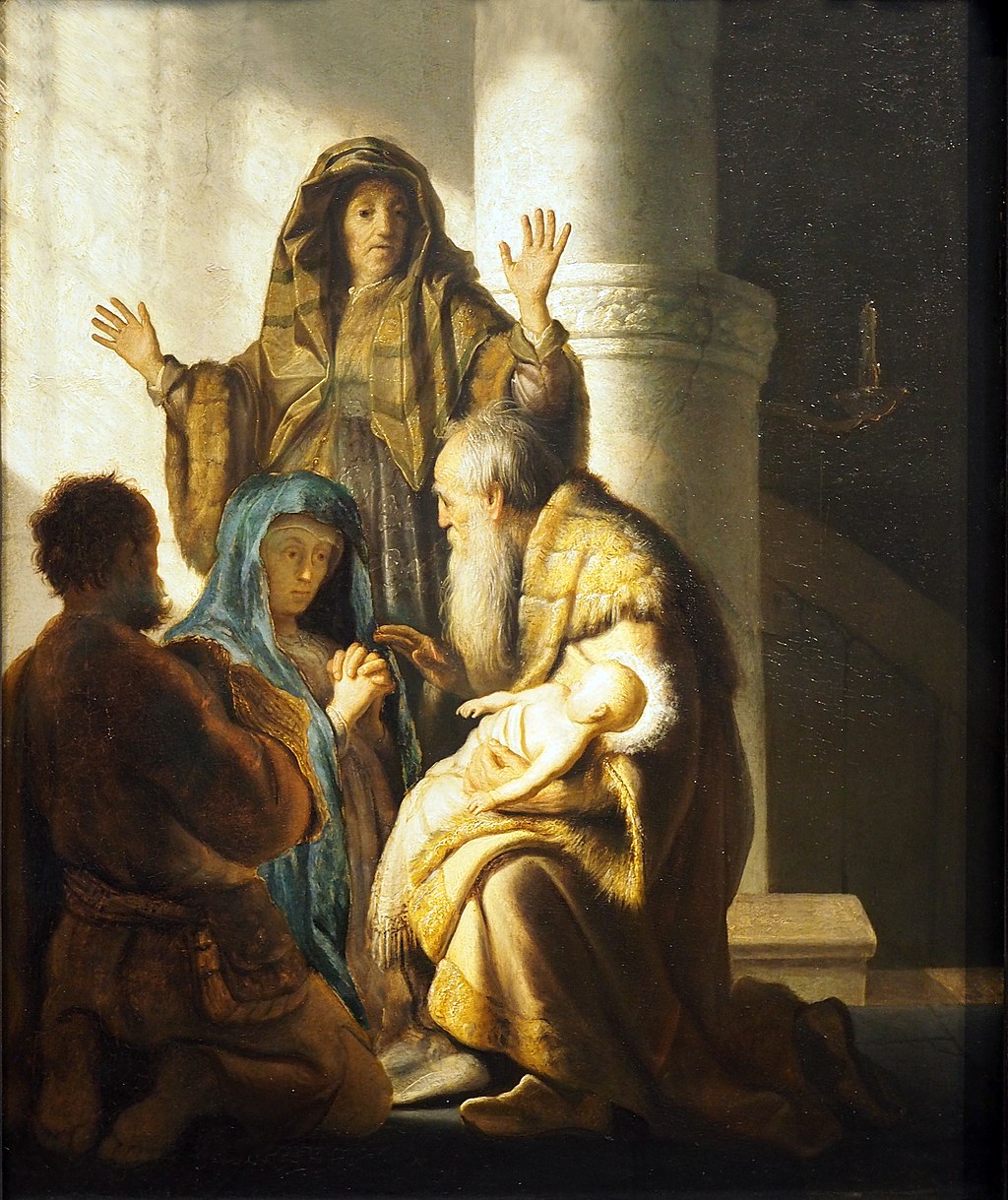
Sixth Day within the Octave of the Nativity of the Lord
Liturgical Color: White
Rosary Mysteries: Sorrowful Mysteries

Daily Readings
First Reading: 1 John 2: 12-17
12 I write unto you, little children, because your sins are forgiven you for his name’s sake.
13 I write unto you, fathers, because you have known him, who is from the beginning. I write unto you, young men, because you have overcome the wicked one.
14 I write unto you, babes, because you have known the Father. I write unto you, young men, because you are strong, and the word of God abideth in you, and you have overcome the wicked one.
15 Love not the world, nor the things which are in the world. If any man love the world, the charity of the Father is not in him.
16 For all that is in the world, is the concupiscence of the flesh, and the concupiscence of the eyes, and the pride of life, which is not of the Father, but is of the world.
17 And the world passeth away, and the concupiscence thereof: but he that doth the will of God, abideth for ever.
12 Scribo vobis, filioli, quoniam remittuntur vobis peccata propter nomen ejus.
13 Scribo vobis, patres, quoniam cognovistis eum, qui ab initio est. Scribo vobis, adolescentes, quoniam vicistis malignum.
14 Scribo vobis, infantes, quoniam cognovistis patrem. Scribo vobis juvenes, quoniam fortes estis, et verbum Dei manet in vobis, et vicistis malignum.
15 Nolite diligere mundum, neque ea quæ in mundo sunt. Si quis diligit mundum, non est caritas Patris in eo:
16 quoniam omne quod est in mundo, concupiscentia carnis est, et concupiscentia oculorum, et superbia vitæ: quæ non est ex Patre, sed ex mundo est.
17 Et mundus transit, et concupiscentia ejus: qui autem facit voluntatem Dei manet in æternum.
Gospel: Luke 2: 36-40
36 And there was one Anna, a prophetess, the daughter of Phanuel, of the tribe of Aser; she was far advanced in years, and had lived with her husband seven years from her virginity.
37 And she was a widow until fourscore and four years; who departed not from the temple, by fastings and prayers serving night and day.
38 Now she, at the same hour, coming in, confessed to the Lord; and spoke of him to all that looked for the redemption of Israel.
39 And after they had performed all things according to the law of the Lord, they returned into Galilee, to their city Nazareth.
40 And the child grew, and waxed strong, full of wisdom; and the grace of God was in him.
36 Et erat Anna prophetissa, filia Phanuel, de tribu Aser: hæc processerat in diebus multis, et vixerat cum viro suo annis septem a virginitate sua.
37 Et hæc vidua usque ad annos octoginta quatuor: quæ non discedebat de templo, jejuniis et obsecrationibus serviens nocte ac die.
38 Et hæc, ipsa hora superveniens, confitebatur Domino: et loquebatur de illo omnibus, qui exspectabant redemptionem Israël.
39 Et ut perfecerunt omnia secundum legem Domini, reversi sunt in Galilæam in civitatem suam Nazareth.
40 Puer autem crescebat, et confortabatur plenus sapientia: et gratia Dei erat in illo.

A Daily Question from the Summa Theologica
Whether Christ’s birth should have been manifested by means of the angels and the star? (Article 4 of 8 of Question 36. Of the Manifestation of the Newly Born Christ from the Treatise on the Incarnation)
Objection 1: It would seem that Christ’s birth should not have been manifested by means of the angels. For angels are spiritual substances, according to Ps. 103:4: “Who maketh His [Vulg.: ‘makest Thy’] angels, spirits.” But Christ’s birth was in the flesh, and not in His spiritual substance. Therefore it should not have been manifested by means of angels.
Objection 2: Further, the righteous are more akin to the angels than to any other, according to Ps. 33:8: “The angel of the Lord shall encamp round about them that fear Him, and shall deliver them.” But Christ’s birth was not announced to the righteous, viz. Simeon and Anna, through the angels. Therefore neither should it have been announced to the shepherds by means of the angels.
Objection 3: Further, it seems that neither ought it to have been announced to the Magi by means of the star. For this seems to favor the error of those who think that man’s birth is influenced by the stars. But occasions of sin should be taken away from man. Therefore it was not fitting that Christ’s birth should be announced by a star.
Objection 4: Further, a sign should be certain, in order that something be made known thereby. But a star does not seem to be a certain sign of Christ’s birth. Therefore Christ’s birth was not suitably announced by a star.
On the contrary, It is written (Dt. 32:4): “The works of God are perfect.” But this manifestation is the work of God. Therefore it was accomplished by means of suitable signs.
I answer that, As knowledge is imparted through a syllogism from something which we know better, so knowledge given by signs must be conveyed through things which are familiar to those to whom the knowledge is imparted. Now, it is clear that the righteous have, through the spirit of prophecy, a certain familiarity with the interior instinct of the Holy Ghost, and are wont to be taught thereby, without the guidance of sensible signs. Whereas others, occupied with material things, are led through the domain of the senses to that of the intellect. The Jews, however, were accustomed to receive Divine answers through the angels; through whom they also received the Law, according to Acts 7:53: “You [Vulg.: ‘who’] . . . have received the Law by the disposition of angels.” And the Gentiles, especially astrologers, were wont to observe the course of the stars. And therefore Christ’s birth was made known to the righteous, viz. Simeon and Anna, by the interior instinct of the Holy Ghost, according to Lk. 2:26: “He had received an answer from the Holy Ghost that he should not see death before he had seen the Christ of the Lord.” But to the shepherds and Magi, as being occupied with material things, Christ’s birth was made known by means of visible apparitions. And since this birth was not only earthly, but also, in a way, heavenly, to both (shepherds and Magi) it is revealed through heavenly signs: for, as Augustine says in a sermon on the Epiphany (cciv): “The angels inhabit, and the stars adorn, the heavens: by both, therefore, do the ‘heavens show forth the glory of God.’” Moreover, it was not without reason that Christ’s birth was made known, by means of angels, to the shepherds, who, being Jews, were accustomed to frequent apparitions of the angels: whereas it was revealed by means of a star to the Magi, who were wont to consider the heavenly bodies. Because, as Chrysostom says (Hom. vi in Matth.): “Our Lord deigned to call them through things to which they were accustomed.” There is also another reason. For, as Gregory says (Hom. x in Evang.): “To the Jews, as rational beings, it was fitting that a rational animal [*Cf. FP, Q[51], A[1], ad 2],” viz. an angel, “should preach. Whereas the Gentiles, who were unable to come to the knowledge of God through the reason, were led to God, not by words, but by signs. And as our Lord, when He was able to speak, was announced by heralds who spoke, so before He could speak He was manifested by speechless elements.” Again, there is yet another reason. For, as Augustine [*Pope Leo] says in a sermon on the Epiphany: “To Abraham was promised an innumerable progeny, begotten, not of carnal propagation, but of the fruitfulness of faith. For this reason it is compared to the multitude of stars; that a heavenly progeny might be hoped for.” Wherefore the Gentiles, “who are thus designated by the stars, are by the rising of a new star stimulated” to seek Christ, through whom they are made the seed of Abraham.
Reply to Objection 1: That which of itself is hidden needs to be manifested, but not that which in itself is manifest. Now, the flesh of Him who was born was manifest, whereas the Godhead was hidden. And therefore it was fitting that this birth should be made known by angels, who are the ministers of God. Wherefore also a certain “brightness” (Lk. 2:9) accompanied the angelic apparition, to indicate that He who was just born was the “Brightness of” the Father’s “glory.”
Reply to Objection 2: The righteous did not need the visible apparition of the angel; on account of their perfection the interior instinct of the Holy Ghost was enough for them.
Reply to Objection 3: The star which manifested Christ’s birth removed all occasion of error. For, as Augustine says (Contra Faust. ii): “No astrologer has ever so far connected the stars with man’s fate at the time of his birth as to assert that one of the stars, at the birth of any man, left its orbit and made its way to him who was just born”: as happened in the case of the star which made known the birth of Christ. Consequently this does not corroborate the error of those who “think there is a connection between man’s birth and the course of the stars, for they do not hold that the course of the stars can be changed at a man’s birth.”
In the same sense Chrysostom says (Hom. vi in Matth.): “It is not an astronomer’s business to know from the stars those who are born, but to tell the future from the hour of a man’s birth: whereas the Magi did not know the time of the birth, so as to conclude therefrom some knowledge of the future; rather was it the other way about.”
Reply to Objection 4: Chrysostom relates (Hom. ii in Matth.) that, according to some apocryphal books, a certain tribe in the far east near the ocean was in the possession of a document written by Seth, referring to this star and to the presents to be offered: which tribe watched attentively for the rising of this star, twelve men being appointed to take observations, who at stated times repaired to the summit of a mountain with faithful assiduity: whence they subsequently perceived the star containing the figure of a small child, and above it the form of a cross.
Or we may say, as may be read in the book De Qq. Vet. et Nov. Test., qu. lxiii, that “these Magi followed the tradition of Balaam,” who said, “‘A star shall rise out of Jacob.’ Wherefore observing this star to be a stranger to the system of this world, they gathered that it was the one foretold by Balaam to indicate the King of the Jews.”
Or again, it may be said with Augustine, in a sermon on the Epiphany (ccclxxiv), that “the Magi had received a revelation through the angels” that the star was a sign of the birth of Christ: and he thinks it probable that these were “good angels; since in adoring Christ they were seeking for salvation.”
Or with Pope Leo, in a sermon on the Epiphany (xxxiv), that “besides the outward form which aroused the attention of their corporeal eyes, a more brilliant ray enlightened their minds with the light of faith.”
Continue reading the rest of the articles on Sacred Texts Archive website.