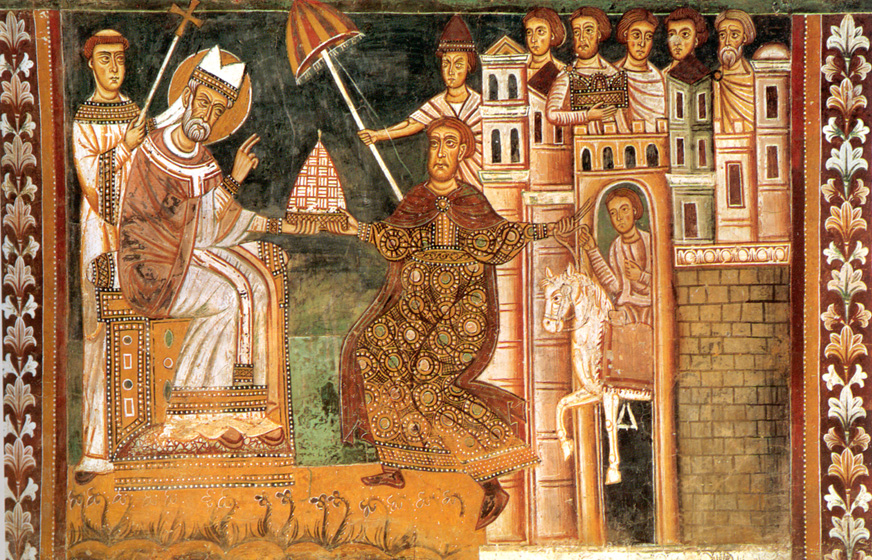
Optional Memorial of Saint Sylvester I, Pope
Happy New Year’s Eve!
Liturgical Color: White
Rosary Mysteries: Glorious Mysteries
“The Son is true God of true God, begotten not made, consubstantial with the Father.”
From the Nicene Creed upheld during the pontificate of Saint Sylvester I
Unknown birthdate – 335
Patron of the Benedictine order and of the chivalric order of the Militia Aurata

Daily Readings
First Reading: 1 John 2: 18-21
18 Little children, it is the last hour; and as you have heard that Antichrist cometh, even now there are become many Antichrists: whereby we know that it is the last hour.
19 They went out from us, but they were not of us. For if they had been of us, they would no doubt have remained with us; but that they may be manifest, that they are not all of us.
20 But you have the unction from the Holy One, and know all things.
21 I have not written to you as to them that know not the truth, but as to them that know it: and that no lie is of the truth.
18 Filioli, novissima hora est: et sicut audistis quia antichristus venit, et nunc antichristi multi facti sunt; unde scimus, quia novissima hora est.
19 Ex nobis prodierunt, sed non erant ex nobis, nam, si fuissent ex nobis, permansissent utique nobiscum: sed ut manifesti sint quoniam non sunt omnes ex nobis.
20 Sed vos unctionem habetis a Sancto, et nostis omnia.
21 Non scripsi vobis quasi ignorantibus veritatem, sed quasi scientibus eam: et quoniam omne mendacium ex veritate non est.
Gospel: John 1: 1-18
1 In the beginning was the Word, and the Word was with God, and the Word was God.
2 The same was in the beginning with God.
3 All things were made by him: and without him was made nothing that was made.
4 In him was life, and the life was the light of men.
5 And the light shineth in darkness, and the darkness did not comprehend it.
6 There was a man sent from God, whose name was John.
7 This man came for a witness, to give testimony of the light, that all men might believe through him.
8 He was not the light, but was to give testimony of the light.
9 That was the true light, which enlighteneth every man that cometh into this world.
10 He was in the world, and the world was made by him, and the world knew him not.
11 He came unto his own, and his own received him not.
12 But as many as received him, he gave them power to be made the sons of God, to them that believe in his name.
13 Who are born, not of blood, nor of the will of the flesh, nor of the will of man, but of God.
14 And the Word was made flesh, and dwelt among us, (and we saw his glory, the glory as it were of the only begotten of the Father,) full of grace and truth.
15 John beareth witness of him, and crieth out, saying: This was he of whom I spoke: He that shall come after me, is preferred before me: because he was before me.
16 And of his fulness we all have received, and grace for grace.
17 For the law was given by Moses; grace and truth came by Jesus Christ.
18 No man hath seen God at any time: the only begotten Son who is in the bosom of the Father, he hath declared him.
1 [In principio erat Verbum,
et Verbum erat apud Deum,
et Deus erat Verbum.
2 Hoc erat in principio apud Deum.
3 Omnia per ipsum facta sunt:
et sine ipso factum est nihil, quod factum est.
4 In ipso vita erat,
et vita erat lux hominum:
5 et lux in tenebris lucet,
et tenebræ eam non comprehenderunt.
6 Fuit homo
missus a Deo,
cui nomen erat Joannes.
7 Hic venit in testimonium
ut testimonium perhiberet de lumine,
ut omnes crederent per illum.
8 Non erat ille lux,
sed ut testimonium perhiberet de lumine.
9 Erat lux vera,
quæ illuminat omnem hominem
venientem in hunc mundum.
10 In mundo erat,
et mundus per ipsum factus est,
et mundus eum non cognovit.
11 In propria venit,
et sui eum non receperunt.
12 Quotquot autem receperunt eum,
dedit eis potestatem filios Dei fieri,
his qui credunt in nomine ejus:
13 qui non ex sanguinibus,
neque ex voluntate carnis,
neque ex voluntate viri,
sed ex Deo nati sunt.
14 Et Verbum caro factum est,
et habitavit in nobis:
et vidimus gloriam ejus,
gloriam quasi unigeniti a Patre
plenum gratiæ et veritatis.
15 Joannes testimonium perhibet de ipso,
et clamat dicens:
Hic erat quem dixi:
Qui post me venturus est,
ante me factus est:
quia prior me erat.
16 Et de plenitudine ejus
nos omnes accepimus, et gratiam pro gratia:
17 quia lex per Moysen data est,
gratia et veritas per Jesum Christum facta est.
18 Deum nemo vidit umquam:
unigenitus Filius, qui est in sinu Patris,
ipse enarravit.]

A Daily Question from the Summa Theologica
Whether Christ’s birth was made known in a becoming order? (Article 5 of 8 of Question 36. Of the Manifestation of the Newly Born Christ from the Treatise on the Incarnation)
Objection 1: It would seem that Christ’s birth was made known in an unbecoming order. For Christ’s birth should have been made known to them first who were nearest to Christ, and who longed for Him most; according to Wis. 6:14: “She preventeth them that covet her, so that she first showeth herself unto them.” But the righteous were nearest to Christ by faith, and longed most for His coming; whence it is written (Lk. 2:25) of Simeon that “he was just and devout, waiting for the consolation of Israel.” Therefore Christ’s birth should have been made known to Simeon before the shepherds and Magi.
Objection 2: Further, the Magi were the “first-fruits of the Gentiles,” who were to believe in Christ. But first the “fulness of the Gentiles . . . come in” unto faith, and afterwards “all Israel” shall “be saved,” as is written (Rom. 11:25). Therefore Christ’s birth should have been made known to the Magi before the shepherds.
Objection 3: Further, it is written (Mat. 2:16) that “Herod killed all the male children that were in Bethlehem, and in all the borders thereof, from two years old and under, according to the time which he had diligently inquired from the wise men”: so that it seems that the Magi were two years in coming to Christ after His birth. It was therefore unbecoming that Christ should be made known to the Gentiles so long after His birth.
On the contrary, It is written (Dan. 2:21): “He changes time and ages.” Consequently the time of the manifestation of Christ’s birth seems to have been arranged in a suitable order.
I answer that, Christ’s birth was first made known to the shepherds on the very day that He was born. For, as it is written (Luke 2:8, 15, 16): “There were in the same country shepherds watching, and keeping the night-watches over their flock . . . And it came to pass, after the angels departed from them into heaven they [Vulg.: ‘the shepherds’] said one to another: Let us go over to Bethlehem . . . and they came with haste.” Second in order were the Magi, who came to Christ on the thirteenth day after His birth, on which day is kept the feast of the Epiphany. For if they had come after a year, or even two years, they would not have found Him in Bethlehem, since it is written (Lk. 2:39) that “after they had performed all things according to the law of the Lord”—that is to say, after they had offered up the Child Jesus in the Temple—“they returned into Galilee, to their city”—namely, “Nazareth.” In the third place, it was made known in the Temple to the righteous on the fortieth day after His birth, as related by Luke (2:22).
The reason of this order is that the shepherds represent the apostles and other believers of the Jews, to whom the faith of Christ was made known first; among whom there were “not many mighty, not many noble,” as we read 1 Cor. 1:26. Secondly, the faith of Christ came to the “fulness of the Gentiles”; and this is foreshadowed in the Magi. Thirdly it came to the fulness of the Jews, which is foreshadowed in the righteous. Wherefore also Christ was manifested to them in the Jewish Temple.
Reply to Objection 1: As the Apostle says (Rom. 9:30, 31): “Israel, by following after the law of justice, is not come unto the law of justice”: but the Gentiles, “who followed not after justice,” forestalled the generality of the Jews in the justice which is of faith. As a figure of this, Simeon, “who was waiting for the consolation of Israel,” was the last to know Christ born: and he was preceded by the Magi and the shepherds, who did not await the coming of Christ with such longing.
Reply to Objection 2: Although the “fulness of the Gentiles came in” unto faith before the fulness of the Jews, yet the first-fruits of the Jews preceded the first-fruits of the Gentiles in faith. For this reason the birth of Christ was made known to the shepherds before the Magi.
Reply to Objection 3: There are two opinions about the apparition of the star seen by the Magi. For Chrysostom (Hom. ii in Matth. [*Opus Imperf. in Matth., falsely ascribed to Chrysostom]), and Augustine in a sermon on the Epiphany (cxxxi, cxxxii), say that the star was seen by the Magi during the two years that preceded the birth of Christ: and then, having first considered the matter and prepared themselves for the journey, they came from the farthest east to Christ, arriving on the thirteenth day after His birth. Wherefore Herod, immediately after the departure of the Magi, “perceiving that He was deluded by them,” commanded the male children to be killed “from two years old and under,” being doubtful lest Christ were already born when the star appeared, according as he had heard from the Magi.
But others say that the star first appeared when Christ was born, and that the Magi set off as soon as they saw the star, and accomplished a journey of very great length in thirteen days, owing partly to the Divine assistance, and partly to the fleetness of the dromedaries. And I say this on the supposition that they came from the far east. But others, again, say that they came from a neighboring country, whence also was Balaam, to whose teaching they were heirs; and they are said to have come from the east, because their country was to the east of the country of the Jews. In this case Herod killed the babes, not as soon as the Magi departed, but two years after: and that either because he is said to have gone to Rome in the meanwhile on account of an accusation brought against him, or because he was troubled at some imminent peril, and for the time being desisted from his anxiety to slay the child, or because he may have thought that the Magi, “being deceived by the illusory appearance of the star, and not finding the child, as they had expected to, were ashamed to return to him”: as Augustine says (De Consensu Evang. ii). And the reason why he killed not only those who were two years old, but also the younger children, would be, as Augustine says in a sermon on the Innocents, because he feared lest a child whom the stars obey, might make himself appear older or younger.
Continue reading the rest of the articles on Sacred Texts Archive website.