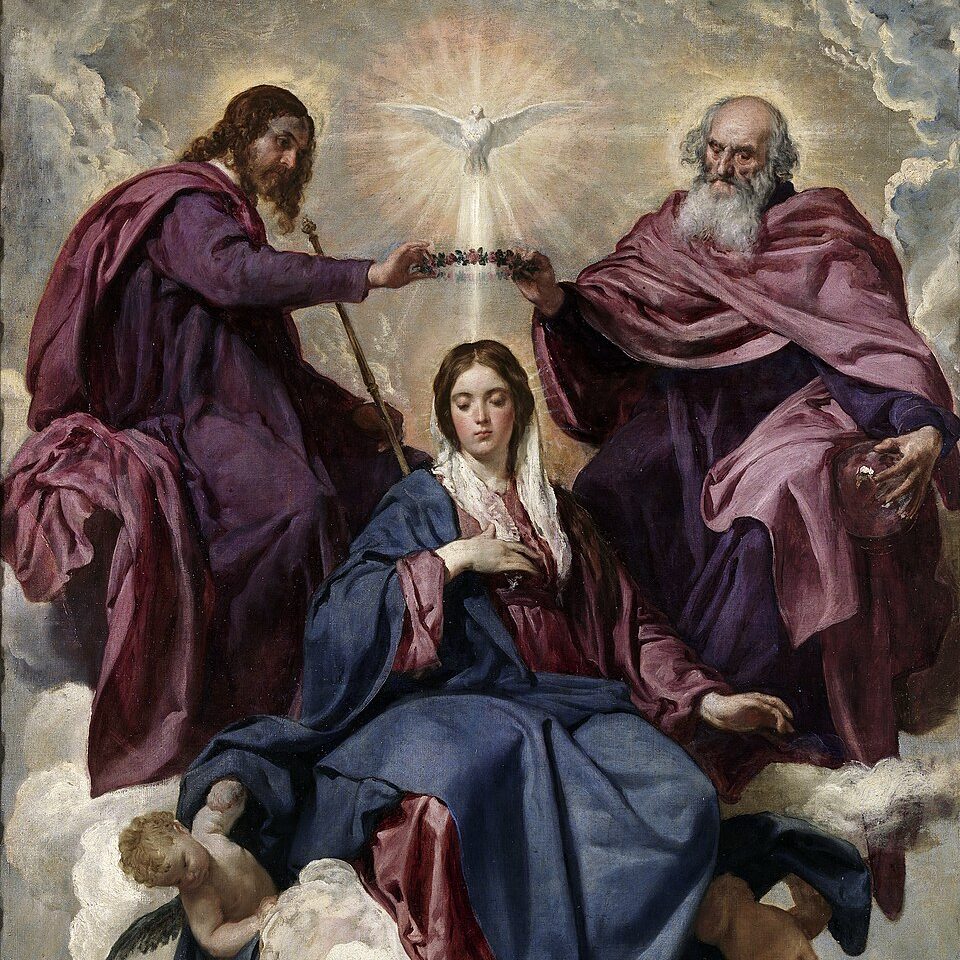
SOLEMNITY OF MARY, THE HOLY MOTHER OF GOD
Holy Day of Obligation
Happy New Year!
Liturgical Color: White
Rosary Mysteries: Luminous Mysteries

Daily Readings
First Reading: Numbers 6: 22-27
22 And the Lord spoke to Moses, saying:
23 Say to Aaron and his sons: Thus shall you bless the children of Israel, and you shall say to them:
24 The Lord bless thee, and keep thee.
25 The Lord shew his face to thee, and have mercy on thee.
26 The Lord turn his countenance to thee, and give thee peace.
27 And they shall invoke my name upon the children of Israel, and I will bless them.
22 Locutusque est Dominus ad Moysen, dicens:
23 Loquere Aaron et filiis ejus: Sic benedicetis filiis Israël, et dicetis eis:
24 Benedicat tibi Dominus, et custodiat te.
25 Ostendat Dominus faciem suam tibi, et misereatur tui.
26 Convertat Dominus vultum suum ad te, et det tibi pacem.
27 Invocabuntque nomen meum super filios Israël, et ego benedicam eis.
Second Reading: Galatians 4: 4-7
4 But when the fulness of the time was come, God sent his Son, made of a woman, made under the law:
5 That he might redeem them who were under the law: that we might receive the adoption of sons.
6 And because you are sons, God hath sent the Spirit of his Son into your hearts, crying: Abba, Father.
7 Therefore now he is not a servant, but a son. And if a son, an heir also through God.
4 At ubi venit plenitudo temporis, misit Deus Filium suum factum ex muliere, factum sub lege,
5 ut eos, qui sub lege erant, redimeret, ut adoptionem filiorum reciperemus.
6 Quoniam autem estis filii, misit Deus Spiritum Filii sui in corda vestra, clamantem: Abba, Pater.
7 Itaque jam non est servus, sed filius: quod si filius, et hæres per Deum.
Gospel: Luke 2: 16-21
16 And they came with haste; and they found Mary and Joseph, and the infant lying in the manger.
17 And seeing, they understood of the word that had been spoken to them concerning this child.
18 And all that heard, wondered; and at those things that were told them by the shepherds.
19 But Mary kept all these words, pondering them in her heart.
20 And the shepherds returned, glorifying and praising God, for all the things they had heard and seen, as it was told unto them.
21 And after eight days were accomplished, that the child should be circumcised, his name was called JESUS, which was called by the angel, before he was conceived in the womb.
16 Et venerunt festinantes: et invenerunt Mariam, et Joseph, et infantem positum in præsepio.
17 Videntes autem cognoverunt de verbo, quod dictum erat illis de puero hoc.
18 Et omnes qui audierunt, mirati sunt: et de his quæ dicta erant a pastoribus ad ipsos.
19 Maria autem conservabat omnia verba hæc, conferens in corde suo.
20 Et reversi sunt pastores glorificantes et laudantes Deum in omnibus quæ audierant et viderant, sicut dictum est ad illos.
21 Et postquam consummati sunt dies octo, ut circumcideretur puer, vocatum est nomen ejus Jesus, quod vocatum est ab angelo priusquam in utero conciperetur.

A Daily Question from the Summa Theologica
Whether the star which appeared to the Magi belonged to the heavenly system? (Article 6 of 8 of Question 36. Of the Manifestation of the Newly Born Christ from the Treatise on the Incarnation)
Objection 1: It would seem that the star which appeared to the Magi belonged to the heavenly system. For Augustine says in a sermon on the Epiphany (cxxii): “While God yet clings to the breast, and suffers Himself to be wrapped in humble swaddling clothes, suddenly a new star shines forth in the heavens.” Therefore the star which appeared to the Magi belonged to the heavenly system.
Objection 2: Further, Augustine says in a sermon on the Epiphany (cci): “Christ was made known to the shepherds by angels, to the Magi by a star. A heavenly tongue speaks to both, because the tongue of the prophets spoke no longer.” But the angels who appeared to the shepherds were really angels from heaven. Therefore also the star which appeared to the Magi was really a star from the heavens.
Objection 3: Further, stars which are not in the heavens but in the air are called comets, which do not appear at the birth of kings, but rather are signs of their approaching death. But this star was a sign of the King’s birth: wherefore the Magi said (Mat. 2:2): “Where is He that is born King of the Jews? For we have seen His star in the east.” Therefore it seems that it was a star from the heavens.
On the contrary, Augustine says (Contra Faust. ii): “It was not one of those stars which since the beginning of the creation observe the course appointed to them by the Creator; but this star was a stranger to the heavens, and made its appearance at the strange sight of a virgin in childbirth.”
I answer that, As Chrysostom says (Hom. vi in Matth.), it is clear, for many reasons, that the star which appeared to the Magi did not belong to the heavenly system. First, because no other star approaches from the same quarter as this star, whose course was from north to south, these being the relative positions of Persia, whence the Magi came, and Judea. Secondly, from the time [at which it was seen]. For it appeared not only at night, but also at midday: and no star can do this, not even the moon. Thirdly, because it was visible at one time and hidden at another. For when they entered Jerusalem it hid itself: then, when they had left Herod, it showed itself again. Fourthly, because its movement was not continuous, but when the Magi had to continue their journey the star moved on; when they had to stop the star stood still; as happened to the pillar of a cloud in the desert. Fifthly, because it indicated the virginal Birth, not by remaining aloft, but by coming down below. For it is written (Mat. 2:9) that “the star which they had seen in the east went before them, until it came and stood over where the child was.” Whence it is evident that the words of the Magi, “We have seen His star in the east,” are to be taken as meaning, not that when they were in the east the star appeared over the country of Judea, but that when they saw the star it was in the east, and that it preceded them into Judea (although this is considered doubtful by some). But it could not have indicated the house distinctly, unless it were near the earth. And, as he [Chrysostom] observes, this does not seem fitting to a star, but “of some power endowed with reason.” Consequently “it seems that this was some invisible force made visible under the form of a star.”
Wherefore some say that, as the Holy Ghost, after our Lord’s Baptism, came down on Him under the form of a dove, so did He appear to the Magi under the form of a star. While others say that the angel who, under a human form, appeared to the shepherds, under the form of a star, appeared to the Magi. But it seems more probable that it was a newly created star, not in the heavens, but in the air near the earth, and that its movement varied according to God’s will. Wherefore Pope Leo says in a sermon on the Epiphany (xxxi): “A star of unusual brightness appeared to the three Magi in the east, which, through being more brilliant and more beautiful than the other stars, drew men’s gaze and attention: so that they understood at once that such an unwonted event could not be devoid of purpose.”
Reply to Objection 1: In Holy Scripture the air is sometimes called the heavens—for instance, “The birds of the heavens [Douay: ‘air’] and the fishes of the sea.”
Reply to Objection 2: The angels of heaven, by reason of their very office, come down to us, being “sent to minister.” But the stars of heaven do not change their position. Wherefore there is no comparison.
Reply to Objection 3: As the star did not follow the course of the heavenly stars, so neither did it follow the course of the comets, which neither appear during the daytime nor vary their customary course. Nevertheless in its signification it has something in common with the comets. Because the heavenly kingdom of Christ “shall break in pieces, and shall consume all the kingdoms” of the earth, “and itself shall stand for ever” (Dan. 2:44).
Continue reading the rest of the articles on Sacred Texts Archive website.