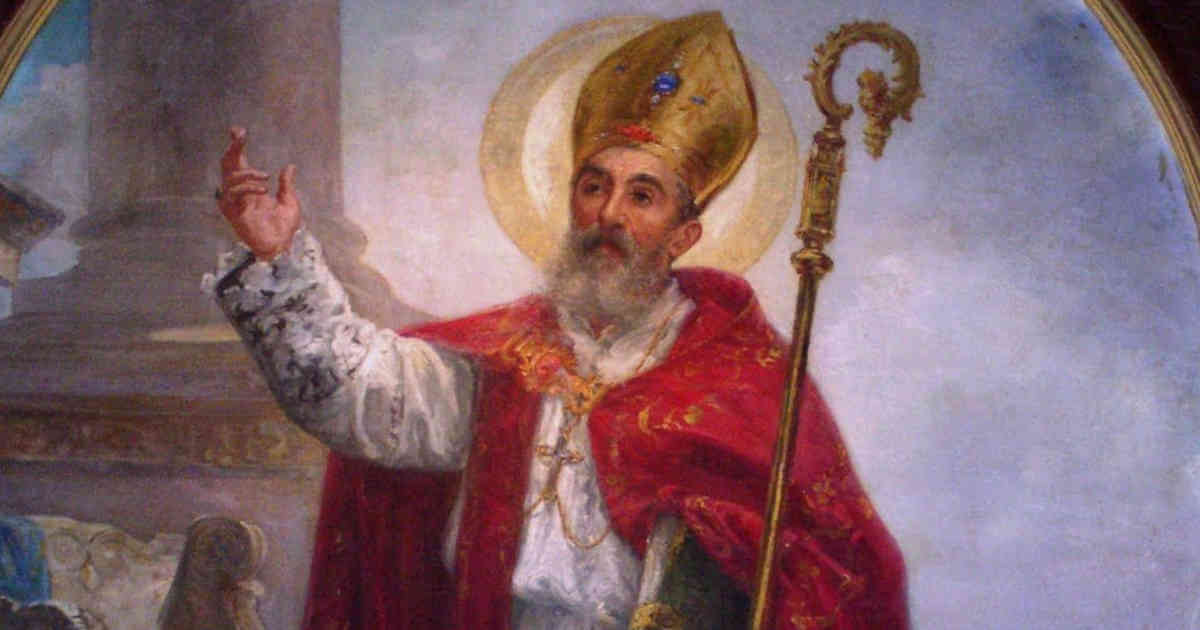
Optional Memorial of Saint Hilary, Bishop and Doctor of the Church
Liturgical Color: Green / White
Rosary Mysteries: Sorrowful Mysteries
“The privilege of our Church is such that it is never stronger than when it is attacked, never better known than when it is accused, never more powerful than when it appears forsaken.”
Saint Hilary
est. 315 – est. 367
Patron of lawyers, mothers, children with disabilities, and sick people

Daily Readings
First Reading: 1 Samuel 1: 9-20
9 So Anna arose after she had eaten and drunk in Silo: And Heli, the priest, sitting upon a stool before the door of the temple of the Lord;
10. As Anna had her heart full of grief, she prayed to the Lord, shedding many tears,
11 And she made a vow, saying: O Lord of hosts, if thou wilt look down, and wilt be mindful of me, and not forget thy handmaid, and wilt give to thy servant a manchild: I will give him to the Lord all the days of his life, and no razor shall come upon his head.
12 And it came to pass, as she multiplied prayers before the Lord, that Heli observed her mouth.
13 Now Anna spoke in her heart, and only her lips moved, but her voice was not heard at all. Heli therefore thought her to be drunk,
14 And said to her: How long wilt thou be drunk? digest a little the wine, of which thou hast taken too much.
15 Anna answering, said: Not so, my lord: for I am an exceeding unhappy woman, and have drunk neither wine nor any strong drink, but I have poured out my soul before the Lord.
16 Count not thy handmaid for one of the daughters of Belial: for out of the abundance of my sorrow and grief have I spoken till now.
17 Then Heli said to her: Go in peace: and the God of Israel grant thee thy petition, which thou hast asked of him.
18 And she said: Would to God thy handmaid may find grace in thy eyes. So the woman went on her way, and ate, and her countenance was no more changed.
19 And they rose in the morning, and worshipped before the Lord: and they returned, and came into their house at Ramatha. And Elcana knew Anna his wife: And the Lord remembered her.
20 And it came to pass when the time was come about, Anna conceived and bore a son, and called his name Samuel: because she had asked him of the Lord.
9 Surrexit autem Anna postquam comederat et biberat in Silo. Et Heli sacerdote sedente super sellam ante postes templi Domini,
10 cum esset Anna amaro animo, oravit ad Dominum, flens largiter,
11 et votum vovit, dicens: Domine exercituum, si respiciens videris afflictionem famulæ tuæ, et recordatus mei fueris, nec oblitus ancillæ tuæ, dederisque servæ tuæ sexum virilem: dabo eum Domino omnibus diebus vitæ ejus, et novacula non ascendet super caput ejus.
12 Factum est autem, cum illa multiplicaret preces coram Domino, ut Heli observaret os ejus.
13 Porro Anna loquebatur in corde suo, tantumque labia illius movebantur, et vox penitus non audiebatur. Æstimavit ergo eam Heli temulentam,
14 dixitque ei: Usquequo ebria eris? digere paulisper vinum, quo mades.
15 Respondens Anna: Nequaquam, inquit, domine mi: nam mulier infelix nimis ego sum: vinumque et omne quod inebriare potest, non bibi, sed effudi animam meam in conspectu Domini.
16 Ne reputes ancillam tuam quasi unam de filiabus Belial: quia ex multitudine doloris et mœroris mei locuta sum usque in præsens.
17 Tunc Heli ait ei: Vade in pace: et Deus Israël det tibi petitionem tuam quam rogasti eum.
18 Et illa dixit: Utinam inveniat ancilla tua gratiam in oculis tuis. Et abiit mulier in viam suam, et comedit, vultusque illius non sunt amplius in diversa mutati.
19 Et surrexerunt mane, et adoraverunt coram Domino: reversique sunt, et venerunt in domum suam Ramatha.
Cognovit autem Elcana Annam uxorem suam: et recordatus est ejus Dominus.
20 Et factum est post circulum dierum, concepit Anna, et peperit filium: vocavitque nomen ejus Samuel, eo quod a Domino postulasset eum.
Gospel: Mark 1: 21-28
21 And they entered into Capharnaum: and forthwith upon the sabbath days going into the synagogue, he taught them.
22 And they were astonished at his doctrine. For he was teaching them as one having power, and not as the scribes.
23 And there was in their synagogue a man with an unclean spirit; and he cried out,
24 Saying: What have we to do with thee, Jesus of Nazareth? Art thou come to destroy us? I know who thou art, the Holy One of God.
25 And Jesus threatened him, saying: Speak no more, and go out of the man.
26 And the unclean spirit, tearing him and crying out with a loud voice, went out of him.
27 And they were all amazed insomuch that they questioned among themselves, saying: What thing is this? What is this new doctrine? For with power he commandeth even the unclean spirits: and they obey him.
28 And the fame of him was spread forthwith into all the country of Galilee.
21 Et ingrediuntur Capharnaum: et statim sabbatis ingressus in synagogam, docebat eos.
22 Et stupebant super doctrina ejus: erat enim docens eos quasi potestatem habens, et non sicut scribæ.
23 Et erat in synagoga eorum homo in spiritu immundo: et exclamavit,
24 dicens: Quid nobis et tibi, Jesu Nazarene? venisti perdere nos? scio qui sis, Sanctus Dei.
25 Et comminatus est ei Jesus, dicens: Obmutesce, et exi de homine.
26 Et discerpens eum spiritus immundus, et exclamans voce magna, exiit ab eo.
27 Et mirati sunt omnes, ita ut conquirerent inter se dicentes: Quidnam est hoc? quænam doctrina hæc nova? quia in potestate etiam spiritibus immundis imperat, et obediunt ei.
28 Et processit rumor ejus statim in omnem regionem Galilææ.

A Daily Question from the Summa Theologica
Whether Christ should have associated with men, or led a solitary life? (Article 1 of 4 of Question 40. Of Christ’s Manner of Life from the Treatise on the Incarnation)
Objection 1: It would seem that Christ should not have associated with men, but should have led a solitary life. For it behooved Christ to show by His manner of life not only that He was man, but also that He was God. But it is not becoming that God should associate with men, for it is written (Dan. 2:11): “Except the gods, whose conversation is not with men”; and the Philosopher says (Polit. i) that he who lives alone is “either a beast”—that is, if he do this from being wild—“or a god,” if his motive be the contemplation of truth. Therefore it seems that it was not becoming for Christ to associate with men.
Objection 2: Further, while He lived in mortal flesh, it behooved Christ to lead a most perfect life. But the most perfect is the contemplative life, as we have stated in the SS, Q[182], AA[1],2. Now, solitude is most suitable to the contemplative life; according to Osee 2:14: “I will lead her into the wilderness, and I will speak to her heart.” Therefore it seems that Christ should have led a solitary life.
Objection 3: Further, Christ’s manner of life should have been uniform: because it should always have given evidence of that which is best. But at times Christ avoided the crowd and sought lonely places: hence Remigius [*Cf. Catena Aurea, Matth. 5:1], commenting on Matthew, says: “We read that our Lord had three places of refuge: the ship, the mountain, the desert; to one or other of which He betook Himself whenever he was harassed by the crowd.” Therefore He ought always to have led a solitary life.
On the contrary, It is written (Baruch 3:38): “Afterwards He was seen upon earth and conversed with men.”
I answer that, Christ’s manner of life had to be in keeping with the end of His Incarnation, by reason of which He came into the world. Now He came into the world, first, that He might publish the truth. thus He says Himself (Jn. 18:37): “For this was I born, and for this came I into the world, that I should give testimony to the truth.” Hence it was fitting not that He should hide Himself by leading a solitary life, but that He should appear openly and preach in public. Wherefore (Luke 4:42, 43) He says to those who wished to stay Him: “To other cities also I must preach the kingdom of God: for therefore am I sent.”
Secondly, He came in order to free men from sin; according to 1 Tim. 1:15: “Christ Jesus came into this world to save sinners.” And hence, as Chrysostom says, “although Christ might, while staying in the same place, have drawn all men to Himself, to hear His preaching, yet He did not do so; thus giving us the example to go about and seek those who perish, like the shepherd in his search of the lost sheep, and the physician in his attendance on the sick.”
Thirdly, He came that by Him “we might have access to God,” as it is written (Rom. 5:2). And thus it was fitting that He should give men confidence in approaching Him by associating familiarly with them. Wherefore it is written (Mat. 9:10): “It came to pass as He was sitting . . . in the house, behold, many publicans and sinners came, and sat down with Jesus and His disciples.” On which Jerome comments as follows: “They had seen the publican who had been converted from a sinful to a better life: and consequently they did not despair of their own salvation.”
Reply to Objection 1: Christ wished to make His Godhead known through His human nature. And therefore, since it is proper to man to do so, He associated with men, at the same time manifesting His Godhead to all, by preaching and working miracles, and by leading among men a blameless and righteous life.
Reply to Objection 2: As stated in the SS, Q[182], A[1]; SS, Q[188], A[6], the contemplative life is, absolutely speaking, more perfect than the active life, because the latter is taken up with bodily actions: yet that form of active life in which a man, by preaching and teaching, delivers to others the fruits of his contemplation, is more perfect than the life that stops at contemplation, because such a life is built on an abundance of contemplation, and consequently such was the life chosen by Christ.
Reply to Objection 3: Christ’s action is our instruction. And therefore, in order to teach preachers that they ought not to be for ever before the public, our Lord withdrew Himself sometimes from the crowd. We are told of three reasons for His doing this. First, for the rest of the body: hence (Mk. 6:31) it is stated that our Lord said to His disciples: “Come apart into a desert place, and rest a little. For there were many coming and going: and they had not so much as time to eat.” But sometimes it was for the sake of prayer; thus it is written (Lk. 6:12): “It came to pass in those days, that He went out into a mountain to pray; and He passed the whole night in the prayer of God.” On this Ambrose remarks that “by His example He instructs us in the precepts of virtue.” And sometimes He did so in order to teach us to avoid the favor of men. Wherefore Chrysostom, commenting on Mat. 5:1, Jesus, “seeing the multitude, went up into a mountain,” says: “By sitting not in the city and in the market-place, but on a mountain and in a place of solitude, He taught us to do nothing for show, and to withdraw from the crowd, especially when we have to discourse of needful things.”
Continue reading the rest of the articles on Sacred Texts Archive website.