Weekday
Liturgical Color: Green
Rosary Mysteries: Luminous Mysteries

Daily Readings
First Reading: 1 Samuel 4: 1-11
1 And it came to pass in those days, that the Philistines gathered themselves together to fight: and Israel went out to war against the Philistines, and camped by the Stone of help. And the Philistines came to Aphec,
2 And put their army in array against Israel. And when they had joined battle, Israel turned their backs to the Philistines, and there was slain in that fight here and there in the fields about four thousand men.
3 And the people returned to the camp: and the ancients of Israel said: Why hath the Lord defeated us today before the Philistines? Let us fetch unto us the ark of the covenant of the Lord from Silo, and let it come in the midst of us, that it may save us from the hand of our enemies.
4 So the people sent to Silo, and they brought from thence the ark of the covenant of the Lord of hosts sitting upon the cherubims: and the two sons of Heli, Ophni and Phinees, were with the ark of the covenant of God.
5 And when the ark of the covenant of the Lord was come into the camp, all Israel shouted with a great shout, and the earth rang again.
6 And the Philistines heard the noise of the shout, and they said: What is this noise of a great shout in the camp of the Hebrews? And they understood that the ark of the Lord was come into the camp.
7 And the Philistines were afraid, saying: God is come into the camp. And sighing, they said:
8 Woe to us: for there was no such great joy yesterday and the day before: Woe to us. Who shall deliver us from the hand of these high gods? these are the gods that struck Egypt with all the plagues in the desert.
9 Take courage and behave like men, ye Philistines: lest you come to be servants to the Hebrews, as they have served you: take courage and fight.
10 So the Philistines fought, and Israel was overthrown, and every man fled to his own dwelling: and there was an exceeding great slaughter; for there fell of Israel thirty thousand footmen.
11 And the ark of God was taken: and the two sons of Heli, Ophni and Phinees, were slain.
1 Et factum est in diebus illis, convenerunt Philisthiim in pugnam: et egressus est Israël obviam Philisthiim in prælium, et castrametatus est juxta lapidem Adjutorii. Porro Philisthiim venerunt in Aphec,
2 et instruxerunt aciem contra Israël. Inito autem certamine, terga vertit Israël Philisthæis: et cæsa sunt in illo certamine passim per agros, quasi quatuor millia virorum.
3 Et reversus est populus ad castra: dixeruntque majores natu de Israël: Quare percussit nos Dominus hodie coram Philisthiim? afferamus ad nos de Silo arcam fœderis Domini, et veniat in medium nostri, ut salvet nos de manu inimicorum nostrorum.
4 Misit ergo populus in Silo, et tulerunt inde arcam fœderis Domini exercituum sedentis super cherubim: erantque duo filii Heli cum arca fœderis Dei, Ophni et Phinees.
5 Cumque venisset arca fœderis Domini in castra, vociferatus est omnis Israël clamore grandi, et personuit terra.
6 Et audierunt Philisthiim vocem clamoris, dixeruntque: Quænam est hæc vox clamoris magni in castris Hebræorum? Et cognoverunt quod arca Domini venisset in castra.
7 Timueruntque Philisthiim, dicentes: Venit Deus in castra. Et ingemuerunt, dicentes:
8 Væ nobis: non enim fuit tanta exultatio heri et nudiustertius: væ nobis. Quis nos salvabit de manu deorum sublimium istorum? hi sunt dii, qui percusserunt Ægyptum omni plaga in deserto.
9 Confortamini, et estote viri, Philisthiim, ne serviatis Hebræis, sicut et illi servierunt vobis: confortamini, et bellate.
10 Pugnaverunt ergo Philisthiim, et cæsus est Israël, et fugit unusquisque in tabernaculum suum: et facta est plaga magna nimis, et ceciderunt de Israël triginta millia peditum.
11 Et arca Dei capta est: duo quoque filii Heli mortui sunt, Ophni et Phinees.
Gospel: Mark 1: 40-45
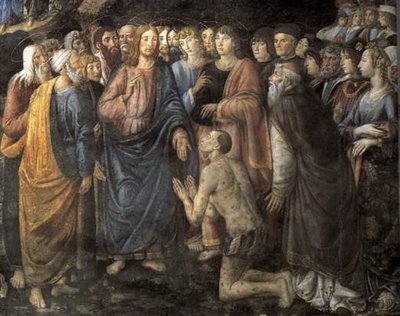
40 And there came a leper to him, beseeching him, and kneeling down said to him: If thou wilt, thou canst make me clean.
41 And Jesus having compassion on him, stretched forth his hand; and touching him, saith to him: I will. Be thou made clean.
42 And when he had spoken, immediately the leprosy departed from him, and he was made clean.
43 And he strictly charged him, and forthwith sent him away.
44 And he saith to him: See thou tell no one; but go, shew thyself to the high priest, and offer for thy cleansing the things that Moses commanded, for a testimony to them.
45 But he being gone out, began to publish and to blaze abroad the word: so that he could not openly go into the city, but was without in desert places: and they flocked to him from all sides.
40 Et venit ad eum leprosus deprecans eum: et genu flexo dixit ei: Si vis, potes me mundare.
41 Jesus autem misertus ejus, extendit manum suam: et tangens eum, ait illi: Volo: mundare.
42 Et cum dixisset, statim discessit ab eo lepra, et mundatus est.
43 Et comminatus est ei, statimque ejecit illum,
44 et dicit ei: Vide nemini dixeris: sed vade, ostende te principi sacerdotum, et offer pro emundatione tua, quæ præcepit Moyses in testimonium illis.
45 At ille egressus cœpit prædicare, et diffamare sermonem, ita ut jam non posset manifeste introire in civitatem, sed foris in desertis locis esset, et conveniebant ad eum undique.

A Daily Question from the Summa Theologica
Whether Christ should have led a life of poverty in this world? (Article 3 of 4 of Question 40. Of Christ’s Manner of Life from the Treatise on the Incarnation)
Objection 1: It would seem that Christ should not have led a life of poverty in this world. Because Christ should have embraced the most eligible form of life. But the most eligible form of life is that which is a mean between riches and poverty; for it is written (Prov. 30:8): “Give me neither beggary nor riches; give me only the necessaries of life.” Therefore Christ should have led a life, not of poverty, but of moderation.
Objection 2: Further, external wealth is ordained to bodily use as to food and raiment. But Christ conformed His manner of life to those among whom He lived, in the matter of food and raiment. Therefore it seems that He should have observed the ordinary manner of life as to riches and poverty, and have avoided extreme poverty.
Objection 3: Further, Christ specially invited men to imitate His example of humility, according to Mat. 11:29: “Learn of Me, because I am meek and humble of heart.” But humility is most commendable in the rich; thus it is written (1 Tim. 6:11): “Charge the rich of this world not to be high-minded.” Therefore it seems that Christ should not have chosen a life of poverty.
On the contrary, It is written (Mat. 8:20): “The Son of Man hath not where to lay His head”: as though He were to say as Jerome observes: “Why desirest thou to follow Me for the sake of riches and worldly gain, since I am so poor that I have not even the smallest dwelling-place, and I am sheltered by a roof that is not Mine?” And on Mat. 17:26: “That we may not scandalize them, go to the sea,” Jerome says: “This incident, taken literally, affords edification to those who hear it when they are told that our Lord was so poor that He had not the wherewithal to pay the tax for Himself and His apostles.”
I answer that, It was fitting for Christ to lead a life of poverty in this world. First, because this was in keeping with the duty of preaching, for which purpose He says that He came (Mk. 1:38): “Let us go into the neighboring towns and cities, that I may preach there also: for to this purpose am I come.” Now in order that the preachers of God’s word may be able to give all their time to preaching, they must be wholly free from care of worldly matters: which is impossible for those who are possessed of wealth. Wherefore the Lord Himself, when sending the apostles to preach, said to them (Mat. 10:9): “Do not possess gold nor silver.” And the apostles (Acts 6:2) say: “It is not reasonable that we should leave the word of God and serve tables.”
Secondly, because just as He took upon Himself the death of the body in order to bestow spiritual life on us, so did He bear bodily poverty, in order to enrich us spiritually, according to 2 Cor. 8:9: “You know the grace of our Lord Jesus Christ: that . . . He became poor for our [Vulg.: ‘your’] sakes that through His poverty we [Vulg.: ‘you’] might be rich.”
Thirdly, lest if He were rich His preaching might be ascribed to cupidity. Wherefore Jerome says on Mat. 10:9, that if the disciples had been possessed of wealth, “they had seemed to preach for gain, not for the salvation of mankind.” And the same reason applies to Christ.
Fourthly, that the more lowly He seemed by reason of His poverty, the greater might the power of His Godhead be shown to be. Hence in a sermon of the Council of Ephesus (P. iii, c. ix) we read: “He chose all that was poor and despicable, all that was of small account and hidden from the majority, that we might recognize His Godhead to have transformed the terrestrial sphere. For this reason did He choose a poor maid for His Mother, a poorer birthplace; for this reason did He live in want. Learn this from the manger.”
Reply to Objection 1: Those who wish to live virtuously need to avoid abundance of riches and beggary, in as far as these are occasions of sin: since abundance of riches is an occasion for being proud; and beggary is an occasion of thieving and lying, or even of perjury. But forasmuch as Christ was incapable of sin, He had not the same motive as Solomon for avoiding these things. Yet neither is every kind of beggary an occasion of theft and perjury, as Solomon seems to add (Prov. 30:8); but only that which is involuntary, in order to avoid which, a man is guilty of theft and perjury. But voluntary poverty is not open to this danger: and such was the poverty chosen by Christ.
Reply to Objection 2: A man may feed and clothe himself in conformity with others, not only by possessing riches, but also by receiving the necessaries of life from those who are rich. This is what happened in regard to Christ: for it is written (Luke 8:2, 3) that certain women followed Christ and “ministered unto Him of their substance.” For, as Jerome says on Mat. 27:55, “It was a Jewish custom, nor was it thought wrong for women, following the ancient tradition of their nation, out of their private means to provide their instructors with food and clothing. But as this might give scandal to the heathens, Paul says that he gave it up”: thus it was possible for them to be fed out of a common fund, but not to possess wealth, without their duty of preaching being hindered by anxiety.
Reply to Objection 3: Humility is not much to be praised in one who is poor of necessity. But in one who, like Christ, is poor willingly, poverty itself is a sign of very great humility.
Continue reading the rest of the articles on Sacred Texts Archive website.