Weekday
Liturgical Color: Green
Rosary Mysteries: Sorrowful Mysteries

Daily Readings
First Reading: 1 Samuel 8: 4-7
4 Then all the ancients of Israel being assembled, came to Samuel to Ramatha.
5 And they said to him: Behold thou art old, and thy sons walk not in thy ways: make us a king, to judge us, as all nations have.
6 And the word was displeasing in the eyes of Samuel, that they should say: Give us a king, to judge us. And Samuel prayed to the Lord.
7 And the Lord said to Samuel: Hearken to the voice of the people in all that they say to thee. For they have not rejected thee, but me, that I should not reign over them.
4 Congregati ergo universi majores natu Israël, venerunt ad Samuelem in Ramatha.
5 Dixeruntque ei: Ecce tu senuisti, et filii tui non ambulant in viis tuis: constitue nobis regem, ut judicet nos, sicut et universæ habent nationes.
6 Displicuit sermo in oculis Samuelis, eo quod dixissent: Da nobis regem, ut judicet nos. Et oravit Samuel ad Dominum.
7 Dixit autem Dominus ad Samuelem: Audi vocem populi in omnibus quæ loquuntur tibi: non enim te abjecerunt, sed me, ne regnem super eos.
Gospel: Mark 2: 1-12
1 And again he entered into Capharnaum after some days.
2 And it was heard that he was in the house, and many came together, so that there was no room; no, not even at the door; and he spoke to them the word.
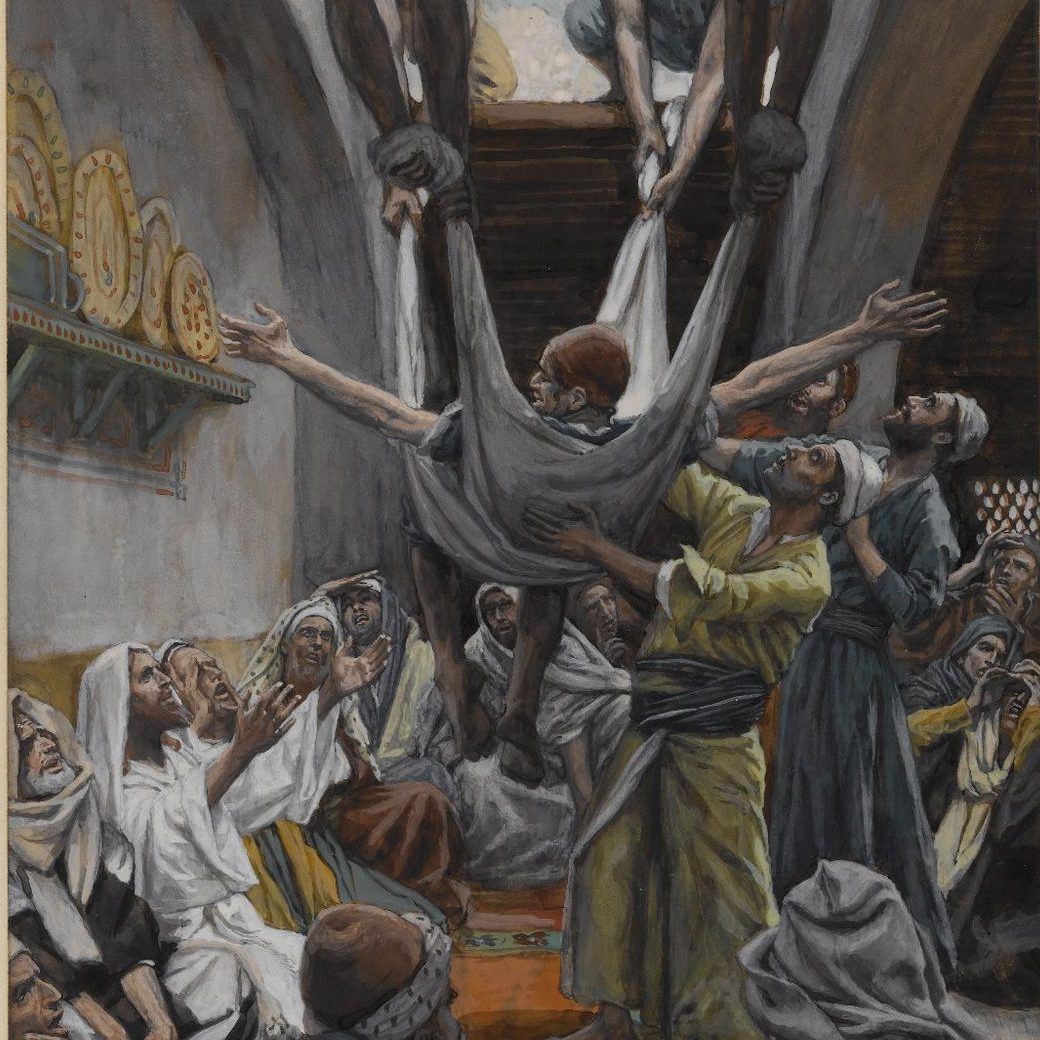
3 And they came to him, bringing one sick of the palsy, who was carried by four.
4 And when they could not offer him unto him for the multitude, they uncovered the roof where he was; and opening it, they let down the bed wherein the man sick of the palsy lay.
5 And when Jesus had seen their faith, he saith to the sick of the palsy: Son, thy sins are forgiven thee.
6 And there were some of the scribes sitting there, and thinking in their hearts:
7 Why doth this man speak thus? he blasphemeth. Who can forgive sins, but God only?
8 Which Jesus presently knowing in his spirit, that they so thought within themselves, saith to them: Why think you these things in your hearts?
9 Which is easier, to say to the sick of the palsy: Thy sins are forgiven thee; or to say: Arise, take up thy bed, and walk?
10 But that you may know that the Son of man hath power on earth to forgive sins, (he saith to the sick of the palsy,)
11 I say to thee: Arise, take up thy bed, and go into thy house.
12 And immediately he arose; and taking up his bed, went his way in the sight of all; so that all wondered and glorified God, saying: We never saw the like.
1 Et iterum intravit Capharnaum post dies,
2 et auditum est quod in domo esset, et convenerunt multi, ita ut non caperet neque ad januam, et loquebatur eis verbum.
3 Et venerunt ad eum ferentes paralyticum, qui a quatuor portabatur.
4 Et cum non possent offerre eum illi præ turba, nudaverunt tectum ubi erat: et patefacientes submiserunt grabatum in quo paralyticus jacebat.
5 Cum autem vidisset Jesus fidem illorum, ait paralytico: Fili, dimittuntur tibi peccata tua.
6 Erant autem illic quidam de scribis sedentes, et cogitantes in cordibus suis:
7 Quid hic sic loquitur? blasphemat. Quis potest dimittere peccata, nisi solus Deus?
8 Quo statim cognito Jesus spiritu suo, quia sic cogitarent intra se, dicit illis: Quid ista cogitatis in cordibus vestris?
9 Quid est facilius dicere paralytico: Dimittuntur tibi peccata tua: an dicere: Surge, tolle grabatum tuum, et ambula?
10 Ut autem sciatis quia Filius hominis habet potestatem in terra dimittendi peccata (ait paralytico),
11 tibi dico: Surge, tolle grabatum tuum, et vade in domum tuam.
12 Et statim surrexit ille: et, sublato grabato, abiit coram omnibus, ita ut mirarentur omnes, et honorificent Deum, dicentes: Quia numquam sic vidimus.

A Daily Question from the Summa Theologica
Whether Christ conformed His conduct to the Law? (Article 4 of 4 of Question 40. Of Christ’s Manner of Life from the Treatise on the Incarnation)
Objection 1: It would seem that Christ did not conform His conduct to the Law. For the Law forbade any work whatsoever to be done on the Sabbath, since God “rested on the seventh day from all His work which He had done.” But He healed a man on the Sabbath, and commanded him to take up his bed. Therefore it seems that He did not conform His conduct to the Law.
Objection 2: Further, what Christ taught, that He also did, according to Acts 1:1: “Jesus began to do and to teach.” But He taught (Mat. 15:11) that “not” all “that which goeth into the mouth defileth a man”: and this is contrary to the precept of the Law, which declared that a man was made unclean by eating and touching certain animals, as stated Lev. 11. Therefore it seems that He did not conform His conduct to the Law.
Objection 3: Further, he who consents to anything is of the same mind as he who does it, according to Rom. 1:32: “Not only they that do them, but they also that consent to them that do them.” But Christ, by excusing His disciples, consented to their breaking the Law by plucking the ears of corn on the Sabbath; as is related Mat. 12:1-8. Therefore it seems that Christ did not conform His conduct to the Law.
On the contrary, It is written (Mat. 5:17): “Do not think that I am come to destroy the Law or the Prophets.” Commenting on these words, Chrysostom says: “He fulfilled the Law . . . in one way, by transgressing none of the precepts of the Law; secondly, by justifying us through faith, which the Law, in the letter, was unable to do.”
I answer that, Christ conformed His conduct in all things to the precepts of the Law. In token of this He wished even to be circumcised; for the circumcision is a kind of protestation of a man’s purpose of keeping the Law, according to Gal. 5:3: “I testify to every man circumcising himself, that he is a debtor to do the whole Law.”
And Christ, indeed, wished to conform His conduct to the Law, first, to show His approval of the Old Law. Secondly, that by obeying the Law He might perfect it and bring it to an end in His own self, so as to show that it was ordained to Him. Thirdly, to deprive the Jews of an excuse for slandering Him. Fourthly, in order to deliver men from subjection to the Law, according toGal. 4:4, 5: “God sent His Son . . . made under the Law that He might redeem them who were under the Law.”
Reply to Objection 1: Our Lord excuses Himself from any transgression of the Law in this matter, for three reasons. First, the precept of the hallowing of the Sabbath forbids not Divine work, but human work: for though God ceased on the seventh day from the creation of new creatures, yet He ever works by keeping and governing His creatures. Now that Christ wrought miracles was a Divine work: hence He says (Jn. 5:17): “My Father worketh until now; and I work.”
Secondly, He excuses Himself on the ground that this precept does not forbid works which are needful for bodily health. Wherefore He says (Lk. 13:15): “Doth not every one of you on the Sabbath-day loose his ox or his ass from the manger, and lead them to water?” And farther on (Lk. 14:5): “Which of you shall have an ass or an ox fall into a pit, and will not immediately draw him out on the Sabbath-day?” Now it is manifest that the miraculous works done by Christ related to health of body and soul.
Thirdly, because this precept does not forbid works pertaining to the worship of God. Wherefore He says (Mat. 12:5): “Have ye not read in the Law that on the Sabbath-days the priests in the Temple break the Sabbath, and are without blame?” And (Jn. 7:23) it is written that a man receives circumcision on the Sabbath-day. Now when Christ commanded the paralytic to carry his bed on the Sabbath-day, this pertained to the worship of God, i.e. to the praise of God’s power. And thus it is clear that He did not break the Sabbath: although the Jews threw this false accusation in His face, saying (Jn. 9:16): “This man is not of God, who keepeth not the Sabbath.”
Reply to Objection 2: By those words Christ wished to show that man is made unclean as to his soul, by the use of any sort of foods considered not in their nature, but only in some signification. And that certain foods are in the Law called “unclean” is due to some signification; whence Augustine says (Contra Faust. vi): “If a question be raised about swine and lambs, both are clean by nature, since ‘all God’s creatures are good’; but by a certain signification lambs are clean and swine unclean.”
Reply to Objection 3: The disciples also, when, being hungry, they plucked the ears of corn on the Sabbath, are to be excused from transgressing the Law, since they were pressed by hunger: just as David did not transgress the Law when, through being compelled by hunger, he ate the loaves which it was not lawful for him to eat.
Continue reading the rest of the articles on Sacred Texts Archive website.