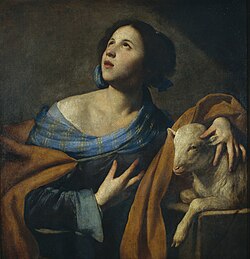
Memorial of Saint Agnes, Virgin and Martyr
Liturgical Color: Red
Rosary Mysteries: Glorious Mysteries
“It is wrong for the bride to keep the bridegroom waiting. He who chose me first shall be the only one to have me. What are you waiting for, Executioner? Destroy this body, for unwanted eyes desire it”
Saint Agnes
est. 291 – est. January 21, 304
Patron of girls, virgins, and rape victims

Daily Readings
First Reading: 1 Samuel 17: 32-33, 37, 40-51
32 And when he was brought to him, he said to him: Let not any man’s heart be dismayed in him: I thy servant will go, and will fight against the Philistine.
33 And Saul said to David: Thou art not able to withstand this Philistine, nor to fight against him: for thou art but a boy, but he is a warrior from his youth.
37 And David said: The Lord who delivered me out of the paw of the lion, and out of the paw of the bear, he will deliver me out of the hand of this Philistine. And Saul said to David: Go, and the Lord be with thee.
40 And he took his staff, which he had always in his hands: and chose him five smooth stones out of the brook, and put them into the shepherd’s scrip, which he had with him, and he took a sling in his hand, and went forth against the Philistine.
41 And the Philistine came on, and drew nigh against David, and his armourbearer before him.
42 And when the Philistine looked, and beheld David, he despised him. For he was a young man, ruddy, and of a comely countenance.
43 And the Philistine said to David: Am I a dog, that thou comest to me with a staff? And the Philistine cursed David by his gods.
44 And he said to David: Come to me, and I will give thy flesh to the birds of the air, and to the beasts of the earth.
45 And David said to the Philistine: Thou comest to me with a sword, and with a spear, and with a shield: but I come to thee in the name of the Lord of hosts, the God of the armies of Israel, which thou hast defied.
46 This day, and the Lord will deliver thee into my hand, and I will slay thee, and take away thy head from thee: and I will give the carcasses of the army of the Philistines this day to the birds of the air, and to the beasts of the earth: that all the earth may know that there is a God in Israel.
47 And all this assembly shall know, that the Lord saveth not with sword and spear: for it is his battle, and he will deliver you into our hands.
48 And when the Philistine arose and was coming, and drew nigh to meet David, David made haste, and ran to the fight to meet the Philistine.
49 And he put his hand into his scrip, and took a stone, and cast it with the sling, and fetching it about struck the Philistine in the forehead: and the stone was fixed in his forehead, and he fell on his face upon the earth.
50 And David prevailed over the Philistine, with a sling and a stone, and he struck, and slew the Philistine. And as David had no sword in his hand,
51 He ran, and stood over the Philistine, and took his sword, and drew it out of the sheath, and slew him, and cut off his head. And the Philistines seeing that their champion was dead, fled away.
32 Ad quem cum fuisset adductus, locutus est ei: Non concidat cor cujusquam in eo: ego servus tuus vadam, et pugnabo adversus Philisthæum.
33 Et ait Saul ad David: Non vales resistere Philisthæo isti, nec pugnare adversus eum, quia puer es: hic autem vir bellator est ab adolescentia sua.
37 Et ait David: Dominus qui eripuit me de manu leonis, et de manu ursi, ipse me liberabit de manu Philisthæi hujus. Dixit autem Saul ad David: Vade, et Dominus tecum sit.
40 et tulit baculum suum, quem semper habebat in manibus: et elegit sibi quinque limpidissimos lapides de torrente, et misit eos in peram pastoralem quam habebat secum, et fundam manu tulit: et processit adversum Philisthæum.
41 Ibat autem Philisthæus incedens, et appropinquans adversum David, et armiger ejus ante eum.
42 Cumque inspexisset Philisthæus, et vidisset David, despexit eum. Erat enim adolescens, rufus, et pulcher aspectu.
43 Et dixit Philisthæus ad David: Numquid ego canis sum, quod tu venis ad me cum baculo? Et maledixit Philisthæus David in diis suis:
44 dixitque ad David: Veni ad me, et dabo carnes tuas volatilibus cæli et bestiis terræ.
45 Dixit autem David ad Philisthæum: Tu venis ad me cum gladio, et hasta, et clypeo: ego autem venio ad te in nomine Domini exercituum, Dei agminum Israël quibus exprobrasti
46 hodie, et dabit te Dominus in manu mea, et percutiam te, et auferam caput tuum a te: et dabo cadavera castrorum Philisthiim hodie volatilibus cæli, et bestiis terræ, ut sciat omnis terra quia est Deus in Israël,
47 et noverit universa ecclesia hæc, quia non in gladio nec in hasta salvat Dominus: ipsius enim est bellum, et tradet vos in manus nostras.
48 Cum ergo surrexisset Philisthæus, et veniret, et appropinquaret contra David, festinavit David et cucurrit ad pugnam ex adverso Philisthæi.
49 Et misit manum suam in peram, tulitque unum lapidem, et funda jecit, et circumducens percussit Philisthæum in fronte: et infixus est lapis in fronte ejus, et cecidit in faciem suam super terram.
50 Prævaluitque David adversum Philisthæum in funda et lapide, percussumque Philisthæum interfecit. Cumque gladium non haberet in manu David,
51 cucurrit, et stetit super Philisthæum, et tulit gladium ejus, et eduxit eum de vagina sua: et interfecit eum, præciditque caput ejus. Videntes autem Philisthiim quod mortuus esset fortissimus eorum, fugerunt.
Gospel: Mark 3: 1-6
1 And he entered again into the synagogue, and there was a man there who had a withered hand.
2 And they watched him whether he would heal on the sabbath days; that they might accuse him.
3 And he said to the man who had the withered hand: Stand up in the midst.
4 And he saith to them: Is it lawful to do good on the sabbath days, or to do evil? to save life, or to destroy? But they held their peace.
5 And looking round about on them with anger, being grieved for the blindness of their hearts, he saith to the man: Stretch forth thy hand. And he stretched it forth: and his hand was restored unto him.
6 And the Pharisees going out, immediately made a consultation with the Herodians against him, how they might destroy him.
1 Et introivit iterum in synagogam: et erat ibi homo habens manum aridam.
2 Et observabant eum, si sabbatis curaret, ut accusarent illum.
3 Et ait homini habenti manum aridam: Surge in medium.
4 Et dicit eis: Licet sabbatis benefacere, an male? animam salvam facere, an perdere? At illi tacebant.
5 Et circumspiciens eos cum ira, contristatus super cæcitate cordis eorum, dicit homini: Extende manum tuam. Et extendit, et restituta est manus illi.
6 Exeuntes autem pharisæi, statim cum Herodianis consilium faciebant adversus eum quomodo eum perderent.

A Daily Question from the Summa Theologica
Whether Christ should have preached not only to the Jews, but also to the Gentiles? (Article 1 of 4 of Question 42. Of Christ’s Doctrine from the Treatise on the Incarnation)
Objection 1: It would seem that Christ should have preached not only to the Jews, but also to the Gentiles. For it is written (Is. 49:6): “It is a small thing that thou shouldst be My servant to raise up the tribes of Israel [Vulg.: ‘Jacob’] and to convert the dregs of Jacob [Vulg.: ‘Israel’]: behold, I have given thee to be the light of the Gentiles, that thou mayest be my salvation even to the farthest part of the earth.” But Christ gave light and salvation through His doctrine. Therefore it seems that it was “a small thing” that He preached to Jews alone, and not to the Gentiles.
Objection 2: Further, as it is written (Mat. 7:29): “He was teaching them as one having power.” Now the power of doctrine is made more manifest in the instruction of those who, like the Gentiles, have received no tidings whatever; hence the Apostle says (Rom. 15:20): “I have so preached the [Vulg.: ‘this’] gospel, not where Christ was named, lest I should build upon another man’s foundation.” Therefore much rather should Christ have preached to the Gentiles than to the Jews.
Objection 3: Further, it is more useful to instruct many than one. But Christ instructed some individual Gentiles, such as the Samaritan woman (Jn. 4) and the Chananaean woman (Mat. 15). Much more reason, therefore, was there for Christ to preach to the Gentiles in general.
On the contrary, our Lord said (Mat. 15:24): “I was not sent but to the sheep that are lost of the house of Israel.” And (Rom. 10:15) it is written: “How shall they preach unless they be sent?” Therefore Christ should not have preached to the Gentiles.
I answer that, It was fitting that Christ’s preaching, whether through Himself or through His apostles, should be directed at first to the Jews alone. First, in order to show that by His coming the promises were fulfilled which had been made to the Jews of old, and not to the Gentiles. Thus the Apostle says (Rom. 15:8): “I say that Christ . . . was minister of the circumcision,” i.e. the apostle and preacher of the Jews, “for the truth of God, to confirm the promises made unto the fathers.”
Secondly, in order to show that His coming was of God; because, as is written Rom. 13:1: “Those things which are of God are well ordered [Vulg.: ‘those that are, are ordained of God’]” [*See Scriptural Index on this passage]. Now the right order demanded that the doctrine of Christ should be made known first to the Jews, who, by believing in and worshiping one God, were nearer to God, and that it should be transmitted through them to the Gentiles: just as in the heavenly hierarchy the Divine enlightenment comes to the lower angels through the higher. Hence on Mat. 15:24, “I was not sent but to the sheep that are lost in the house of Israel,” Jerome says: “He does not mean by this that He was not sent to the Gentiles, but that He was sent to the Jews first.” And so we read (Is. 66:19): “I will send of them that shall be saved,” i.e. of the Jews, “to the Gentiles . . . and they shall declare My glory unto the Gentiles.”
Thirdly, in order to deprive the Jews of ground for quibbling. Hence on Mat. 10:5, “Go ye not into the way of the Gentiles.” Jerome says: “It behooved Christ’s coming to be announced to the Jews first, lest they should have a valid excuse, and say that they had rejected our Lord because He had sent His apostles to the Gentiles and Samaritans.”
Fourthly, because it was through the triumph of the cross that Christ merited power and lordship over the Gentiles. Hence it is written (Rev. 2:26, 28): “He that shall overcome . . . I will give him power over the nations . . . as I also have received of My Father”; and that because He became “obedient unto the death of the cross, God hath exalted Him . . . that in the name of Jesus every knee should bow . . .” and that “every tongue should confess Him” (Phil. 2:8-11). Consequently He did not wish His doctrine to be preached to the Gentiles before His Passion: it was after His Passion that He said to His disciples (Mat. 28:19): “Going, teach ye all nations.” For this reason it was that when, shortly before His Passion, certain Gentiles wished to see Jesus, He said: “Unless the grain of wheat falling into the ground dieth, itself remaineth alone: but if it die it bringeth forth much fruit” (Jn. 12:20-25); and as Augustine says, commenting on this passage: “He called Himself the grain of wheat that must be mortified by the unbelief of the Jews, multiplied by the faith of the nations.”
Reply to Objection 1: Christ was given to be the light and salvation of the Gentiles through His disciples, whom He sent to preach to them.
Reply to Objection 2: It is a sign, not of lesser, but of greater power to do something by means of others rather than by oneself. And thus the Divine power of Christ was specially shown in this, that He bestowed on the teaching of His disciples such a power that they converted the Gentiles to Christ, although these had heard nothing of Him.
Now the power of Christ’s teaching is to be considered in the miracles by which He confirmed His doctrine, in the efficacy of His persuasion, and in the authority of His words, for He spoke as being Himself above the Law when He said: “But I say to you” (Matt. 5:22, 28, 32, 34, 39, 44); and, again, in the force of His righteousness shown in His sinless manner of life.
Reply to Objection 3: Just as it was unfitting that Christ should at the outset make His doctrine known to the Gentiles equally with the Jews, in order that He might appear as being sent to the Jews, as to the first-born people; so neither was it fitting for Him to neglect the Gentiles altogether, lest they should be deprived of the hope of salvation. For this reason certain individual Gentiles were admitted, on account of the excellence of their faith and devotedness.
Continue reading the rest of the articles on Sacred Texts Archive website.