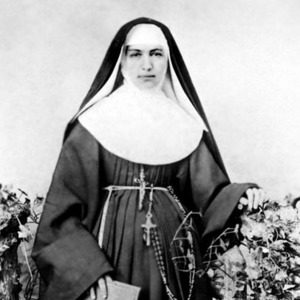
Optional Memorials of Saint Vincent, Deacon and Martyr and Saint Marianne Cope, Virgin
Liturgical Color: Green / Red / White
Rosary Mysteries: Sorrowful Mysteries
“I am hungry for the work, and I wish with all my heart to be one of the chosen ones, whose privilege it will be to sacrifice themselves for the salvation of the souls of the poor Islanders… I am not afraid of any disease, hence, it would be my greatest delight even to minister to the abandoned ‘lepers.’”
Saint Marianne Cope
January 23, 1838 – August 9, 1918
Patron of lepers, outcasts, those with HIV/AIDS, Hawaii

Daily Readings
First Reading: 1 Samuel 24: 3-21
3 Saul therefore took three thousand chosen men out of all Israel, and went out to seek after David, and his men, even upon the most craggy rocks, which are accessible only to wild goats.
4 And he came to the sheepcotes, which were in his way. And there was a cave, into which Saul went, to ease nature: now David and his men lay hid in the inner part of the cave.
5 And the servants of David said to him: Behold the day, of which the Lord said to thee: I will deliver thy enemy unto thee, that thou mayest do to him as it shall seem good in thy eyes. Then David arose, and secretly cut off the hem of Saul’s robe.
6 After which David’s heart struck him, because he had cut off the hem of Saul’s robe.
7 And he said to his men: The Lord be merciful unto me, that I may do no such thing to my master the Lord’s anointed, as to lay my hand upon him, because he is the Lord’s anointed.
8 And David stopped his men with his words, and suffered them not to rise against Saul. But Saul rising up out of the cave, went on his way.
9 And David also rose up after him: and going out of the cave cried after Saul, saying: My lord the king. And Saul looked behind him: and David bowing himself down to the ground, worshipped,
10 And said to Saul: Why dost thou hear the words of men that say David seeketh thy hurt?
11 Behold this day thy eyes have seen, that the Lord hath delivered thee into my hand, in the cave, and I had a thought to kill thee, but my eye hath spared thee. For I said: I will not put out my hand against my lord, because he is the Lord’s anointed.
12 Moreover see and know, O my father, the hem of thy robe in my hand, that when I cut, off the hem of thy robe, I would not put out my hand against thee. Reflect, and see, that there is no evil in my hand, nor iniquity, neither have I sinned against thee: but thou liest in wait for my life, to take it away.
13 The Lord judge between me and thee, and the Lord revenge me of thee: but my hand shall not be upon thee.
14 As also it is said in the old proverb: From the wicked shall wickedness come forth: therefore my hand shall not be upon thee. After whom dost thou come out, O king of Israel?
15 After whom dost thou pursue? After a dead dog, after a flea.
16 Be the Lord judge, and judge between me and thee, and see, and judge my cause, and deliver me out of thy hand.
17 And when David had made an end of speaking these words to Saul, Saul said: Is this thy voice, my son David? And Saul lifted up his voice, and wept.
18 And he said to David: Thou art more just than I: for thou hast done good to me, and I have rewarded thee with evil.
19 And thou hast shewn this day what good things thou hast done to me: how the Lord delivered me into thy hand, and thou hast not killed me.
20 For who when he hath found his enemy, will let him go well away? But the Lord reward thee for this good turn, for what thou hast done to me this day.
21 And now as I know that thou shalt surely be king, and have the kingdom of Israel in thy hand
3 Assumens ergo Saul tria millia electorum virorum ex omni Israël, perrexit ad investigandum David et viros ejus, etiam super abruptissimas petras, quæ solis ibicibus perviæ sunt.
4 Et venit ad caulas ovium, quæ se offerebant vianti: eratque ibi spelunca, quam ingressus est Saul ut purgaret ventrem: porro David et viri ejus in interiore parte speluncæ latebant.
5 Et dixerunt servi David ad eum: Ecce dies de qua locutus est Dominus ad te: Ego tradam tibi inimicum tuum, ut facias ei sicut placuerit in oculis tuis. Surrexit ergo David, et præcidit oram chlamydis Saul silenter.
6 Post hæc percussit cor suum David, eo quod abscidisset oram chlamydis Saul.
7 Dixitque ad viros suos: Propitius sit mihi Dominus, ne faciam hanc rem domino meo, christo Domini, ut mittam manum meam in eum: quia christus Domini est.
8 Et confregit David viros suos sermonibus, et non permisit eos ut consurgerent in Saul: porro Saul exsurgens de spelunca, pergebat cœpto itinere.
9 Surrexit autem et David post eum: et egressus de spelunca, clamavit post tergum Saul, dicens: Domine mi rex. Et respexit Saul post se: et inclinans se David pronus in terram adoravit,
10 dixitque ad Saul: Quare audis verba hominum loquentium: David quærit malum adversum te?
11 Ecce hodie viderunt oculi tui quod tradiderit te Dominus in manu mea in spelunca: et cogitavi ut occiderem te, sed pepercit tibi oculus meus: dixi enim: Non extendam manum meam in dominum meum, quia christus Domini est.
12 Quin potius pater mi, vide, et cognosce oram chlamydis tuæ in manu mea: quoniam cum præscinderem summitatem chlamydis tuæ, nolui extendere manum meam in te: animadverte, et vide, quoniam non est in manu mea malum, neque iniquitas, neque peccavi in te: tu autem insidiaris animæ meæ ut auferas eam.
13 Judicet Dominus inter me et te, et ulciscatur me Dominus ex te: manus autem mea non sit in te.
14 Sicut et in proverbio antiquo dicitur: Ab impiis egredietur impietas: manus ergo mea non sit in te.
15 Quem persequeris, rex Israël? quem persequeris? canem mortuum persequeris, et pulicem unum.
16 Sit Dominus judex, et judicet inter me et te: et videat, et judicet causam meam, et eruat me de manu tua.
17 Cum autem complesset David loquens sermones hujuscemodi ad Saul, dixit Saul: Numquid vox hæc tua est, fili mi David? Et levavit Saul vocem suam, et flevit:
18 dixitque ad David: Justior tu es quam ego: tu enim tribuisti mihi bona, ego autem reddidi tibi mala.
19 Et tu indicasti hodie quæ feceris mihi bona: quomodo tradiderit me Dominus in manum tuam, et non occideris me.
20 Quis enim cum invenerit inimicum suum, dimittet eum in via bona? sed Dominus reddat tibi vicissitudinem hanc pro eo quod hodie operatus es in me.
21 Et nunc quia scio quod certissime regnaturus sis, et habiturus in manu tua regnum Israël
Gospel: Mark 3: 13-19
13 And going up into a mountain, he called unto him whom he would himself: and they came to him.
14 And he made that twelve should be with him, and that he might send them to preach.
15 And he gave them power to heal sicknesses, and to cast out devils.
16 And to Simon he gave the name Peter:
17 And James the son of Zebedee, and John the brother of James; and he named them Boanerges, which is, The sons of thunder:
18 And Andrew and Philip, and Bartholomew and Matthew, and Thomas and James of Alpheus, and Thaddeus, and Simon the Cananean:
19 And Judas Iscariot, who also betrayed him.
13 Et ascendens in montem vocavit ad se quos voluit ipse: et venerunt ad eum.
14 Et fecit ut essent duodecim cum illo: et ut mitteret eos prædicare.
15 Et dedit illis potestatem curandi infirmitates et ejiciendi dæmonia.
16 Et imposuit Simoni nomen Petrus:
17 et Jacobum Zebedæi, et Joannem fratrem Jacobi, et imposuit eis nomina Boanerges, quod est, Filii tonitrui:
18 et Andræam, et Philippum, et Bartholomæum, et Matthæum, et Thomam, et Jacobum Alphæi, et Thaddæum, et Simonem Cananæum,
19 et Judam Iscariotem, qui et tradidit illum.

A Daily Question from the Summa Theologica
Whether Christ should have taught all things openly? (Article 3 of 4 of Question 42. Of Christ’s Doctrine from the Treatise on the Incarnation)
Objection 1: It would seem that Christ should not have taught all things openly. For we read that He taught many things to His disciples apart: as is seen clearly in the sermon at the Supper. Wherefore He said: “That which you heard in the ear in the chambers shall be preached on the housetops” [*St. Thomas, probably quoting from memory, combines Mat. 10:27 with Lk. 12:3]. Therefore He did not teach all things openly.
Objection 2: Further, the depths of wisdom should not be expounded save to the perfect, according to 1 Cor. 2:6: “We speak wisdom among the perfect.” Now Christ’s doctrine contained the most profound wisdom. Therefore it should not have been made known to the imperfect crowd.
Objection 3: Further, it comes to the same, to hide the truth, whether by saying nothing or by making use of a language that is difficult to understand. Now Christ, by speaking to the multitudes a language they would not understand, hid from them the truth that He preached; since “without parables He did not speak to them” (Mat. 13:34). In the same way, therefore, He could have hidden it from them by saying nothing at all.
On the contrary, He says Himself (Jn. 18:20): “In secret I have spoken nothing.”
I answer that, Anyone’s doctrine may be hidden in three ways. First, on the part of the intention of the teacher, who does not wish to make his doctrine known to many, but rather to hide it. And this may happen in two ways—sometimes through envy on the part of the teacher, who desires to excel in his knowledge, wherefore he is unwilling to communicate it to others. But this was not the case with Christ, in whose person the following words are spoken (Wis. 7:13): “Which I have learned without guile, and communicate without envy, and her riches I hide not.” But sometimes this happens through the vileness of the things taught; thus Augustine says on Jn. 16:12: “There are some things so bad that no sort of human modesty can bear them.” Wherefore of heretical doctrine it is written (Prov. 9:17): “Stolen waters are sweeter.” Now, Christ’s doctrine is “not of error nor of uncleanness” (1 Thess. 2:3). Wherefore our Lord says (Mk. 4:21): “Doth a candle,” i.e. true and pure doctrine, “come in to be put under a bushel?”
Secondly, doctrine is hidden because it is put before few. And thus, again, did Christ teach nothing in secret: for He propounded His entire doctrine either to the whole crowd or to His disciples gathered together. Hence Augustine says on Jn. 18:20: “How can it be said that He speaks in secret when He speaks before so many men? . . . especially if what He says to few He wishes through them to be made known to many?”
Thirdly, doctrine is hidden, as to the manner in which it is propounded. And thus Christ spoke certain things in secret to the crowds, by employing parables in teaching them spiritual mysteries which they were either unable or unworthy to grasp: and yet it was better for them to be instructed in the knowledge of spiritual things, albeit hidden under the garb of parables, than to be deprived of it altogether. Nevertheless our Lord expounded the open and unveiled truth of these parables to His disciples, so that they might hand it down to others worthy of it; according to 2 Tim. 2:2: “The things which thou hast heard of me by many witnesses, the same command to faithful men, who shall be fit to teach others.” This is foreshadowed, Num. 4, where the sons of Aaron are commanded to wrap up the sacred vessels that were to be carried by the Levites.
Reply to Objection 1: As Hilary says, commenting on the passage quoted, “we do not read that our Lord was wont to preach at night, and expound His doctrine in the dark: but He says this because His speech is darkness to the carnal-minded, and His words are night to the unbeliever. His meaning, therefore, is that whatever He said we also should say in the midst of unbelievers, by openly believing and professing it.”
Or, according to Jerome, He speaks comparatively—that is to say, because He was instructing them in Judea, which was a small place compared with the whole world, where Christ’s doctrine was to be published by the preaching of the apostles.
Reply to Objection 2: By His doctrine our Lord did not make known all the depths of His wisdom, neither to the multitudes, nor, indeed, to His disciples, to whom He said (Jn. 16:12): “I have yet many things to say to you, but you cannot bear them now.” Yet whatever things out of His wisdom He judged it right to make known to others, He expounded, not in secret, but openly; although He was not understood by all. Hence Augustine says on Jn. 18:20: “We must understand this, ‘I have spoken openly to the world,’ as though our Lord had said, ‘Many have heard Me’ . . . and, again, it was not ‘openly,’ because they did not understand.”
Reply to Objection 3: As stated above, our Lord spoke to the multitudes in parables, because they were neither able nor worthy to receive the naked truth, which He revealed to His disciples.
And when it is said that “without parables He did not speak to them,” according to Chrysostom (Hom. xlvii in Matth.), we are to understand this of that particular sermon, since on other occasions He said many things to the multitude without parables. Or, as Augustine says (De Qq. Evang., qu. xvii), this means, “not that He spoke nothing literally, but that He scarcely ever spoke without introducing a parable, although He also spoke some things in the literal sense.”
Continue reading the rest of the articles on Sacred Texts Archive website.