Third Sunday of Ordinary Time
Liturgical Color: Green
Rosary Mysteries: Glorious Mysteries

Daily Readings
First Reading: Isaiah 8:23 – 9:3
1 At the first time the land of Zabulon, and the land of Nephtali was lightly touched: and at the last the way of the sea beyond the Jordan of the Galilee of the Gentiles was heavily loaded.
2 The people that walked in darkness, have seen a great light: to them that dwelt in the region of the shadow of death, light is risen.
3 Thou hast multiplied the nation, and hast not increased the joy. They shall rejoice before thee, as they that rejoice in the harvest, as conquerors rejoice after taking a prey, when they divide the spoils.
1 [Primo tempore alleviata est
terra Zabulon et terra Nephthali:
et novissimo aggravata est via maris
trans Jordanem Galilææ gentium.
2 Populus qui ambulabat in tenebris,
vidit lucem magnam;
habitantibus in regione umbræ mortis,
lux orta est eis.
3 Multiplicasti gentem,
et non magnificasti lætitiam.
Lætabuntur coram te, sicut qui lætantur in messe;
sicut exsultant victores capta præda, quando dividunt spolia.
Second Reading: 1 Corinthians 1: 10-13, 17
10 Now I beseech you, brethren, by the name of our Lord Jesus Christ, that you all speak the same thing, and that there be no schisms among you; but that you be perfect in the same mind, and in the same judgment.
11 For it hath been signified unto me, my brethren, of you, by them that are of the house of Chloe, that there are contentions among you.
12 Now this I say, that every one of you saith: I indeed am of Paul; and I am of Apollo; and I am of Cephas; and I of Christ.
13 Is Christ divided? Was Paul then crucified for you? or were you baptized in the name of Paul?
17 For Christ sent me not to baptize, but to preach the gospel: not in wisdom of speech, lest the cross of Christ should be made void.
10 Obsecro autem vos fratres per nomen Domini nostri Jesu Christi: ut idipsum dicatis omnes, et non sint in vobis schismata: sitis autem perfecti in eodem sensu, et in eadem sententia.
11 Significatum est enim mihi de vobis fratres mei ab iis, qui sunt Chloës, quia contentiones sunt inter vos.
12 Hoc autem dico, quod unusquisque vestrum dicit: Ego quidem sum Pauli: ego autem Apollo: ego vero Cephæ: ego autem Christi.
13 Divisus est Christus? numquid Paulus crucifixus est pro vobis? aut in nomine Pauli baptizati estis?
17 Non enim misit me Christus baptizare, sed evangelizare: non in sapientia verbi, ut non evacuetur crux Christi.
Gospel: Matthew 4: 12-23
12 And when Jesus had heard that John was delivered up, he retired into Galilee:
13 And leaving the city Nazareth, he came and dwelt in Capharnaum on the sea coast, in the borders of Zabulon and Nephthalim;
14 That it might be fulfilled which was said by Isaias the prophet:
15 Land of Zabulon and land of Nephthalim, the way of the sea beyond the Jordan, Galilee of the Gentiles:
16 The people that sat in darkness, hath seen great light: and to them that sat in the region of the shadow of death, light is sprung up.
17 From that time Jesus began to preach, and to say: Do penance, for the kingdom of heaven is at hand.
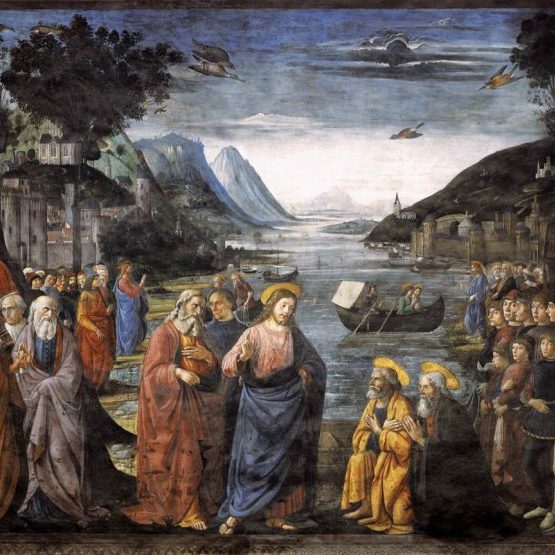
18 And Jesus walking by the sea of Galilee, saw two brethren, Simon who is called Peter, and Andrew his brother, casting a net into the sea (for they were fishers).
19 And he saith to them: Come ye after me, and I will make you to be fishers of men.
20 And they immediately leaving their nets, followed him.
21 And going on from thence, he saw other two brethren, James the son of Zebedee, and John his brother, in a ship with Zebedee their father, mending their nets: and he called them.
22 And they forthwith left their nets and father, and followed him.
23 And Jesus went about all Galilee, teaching in their synagogues, and preaching the gospel of the kingdom: and healing all manner of sickness and every infirmity, among the people.
12 Cum autem audisset Jesus quod Joannes traditus esset, secessit in Galilæam:
13 et, relicta civitate Nazareth, venit, et habitavit in Capharnaum maritima, in finibus Zabulon et Nephthalim:
14 ut adimpleretur quod dictum est per Isaiam prophetam:
15 [Terra Zabulon, et terra Nephthalim,
via maris trans Jordanem,
Galilæa gentium:
16 populus, qui sedebat in tenebris,
vidit lucem magnam:
et sedentibus in regione umbræ mortis,
lux orta est eis.]
17 Exinde cœpit Jesus prædicare, et dicere: Pœnitentiam agite: appropinquavit enim regnum cælorum.
18 Ambulans autem Jesus juxta mare Galilææ, vidit duos fratres, Simonem, qui vocatur Petrus, et Andream fratrem ejus, mittentes rete in mare (erant enim piscatores),
19 et ait illis: Venite post me, et faciam vos fieri piscatores hominum.
20 At illi continuo relictis retibus secuti sunt eum.
21 Et procedens inde, vidit alios duos fratres, Jacobum Zebedæi, et Joannem fratrem ejus, in navi cum Zebedæo patre eorum, reficientes retia sua: et vocavit eos.
22 Illi autem statim relictis retibus et patre, secuti sunt eum.
23 Et circuibat Jesus totam Galilæam, docens in synagogis eorum, et prædicans Evangelium regni: et sanans omnem languorem, et omnem infirmitatem in populo.

A Daily Question from the Summa Theologica
Whether sacraments are necessary for man’s salvation? (Article 1 of 4 of Question 61. Of the Necessity of the Sacraments from the Treatise on the Sacraments)
Objection 1: It seems that sacraments are not necessary for man’s salvation. For the Apostle says (1 Tim. 4:8): “Bodily exercise is profitable to little.” But the use of sacraments pertains to bodily exercise; because sacraments are perfected in the signification of sensible things and words, as stated above (Q[60], A[6]). Therefore sacraments are not necessary for the salvation of man.
Objection 2: Further, the Apostle was told (2 Cor. 12:9): “My grace is sufficient for thee.” But it would not suffice if sacraments were necessary for salvation. Therefore sacraments are not necessary for man’s salvation.
Objection 3: Further, given a sufficient cause, nothing more seems to be required for the effect. But Christ’s Passion is the sufficient cause of our salvation; for the Apostle says (Rom. 5:10): “If, when we were enemies, we were reconciled to God by the death of His Son: much more, being reconciled, shall we be saved by His life.” Therefore sacraments are not necessary for man’s salvation.
On the contrary, Augustine says (Contra Faust. xix): “It is impossible to keep men together in one religious denomination, whether true or false, except they be united by means of visible signs or sacraments.” But it is necessary for salvation that men be united together in the name of the one true religion. Therefore sacraments are necessary for man’s salvation.
I answer that, Sacraments are necessary unto man’s salvation for three reasons. The first is taken from the condition of human nature which is such that it has to be led by things corporeal and sensible to things spiritual and intelligible. Now it belongs to Divine providence to provide for each one according as its condition requires. Divine wisdom, therefore, fittingly provides man with means of salvation, in the shape of corporeal and sensible signs that are called sacraments.
The second reason is taken from the state of man who in sinning subjected himself by his affections to corporeal things. Now the healing remedy should be given to a man so as to reach the part affected by disease. Consequently it was fitting that God should provide man with a spiritual medicine by means of certain corporeal signs; for if man were offered spiritual things without a veil, his mind being taken up with the material world would be unable to apply itself to them.
The third reason is taken from the fact that man is prone to direct his activity chiefly towards material things. Lest, therefore, it should be too hard for man to be drawn away entirely from bodily actions, bodily exercise was offered to him in the sacraments, by which he might be trained to avoid superstitious practices, consisting in the worship of demons, and all manner of harmful action, consisting in sinful deeds.
It follows, therefore, that through the institution of the sacraments man, consistently with his nature, is instructed through sensible things; he is humbled, through confessing that he is subject to corporeal things, seeing that he receives assistance through them: and he is even preserved from bodily hurt, by the healthy exercise of the sacraments.
Reply to Objection 1: Bodily exercise, as such, is not very profitable: but exercise taken in the use of the sacraments is not merely bodily, but to a certain extent spiritual, viz. in its signification and in its causality.
Reply to Objection 2: God’s grace is a sufficient cause of man’s salvation. But God gives grace to man in a way which is suitable to him. Hence it is that man needs the sacraments that he may obtain grace.
Reply to Objection 3: Christ’s Passion is a sufficient cause of man’s salvation. But it does not follow that the sacraments are not also necessary for that purpose: because they obtain their effect through the power of Christ’s Passion; and Christ’s Passion is, so to say, applied to man through the sacraments according to the Apostle (Rom. 6:3): “All we who are baptized in Christ Jesus, are baptized in His death.”
Continue reading the rest of the articles on Sacred Texts Archive website.