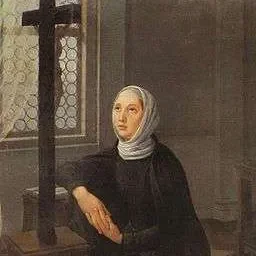
Optional Memorial of Saint Angela Merici, Virgin
Liturgical Color: Green / White
Rosary Mysteries: Sorrowful Mysteries
“He who called you will not desert you, but the moment you are in need he will stretch out his saving hand”
Saint Angela Merici
March 21, 1474 – January 27, 1540
Patron of educators, teachers, the sick, disabled, and physically challenged people, and those grieving the loss of parents

Daily Readings
First Reading: 2 Samuel 6: 12b – 15, 17-19
12 And it was told king David, that the Lord had blessed Obededom, and all that he had, because of the ark of God. So David went, and brought away the ark of God out of the house of Obededom into the city of David with joy. And there were with David seven choirs, and calves for victims.
13 And when they that carried the ark of the Lord had gone six paces, he sacrificed an ox and a ram:
14 And David danced with all his might before the Lord: and David was girded with a linen ephod.
15 And David and all the house of Israel brought the ark of the covenant of the Lord with joyful shouting, and with sound of trumpet.
17 And they brought the ark of the Lord, and set it in its place in the midst of the tabernacle, which David had pitched for it: and David offered holocausts, and peace offerings before the Lord.
18 And when he had made an end of offering holocausts and peace offerings, he blessed the people in the name of the Lord of hosts.
19 And he distributed to all the multitude of Israel both men and women, to every one, a cake of bread, and a piece of roasted beef, and fine flour fried with oil: and all the people departed every one to his house.
12 Nuntiatumque est regi David quod benedixisset Dominus Obededom, et omnia ejus, propter arcam Dei. Abiit ergo David, et adduxit arcam Dei de domo Obededom in civitatem David cum gaudio: et erant cum David septem chori, et victima vituli.
13 Cumque transcendissent qui portabant arcam Domini sex passus, immolabat bovem et arietem,
14 et David saltabat totis viribus ante Dominum: porro David erat accinctus ephod lineo.
15 Et David et omnis domus Israël ducebant arcam testamenti Domini in jubilo, et in clangore buccinæ.
17 Et introduxerunt arcam Domini, et imposuerunt eam in loco suo in medio tabernaculi, quod tetenderat ei David: et obtulit David holocausta et pacifica coram Domino.
18 Cumque complesset offerens holocausta et pacifica, benedixit populo in nomine Domini exercituum.
19 Et partitus est universæ multitudini Israël tam viro quam mulieri singulis collyridam panis unam, et assaturam bubulæ carnis unam, et similam frixam oleo: et abiit omnis populus, unusquisque in domum suam.
Gospel: Mark 3: 31-35
31 And his mother and his brethren came; and standing without, sent unto him, calling him.
32 And the multitude sat about him; and they say to him: Behold thy mother and thy brethren without seek for thee.
33 And answering them, he said: Who is my mother and my brethren?
34 And looking round about on them who sat about him, he saith: Behold my mother and my brethren.
35 For whosoever shall do the will of God, he is my brother, and my sister, and mother.
31 Et veniunt mater ejus et fratres: et foris stantes miserunt ad eum vocantes eum,
32 et sedebat circa eum turba: et dicunt ei: Ecce mater tua et fratres tui foris quærunt te.
33 Et respondens eis, ait: Quæ est mater mea et fratres mei?
34 Et circumspiciens eos, qui in circuitu ejus sedebant, ait: Ecce mater mea et fratres mei.
35 Qui enim fecerit voluntatem Dei, hic frater meus, et soror mea, et mater est.

A Daily Question from the Summa Theologica
Whether there should have been sacraments after sin, before Christ? (Article 3 of 4 of Question 61. Of the Necessity of the Sacraments from the Treatise on the Sacraments)
Objection 1: It seems that there should have been no sacraments after sin, before Christ. For it has been stated that the Passion of Christ is applied to men through the sacraments: so that Christ’s Passion is compared to the sacraments as cause to effect. But effect does not precede cause. Therefore there should have been no sacraments before Christ’s coming.
Objection 2: Further, sacraments should be suitable to the state of the human race, as Augustine declares (Contra Faust. xix). But the state of the human race underwent no change after sin until it was repaired by Christ. Neither, therefore, should the sacraments have been changed, so that besides the sacraments of the natural law, others should be instituted in the law of Moses.
Objection 3: Further, the nearer a thing approaches to that which is perfect, the more like it should it be. Now the perfection of human salvation was accomplished by Christ; to Whom the sacraments of the Old Law were nearer than those that preceded the Law. Therefore they should have borne a greater likeness to the sacraments of Christ. And yet the contrary is the case, since it was foretold that the priesthood of Christ would be “according to the order of Melchisedech, and not . . . according to the order of Aaron” (Heb. 7:11). Therefore sacraments were unsuitably instituted before Christ.
On the contrary, Augustine says (Contra Faust. xix) that “the first sacraments which the Law commanded to be solemnized and observed were announcements of Christ’s future coming.” But it was necessary for man’s salvation that Christ’s coming should be announced beforehand. Therefore it was necessary that some sacraments should be instituted before Christ.
I answer that, Sacraments are necessary for man’s salvation, in so far as they are sensible signs of invisible things whereby man is made holy. Now after sin no man can be made holy save through Christ, “Whom God hath proposed to be a propitiation, through faith in His blood, to the showing of His justice . . . that He Himself may be just, and the justifier of him who is of the faith of Jesus Christ” (Rom. 3:25, 26). Therefore before Christ’s coming there was need for some visible signs whereby man might testify to his faith in the future coming of a Saviour. And these signs are called sacraments. It is therefore clear that some sacraments were necessary before Christ’s coming.
Reply to Objection 1: Christ’s Passion is the final cause of the old sacraments: for they were instituted in order to foreshadow it. Now the final cause precedes not in time, but in the intention of the agent. Consequently, there is no reason against the existence of sacraments before Christ’s Passion.
Reply to Objection 2: The state of the human race after sin and before Christ can be considered from two points of view. First, from that of faith: and thus it was always one and the same: since men were made righteous, through faith in the future coming of Christ. Secondly, according as sin was more or less intense, and knowledge concerning Christ more or less explicit. For as time went on sin gained a greater hold on man, so much so that it clouded man’s reason, the consequence being that the precepts of the natural law were insufficient to make man live aright, and it became necessary to have a written code of fixed laws, and together with these certain sacraments of faith. For it was necessary, as time went on, that the knowledge of faith should be more and more unfolded, since, as Gregory says (Hom. vi in Ezech.): “With the advance of time there was an advance in the knowledge of Divine things.” Consequently in the old Law there was also a need for certain fixed sacraments significative of man’s faith in the future coming of Christ: which sacraments are compared to those that preceded the Law, as something determinate to that which is indeterminate: inasmuch as before the Law it was not laid down precisely of what sacraments men were to make use: whereas this was prescribed by the Law; and this was necessary both on account of the overclouding of the natural law, and for the clearer signification of faith.
Reply to Objection 3: The sacrament of Melchisedech which preceded the Law is more like the Sacrament of the New Law in its matter: in so far as “he offered bread and wine” (Gn. 14:18), just as bread and wine are offered in the sacrifice of the New Testament. Nevertheless the sacraments of the Mosaic Law are more like the thing signified by the sacrament, i.e. the Passion of Christ: as clearly appears in the Paschal Lamb and such like. The reason of this was lest, if the sacraments retained the same appearance, it might seem to be the continuation of one and the same sacrament, where there was no interruption of time.
Continue reading the rest of the articles on Sacred Texts Archive website.