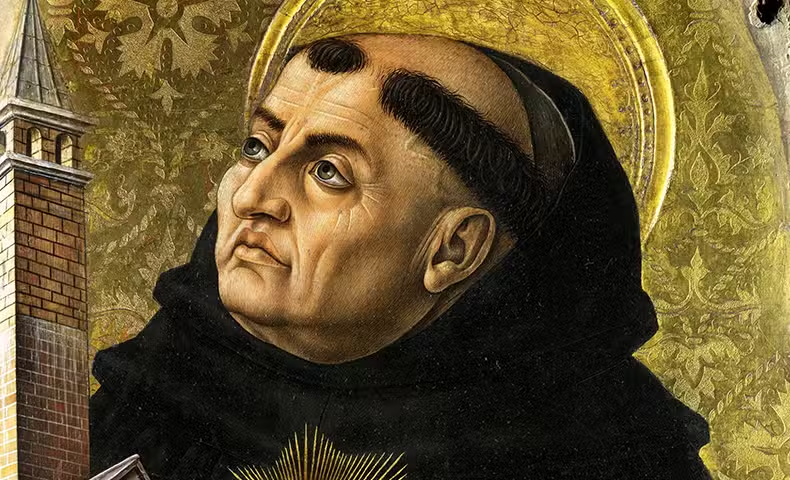
Memorial of Saint Saint Thomas Aquinas, Priest and Doctor of the Church
Liturgical Color: White
Rosary Mysteries: Glorious Mysteries
“It is not necessary for us to set forth our petitions before God in order to make known to Him our needs and desires, but rather that we ourselves may realize that in these things it is necessary to have recourse to God’s assistance.”
Saint Thomas Aquinas
est. 1224/1225 – March 7, 1274
Patron of students, scholars, teachers, theologians, and philosophers

Daily Readings
First Reading: 2 Samuel 7: 4 -17
4 But it came to pass that night, that the word of the Lord came to Nathan, saying:
5 Go, and say to my servant David: Thus saith the Lord: Shalt thou build me a house to dwell in?
6 Whereas I have not dwelt in a house from the day that I brought the children of Israel out of the land of Egypt even to this day: but have walked in a tabernacle, and in a tent.
7 In all the places that I have gone through with all the children of Israel, did ever I speak a word to any one of the tribes of Israel, whom I commanded to feed my people Israel, saying: Why have you not built me a house of cedar?
8 And now thus shalt thou speak to my servant David: Thus saith the Lord of hosts: I took thee out of the pastures from following the sheep to be ruler over my people Israel:
9 And I have been with thee wheresoever thou hast walked, and have slain all thy enemies from before thy face: and I have made thee a great man, like unto the name of the great ones that are on the earth.
10 And I will appoint a place for my people Israel, and I will plant them, and they shall dwell therein, and shall be disturbed no more: neither shall the children of iniquity afflict them any more as they did before,
11 From the day that I appointed judges over my people Israel: and I will give thee rest from all thy enemies. And the Lord foretelleth to thee, that the Lord will make thee a house.
12 And when thy days shall be fulfilled, and thou shalt sleep with thy fathers, I will raise up thy seed after thee, which shall proceed out of thy bowels, and I will establish his kingdom.
13 He shall build a house to my name, and I will establish the throne of his kingdom for ever.
14 I will be to him a father, and he shall be to me a son: and if he commit any iniquity, I will correct him with the rod of men, and with the stripes of the children of men.
15 But my mercy I will not take away from him, as I took it from Saul, whom I removed from before my face.
16 And thy house shall be faithful, and thy kingdom for ever before thy face, and thy throne shall be firm for ever.
17 According to all these words and according to all this vision, so did Nathan speak to David.
4 Factum est autem in illa nocte: et ecce sermo Domini ad Nathan, dicens:
5 Vade, et loquere ad servum meum David: Hæc dicit Dominus: Numquid tu ædificabis mihi domum ad habitandum?
6 Neque enim habitavi in domo ex die illa, qua eduxi filios Israël de terra Ægypti, usque in diem hanc: sed ambulabam in tabernaculo, et in tentorio.
7 Per cuncta loca quæ transivi cum omnibus filiis Israël, numquid loquens locutus sum ad unam de tribubus Israël, cui præcepi ut pasceret populum meum Israël, dicens: Quare non ædificastis mihi domum cedrinam?
8 Et nunc hæc dices servo meo David: Hæc dicit Dominus exercituum: Ego tuli te de pascuis sequentem greges, ut esses dux super populum meum Israël:
9 et fui tecum in omnibus ubicumque ambulasti, et interfeci universos inimicos tuos a facie tua: fecique tibi nomen grande, juxta nomen magnorum qui sunt in terra.
10 Et ponam locum populo meo Israël, et plantabo eum, et habitabit sub eo, et non turbabitur amplius: nec addent filii iniquitatis ut affligant eum sicut prius,
11 ex die qua constitui judices super populum meum Israël: et requiem dabo tibi ab omnibus inimicis tuis: prædicitque tibi Dominus quod domum faciat tibi Dominus.
12 Cumque completi fuerint dies tui, et dormieris cum patribus tuis, suscitabo semen tuum post te, quod egredietur de utero tuo, et firmabo regnum ejus.
13 Ipse ædificabit domum nomini meo, et stabiliam thronum regni ejus usque in sempiternum.
14 Ego ero ei in patrem, et ipse erit mihi in filium: qui si inique aliquid gesserit, arguam eum in virga virorum, et in plagis filiorum hominum.
15 Misericordiam autem meam non auferam ab eo, sicut abstuli a Saul, quem amovi a facie mea.
16 Et fidelis erit domus tua, et regnum tuum usque in æternum ante faciem tuam, et thronus tuus erit firmus jugiter.
17 Secundum omnia verba hæc, et juxta universam visionem istam, sic locutus est Nathan ad David.
Gospel: Mark 4: 1-20
1 And again he began to teach by the sea side; and a great multitude was gathered together unto him, so that he went up into a ship, and sat in the sea; and all the multitude was upon the land by the sea side.
2 And he taught them many things in parables, and said unto them in his doctrine:
3 Hear ye: Behold, the sower went out to sow.
4 And whilst he sowed, some fell by the way side, and the birds of the air came and ate it up.
5 And other some fell upon stony ground, where it had not much earth; and it shot up immediately, because it had no depth of earth.
6 And when the sun was risen, it was scorched; and because it had no root, it withered away.
7 And some fell among thorns; and the thorns grew up, and choked it, and it yielded no fruit.
8 And some fell upon good ground; and brought forth fruit that grew up, and increased and yielded, one thirty, another sixty, and another a hundred.
9 And he said: He that hath ears to hear, let him hear.
10 And when he was alone, the twelve that were with him asked him the parable.
11 And he said to them: To you it is given to know the mystery of the kingdom of God: but to them that are without, all things are done in parables:
12 That seeing they may see, and not perceive; and hearing they may hear, and not understand: lest at any time they should be converted, and their sins should be forgiven them.
13 And he saith to them: Are you ignorant of this parable? and how shall you know all parables?
14 He that soweth, soweth the word.
15 And these are they by the way side, where the word is sown, and as soon as they have heard, immediately Satan cometh and taketh away the word that was sown in their hearts.
16 And these likewise are they that are sown on the stony ground: who when they have heard the word, immediately receive it with joy.
17 And they have no root in themselves, but are only for a time: and then when tribulation and persecution ariseth for the word they are presently scandalized.
18 And others there are who are sown among thorns: these are they that hear the word,
19 And the cares of the world, and the deceitfulness of riches, and the lusts after other things entering in choke the word, and it is made fruitless.
20 And these are they who are sown upon the good ground, who hear the word, and receive it, and yield fruit, the one thirty, another sixty, and another a hundred.
1 Et iterum cœpit docere ad mare: et congregata est ad eum turba multa, ita ut navim ascendens sederet in mari, et omnis turba circa mare super terram erat:
2 et docebat eos in parabolis multa, et dicebat illis in doctrina sua:
3 Audite: ecce exiit seminans ad seminandum.
4 Et dum seminat, aliud cecidit circa viam, et venerunt volucres cæli, et comederunt illud.
5 Aliud vero cecidit super petrosa, ubi non habuit terram multam: et statim exortum est, quoniam non habebat altitudinem terræ:
6 et quando exortus est sol, exæstuavit: et eo quod non habebat radicem, exaruit.
7 Et aliud cecidit in spinas: et ascenderunt spinæ, et suffocaverunt illud, et fructum non dedit.
8 Et aliud cecidit in terram bonam: et dabat fructum ascendentem et crescentem, et afferebat unum triginta, unum sexaginta, et unum centum.
9 Et dicebat: Qui habet aures audiendi, audiat.
10 Et cum esset singularis, interrogaverunt eum hi qui cum eo erant duodecim, parabolam.
11 Et dicebat eis: Vobis datum est nosse mysterium regni Dei: illis autem, qui foris sunt, in parabolis omnia fiunt:
12 ut videntes videant, et non videant: et audientes audiant, et non intelligant: nequando convertantur, et dimittantur eis peccata.
13 Et ait illis: Nescitis parabolam hanc? Et quomodo omnes parabolas cognoscetis?
14 Qui seminat, verbum seminat.
15 Hi autem sunt, qui circa viam, ubi seminatur verbum, et cum audierint, confestim venit Satanas, et aufert verbum, quod seminatum est in cordibus eorum.
16 Et hi sunt similiter, qui super petrosa seminantur: qui cum audierint verbum, statim cum gaudio accipiunt illud:
17 et non habent radicem in se, sed temporales sunt: deinde orta tribulatione et persecutione propter verbum, confestim scandalizantur.
18 Et alii sunt qui in spinas seminantur: hi sunt qui verbum audiunt,
19 et ærumnæ sæculi, et deceptio divitiarum, et circa reliqua concupiscentiæ introëuntes suffocant verbum, et sine fructu efficitur.
20 Et hi sunt qui super terram bonam seminati sunt, qui audiunt verbum, et suscipiunt, et fructificant, unum triginta, unum sexaginta, et unum centum.

A Daily Question from the Summa Theologica
Whether there was need for any sacraments after Christ came? (Article 4 of 4 of Question 61. Of the Necessity of the Sacraments from the Treatise on the Sacraments)
Objection 1: It seems that there was no need for any sacraments after Christ came. For the figure should cease with the advent of the truth. But “grace and truth came by Jesus Christ” (Jn. 1:17). Since, therefore, the sacraments are signs or figures of the truth, it seems that there was no need for any sacraments after Christ’s Passion.
Objection 2: Further, the sacraments consist in certain elements, as stated above (Q[60], A[4]). But the Apostle says (Gal. 4:3, 4) that “when we were children we were serving under the elements of the world”: but that now “when the fulness of time” has “come,” we are no longer children. Therefore it seems that we should not serve God under the elements of this world, by making use of corporeal sacraments.
Objection 3: Further, according to James 1:17 with God “there is no change, nor shadow of alteration.” But it seems to argue some change in the Divine will that God should give man certain sacraments for his sanctification now during the time of grace, and other sacraments before Christ’s coming. Therefore it seems that other sacraments should not have been instituted after Christ.
On the contrary, Augustine says (Contra Faust. xix) that the sacraments of the Old Law “were abolished because they were fulfilled; and others were instituted, fewer in number, but more efficacious, more profitable, and of easier accomplishment.”
I answer that, As the ancient Fathers were saved through faith in Christ’s future coming, so are we saved through faith in Christ’s past birth and Passion. Now the sacraments are signs in protestation of the faith whereby man is justified; and signs should vary according as they signify the future, the past, or the present; for as Augustine says (Contra Faust. xix), “the same thing is variously pronounced as to be done and as having been done: for instance the word ‘passurus’ [going to suffer] differs from ‘passus’ [having suffered].” Therefore the sacraments of the New Law, that signify Christ in relation to the past, must needs differ from those of the Old Law, that foreshadowed the future.
Reply to Objection 1: As Dionysius says (Eccl. Hier. v), the state of the New Law. is between the state of the Old Law, whose figures are fulfilled in the New, and the state of glory, in which all truth will be openly and perfectly revealed. Wherefore then there will be no sacraments. But now, so long as we know “through a glass in a dark manner,” (1 Cor. 13:12) we need sensible signs in order to reach spiritual things: and this is the province of the sacraments.
Reply to Objection 2: The Apostle calls the sacraments of the Old Law “weak and needy elements” (Gal. 4:9) because they neither contained nor caused grace. Hence the Apostle says that those who used these sacraments served God “under the elements of this world”: for the very reason that these sacraments were nothing else than the elements of this world. But our sacraments both contain and cause grace: consequently the comparison does not hold.
Reply to Objection 3: Just as the head of the house is not proved to have a changeable mind, through issuing various commands to his household at various seasons, ordering things differently in winter and summer; so it does not follow that there is any change in God, because He instituted sacraments of one kind after Christ’s coming, and of another kind at the time of the Law. because the latter were suitable as foreshadowing grace; the former as signifying the presence of grace,
Continue reading the rest of the articles on Sacred Texts Archive website.