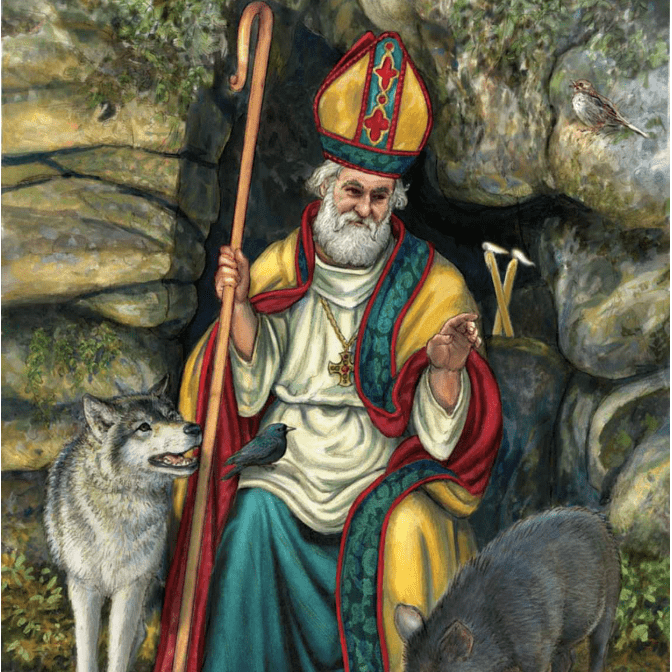
Optional Memorial of Saint Blaise, Bishop and Martyr and Saint Ansgar, Bishop
Liturgical Color: Green/Red/White
Rosary Mysteries: Sorrowful Mysteries

Daily Readings
First Reading: 2 Samuel 18: 9-10, 14, 24-25, 30 – 19:3
9 And it happened that Absalom met the servants of David, riding on a mule: and as the mule went under a thick and large oak, his head stuck in the oak: and while he hung between the heaven and the earth, the mule on which he rode passed on.
10 And one saw this and told Joab, saying: I saw Absalom hanging upon an oak.
14 And Joab said: Not as thou wilt, but will set upon him in thy sight. So he took three lances in his hand, and thrust them into the heart of Absalom: and whilst he yet panted for life, sticking on the oak
24 And David sat between the two gates: and the watchman that was on the top of the gate upon the wall, lifting up his eyes, saw a man running alone.
25 And crying out he told the king: and the king said: If he be alone, there are good tidings in his mouth. And as he was coming apace, and drawing nearer
30 And the king said to him: Pass, and stand here.
31 And when he had passed, and stood still, Chusai appeared: and coming up he said: I bring good tidings, my lord, the king, for the Lord hath judged for thee this day from the hand of all that have risen up against thee.
32 And the king said to Chusai: Is the young man Absalom safe? And Chusai answering him, said: Let the enemies of my lord, the king, and all that rise against him unto evil, be as the young man is.
33 The king therefore being much moved, went up to the high chamber over the gate, and wept. And as he went he spoke in this manner: My son Absalom, Absalom my son: would to God that I might die for thee, Absalom my son, my son Absalom.
1 And it was told Joab, that the king wept and mourned for his son:
2 And the victory that day was turned into mourning unto all the people: for the people heard say that day: The king grieveth for his son.
3 And the people shunned the going into the city that day as a people would do that hath turned their backs, and fled away from the battle.
9 Accidit autem ut occurreret Absalom servis David, sedens mulo: cumque ingressus fuisset mulus subter condensam quercum et magnam, adhæsit caput ejus quercui: et illo suspenso inter cælum et terram, mulus cui insederat, pertransivit.
10 Vidit autem hoc quispiam, et nuntiavit Joab, dicens: Vidi Absalom pendere de quercu.
14 Et ait Joab: Non sicut tu vis, sed aggrediar eum coram te. Tulit ergo tres lanceas in manu sua, et infixit eas in corde Absalom: cumque adhuc palpitaret hærens in quercu
24 David autem sedebat inter duas portas: speculator vero, qui erat in fastigio portæ super murum, elevans oculos, vidit hominem currentem solum.
25 Et exclamans indicavit regi: dixitque rex: Si solus est, bonus est nuntius in ore ejus. Properante autem illo, et accedente propius
30 Ad quem rex: Transi, ait, et sta hic. Cumque ille transisset, et staret,
31 apparuit Chusi: et veniens ait: Bonum apporto nuntium, domine mi rex: judicavit enim pro te Dominus hodie de manu omnium qui surrexerunt contra te.
32 Dixit autem rex ad Chusi: Estne pax puero Absalom? Cui respondens Chusi: Fiant, inquit, sicut puer, inimici domini mei regis, et universi qui consurgunt adversus eum in malum.
33 Contristatus itaque rex, ascendit cœnaculum portæ, et flevit. Et sic loquebatur, vadens: Fili mi Absalom, Absalom fili mi: quis mihi tribuat ut ego moriar pro te, Absalom fili mi, fili mi Absalom?
1 Nuntiatum est autem Joab quod rex fleret et lugeret filium suum,
2 et versa est victoria in luctum in die illa omni populo: audivit enim populus in die illa dici: Dolet rex super filio suo.
3 Et declinavit populus in die illa ingredi civitatem, quomodo declinare solet populus versus et fugiens de prælio.
Gospel: Mark 5: 21-43
21 And when Jesus had passed again in the ship over the strait, a great multitude assembled together unto him, and he was nigh unto the sea.
22 And there cometh one of the rulers of the synagogue named Jairus: and seeing him, falleth down at his feet.
23 And he besought him much, saying: My daughter is at the point of death, come, lay thy hand upon her, that she may be safe, and may live.
24 And he went with him, and a great multitude followed him, and they thronged him.
25 And a woman who was under an issue of blood twelve years,
26 And had suffered many things from many physicians; and had spent all that she had, and was nothing the better, but rather worse,
27 When she had heard of Jesus, came in the crowd behind him, and touched his garment.
28 For she said: If I shall touch but his garment, I shall be whole.
29 And forthwith the fountain of her blood was dried up, and she felt in her body that she was healed of the evil.
30 And immediately Jesus knowing in himself the virtue that had proceeded from him, turning to the multitude, said: Who hath touched my garments?
31 And his disciples said to him: Thou seest the multitude thronging thee, and sayest thou who hath touched me?
32 And he looked about to see her who had done this.
33 But the woman fearing and trembling, knowing what was done in her, came and fell down before him, and told him all the truth.
34 And he said to her: Daughter, thy faith hath made thee whole: go in peace, and be thou whole of thy disease.
35 While he was yet speaking, some come from the ruler of the synagogue’s house, saying: Thy daughter is dead: why dost thou trouble the master any further?
36 But Jesus having heard the word that was spoken, saith to the ruler of the synagogue: Fear not, only believe.
37 And he admitted not any man to follow him, but Peter, and James, and John the brother of James.
38 And they come to the house of the ruler of the synagogue; and he seeth a tumult, and people weeping and wailing much.
39 And going in, he saith to them: Why make you this ado, and weep? the damsel is not dead, but sleepeth.
40 And they laughed him to scorn. But he having put them all out, taketh the father and the mother of the damsel, and them that were with him, and entereth in where the damsel was lying.
41 And taking the damsel by the hand, he saith to her: Talitha cumi, which is, being interpreted: Damsel (I say to thee) arise.
42 And immediately the damsel rose up, and walked: and she was twelve years old: and they were astonished with a great astonishment.
43 And he charged them strictly that no man should know it: and commanded that something should be given her to eat.
21 Et cum transcendisset Jesus in navi rursum trans fretum, convenit turba multa ad eum, et erat circa mare.
22 Et venit quidam de archisynagogis nomine Jairus, et videns eum procidit ad pedes ejus,
23 et deprecabatur eum multum, dicens: Quoniam filia mea in extremis est, veni, impone manum super eam, ut salva sit, et vivat.
24 Et abiit cum illo, et sequebatur eum turba multa, et comprimebant eum.
25 Et mulier, quæ erat in profluvio sanguinis annis duodecim,
26 et fuerat multa perpessa a compluribus medicis: et erogaverat omnia sua, nec quidquam profecerat, sed magis deterius habebat:
27 cum audisset de Jesu, venit in turba retro, et tetigit vestimentum ejus:
28 dicebat enim: Quia si vel vestimentum ejus tetigero, salva ero.
29 Et confestim siccatus est fons sanguinis ejus: et sensit corpore quia sanata esset a plaga.
30 Et statim Jesus in semetipso cognoscens virtutem quæ exierat de illo, conversus ad turbam, aiebat: Quis tetigit vestimenta mea?
31 Et dicebant ei discipuli sui: Vides turbam comprimentem te, et dicis: Quis me tetigit?
32 Et circumspiciebat videre eam, quæ hoc fecerat.
33 Mulier vero timens et tremens, sciens quod factum esset in se, venit et procidit ante eum, et dixit ei omnem veritatem.
34 Ille autem dixit ei: Filia, fides tua te salvam fecit: vade in pace, et esto sana a plaga tua.
35 Adhuc eo loquente, veniunt ab archisynagogo, dicentes: Quia filia tua mortua est: quid ultra vexas magistrum?
36 Jesus autem audito verbo quod dicebatur, ait archisynagogo: Noli timere: tantummodo crede.
37 Et non admisit quemquam se sequi nisi Petrum, et Jacobum, et Joannem fratrem Jacobi.
38 Et veniunt in domum archisynagogi, et videt tumultum, et flentes, et ejulantes multum.
39 Et ingressus, ait illis: Quid turbamini, et ploratis? puella non est mortua, sed dormit.
40 Et irridebant eum. Ipse vero ejectis omnibus assumit patrem, et matrem puellæ, et qui secum erant, et ingreditur ubi puella erat jacens.
41 Et tenens manum puellæ, ait illi: Talitha cumi, quod est interpretatum: Puella (tibi dico), surge.
42 Et confestim surrexit puella, et ambulabat: erat autem annorum duodecim: et obstupuerunt stupore magno.
43 Et præcepit illis vehementer ut nemo id sciret: et dixit dari illi manducare.

A Daily Question from the Summa Theologica
Whether the sacraments of the Old Law caused grace? (Article 6 of 6 of Question 62. Of the Sacraments’ Principal Effect Which is Grace from the Treatise on the Sacraments)
Objection 1: It seems that the sacraments of the Old Law caused grace. For, as stated above (A[5], ad 2) the sacraments of the New Law derive their efficacy from faith in Christ’s Passion. But there was faith in Christ’s Passion under the Old Law, as well as under the New, since we have “the same spirit of faith” (2 Cor. 4:13). Therefore just as the sacraments of the New Law confer grace, so did the sacraments of the Old Law.
Objection 2: Further, there is no sanctification save by grace. But men were sanctified by the sacraments of the Old Law: for it is written (Lev. 8:31): “And when he,” i.e. Moses, “had sanctified them,” i.e. Aaron and his sons, “in their vestments,” etc. Therefore it seems that the sacraments of the Old Law conferred grace.
Objection 3: Further, Bede says in a homily on the Circumcision: “Under the Law circumcision provided the same health-giving balm against the wound of original sin, as baptism in the time of revealed grace.” But Baptism confers grace now. Therefore circumcision conferred grace; and in like manner, the other sacraments of the Law; for just as Baptism is the door of the sacraments of the New Law, so was circumcision the door of the sacraments of the Old Law: hence the Apostle says (Gal. 5:3): “I testify to every man circumcising himself, that he is a debtor to the whole law.”
On the contrary, It is written (Gal. 4:9): “Turn you again to the weak and needy elements?” i.e. “to the Law,” says the gloss, “which is called weak, because it does not justify perfectly.” But grace justifies perfectly. Therefore the sacraments of the old Law did not confer grace.
I answer that, It cannot be said that the sacraments of the Old Law conferred sanctifying grace of themselves, i.e. by their own power: since thus Christ’s Passion would not have been necessary, according to Gal. 2:21: “If justice be by the Law, then Christ died in vain.”
But neither can it be said that they derived the power of conferring sanctifying grace from Christ’s Passion. For as it was stated above (A[5] ), the power of Christ’s Passion is united to us by faith and the sacraments, but in different ways; because the link that comes from faith is produced by an act of the soul; whereas the link that comes from the sacraments, is produced by making use of exterior things. Now nothing hinders that which is subsequent in point of time, from causing movement, even before it exists in reality, in so far as it pre-exists in an act of the soul: thus the end, which is subsequent in point of time, moves the agent in so far as it is apprehended and desired by him. On the other hand, what does not yet actually exist, does not cause movement if we consider the use of exterior things. Consequently, the efficient cause cannot in point of time come into existence after causing movement, as does the final cause. It is therefore clear that the sacraments of the New Law do reasonably derive the power of justification from Christ’s Passion, which is the cause of man’s righteousness; whereas the sacraments of the Old Law did not.
Nevertheless the Fathers of old were justified by faith in Christ’s Passion, just as we are. And the sacraments of the old Law were a kind of protestation of that faith, inasmuch as they signified Christ’s Passion and its effects. It is therefore manifest that the sacraments of the Old Law were not endowed with any power by which they conduced to the bestowal of justifying grace: and they merely signified faith by which men were justified.
Reply to Objection 1: The Fathers of old had faith in the future Passion of Christ, which, inasmuch as it was apprehended by the mind, was able to justify them. But we have faith in the past Passion of Christ, which is able to justify, also by the real use of sacramental things as stated above.
Reply to Objection 2: That sanctification was but a figure: for they were said to be sanctified forasmuch as they gave themselves up to the Divine worship according to the rite of the Old Law, which was wholly ordained to the foreshadowing of Christ’s Passion.
Reply to Objection 3: There have been many opinions about Circumcision. For, according to some, Circumcision conferred no grace, but only remitted sin. But this is impossible; because man is not justified from sin save by grace, according to Rom. 3:24: “Being justified freely by His grace.”
Wherefore others said that by Circumcision grace is conferred, as to the privative effects of sin, but not as to its positive effects. But this also appears to be false, because by Circumcision, children received the faculty of obtaining glory, which is the ultimate positive effect of grace. Moreover, as regards the order of the formal cause, positive effects are naturally prior to privative effects, though according to the order of the material cause, the reverse is the case: for a form does not exclude privation save by informing the subject.
Hence others say that Circumcision conferred grace also as regards a certain positive effect, i.e. by making man worthy of eternal life, but not so as to repress concupiscence which makes man prone to sin. And so at one time it seemed to me. But if the matter be considered carefully, this too appears to be untrue; because the very least grace is sufficient to resist any degree of concupiscence, and to merit eternal life.
And therefore it seems better to say that Circumcision was a sign of justifying faith: wherefore the Apostle says (Rom. 4:11) that Abraham “received the sign of Circumcision, a seal of the justice of faith.” Consequently grace was conferred in Circumcision in so far as it was a sign of Christ’s future Passion, as will be made clear further on (Q[70], A[4]).
Continue reading the rest of the articles on Sacred Texts Archive website.