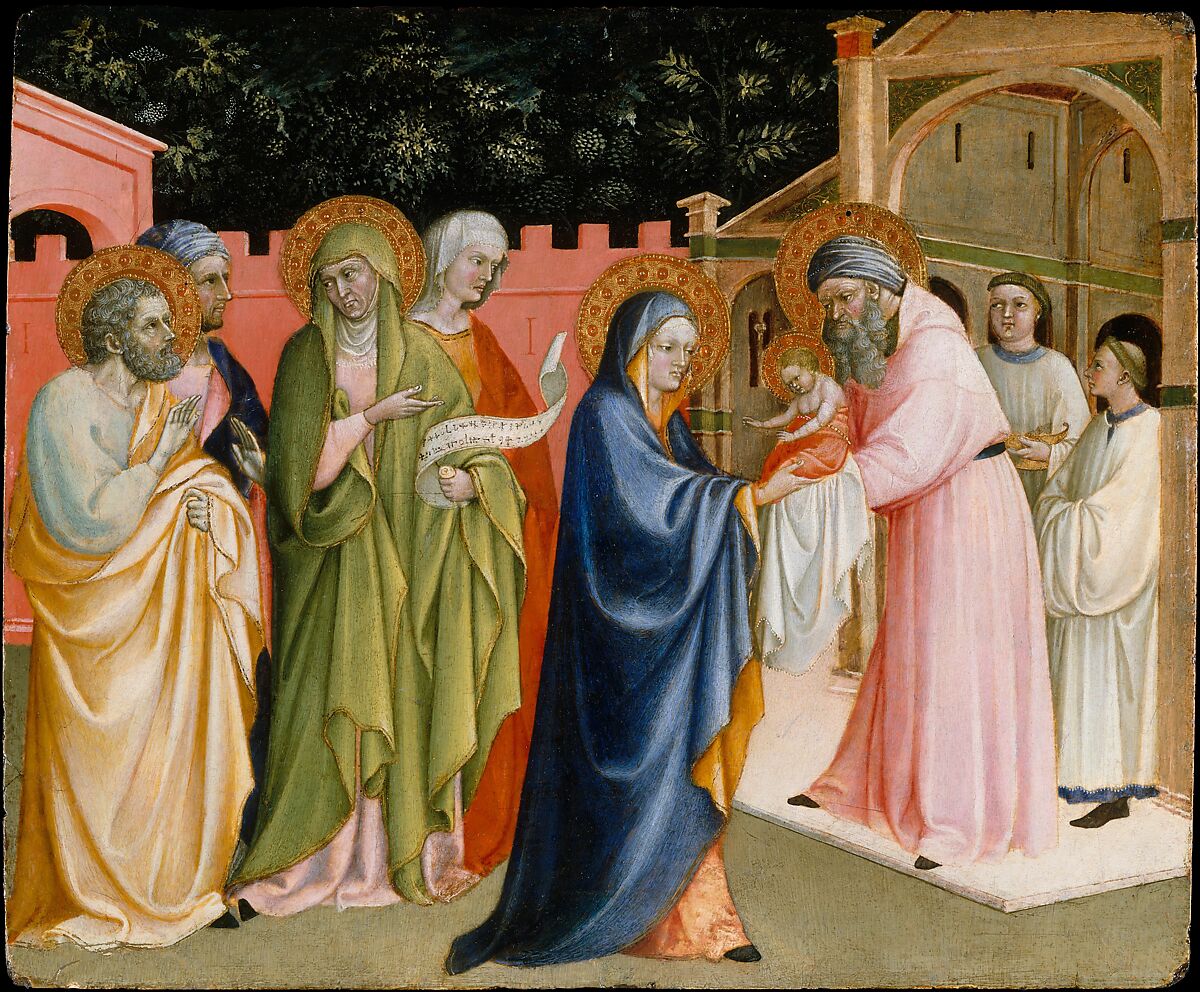
The Presentation of the Lord
Liturgical Color: White
Rosary Mysteries: Joyful Mysteries

Daily Readings
First Reading: Malachi 3: 1-4
1 Behold I send my angel, and he shall prepare the way before my face. And presently the Lord, whom you seek, and the angel of the testament, whom you desire, shall come to his temple. Behold he cometh, saith the Lord of hosts.
2 And who shall be able to think of the day of his coming? and who shall stand to see him? for he is like a refining fire, and like the fuller’s herb:
3 And he shall sit refining and cleansing the silver, and he shall purify the sons of Levi, and shall refine them as gold, and as silver, and they shall offer sacrifices to the Lord in justice.
4 And the sacrifice of Juda and of Jerusalem shall please the Lord, as in the days of old, and in the ancient years.
1 Ecce ego mitto angelum meum, et præparabit viam ante faciem meam: et statim veniet ad templum suum Dominator quem vos quæritis, et angelus testamenti quem vos vultis. Ecce venit, dicit Dominus exercituum.
2 Et quis poterit cogitare diem adventus ejus, et quis stabit ad videndum eum? ipse enim quasi ignis conflans, et quasi herba fullonum:
3 et sedebit conflans, et emundans argentum: et purgabit filios Levi, et colabit eos quasi aurum et quasi argentum, et erunt Domino offerentes sacrificia in justitia.
4 Et placebit Domino sacrificium Juda et Jerusalem, sicut dies sæculi, et sicut anni antiqui.
Second Reading: Hebrews 2: 14-18
14 Therefore because the children are partakers of flesh and blood, he also himself in like manner hath been partaker of the same: that, through death, he might destroy him who had the empire of death, that is to say, the devil:
15 And might deliver them, who through the fear of death were all their lifetime subject to servitude.
16 For no where doth he take hold of the angels: but of the seed of Abraham he taketh hold.
17 Wherefore it behoved him in all things to be made like unto his brethren, that he might become a merciful and faithful priest before God, that he might be a propitiation for the sins of the people.
18 For in that, wherein he himself hath suffered and been tempted, he is able to succour them also that are tempted.
14 Quia ergo pueri communicaverunt carni, et sanguini, et ipse similiter participavit eisdem: ut per mortem destrueret eum qui habebat mortis imperium, id est, diabolum:
15 et liberaret eos qui timore mortis per totam vitam obnoxii erant servituti.
16 Nusquam enim angelos apprehendit, sed semen Abrahæ apprehendit.
17 Unde debuit per omnia fratribus similari, ut misericors fieret, et fidelis pontifex ad Deum, ut repropitiaret delicta populi.
18 In eo enim, in quo passus est ipse et tentatus, potens est et eis, qui tentantur, auxiliari.
Gospel: Luke 2: 22-40
22 And after the days of her purification, according to the law of Moses, were accomplished, they carried him to Jerusalem, to present him to the Lord:
23 As it is written in the law of the Lord: Every male opening the womb shall be called holy to the Lord:
24 And to offer a sacrifice, according as it is written in the law of the Lord, a pair of turtledoves, or two young pigeons:
25 And behold there was a man in Jerusalem named Simeon, and this man was just and devout, waiting for the consolation of Israel; and the Holy Ghost was in him.
26 And he had received an answer from the Holy Ghost, that he should not see death, before he had seen the Christ of the Lord.
27 And he came by the Spirit into the temple. And when his parents brought in the child Jesus, to do for him according to the custom of the law,
28 He also took him into his arms, and blessed God, and said:
29 Now thou dost dismiss thy servant, O Lord, according to thy word in peace;
30 Because my eyes have seen thy salvation,
31 Which thou hast prepared before the face of all peoples:
32 A light to the revelation of the Gentiles, and the glory of thy people Israel.
33 And his father and mother were wondering at those things which were spoken concerning him.
34 And Simeon blessed them, and said to Mary his mother: Behold this child is set for the fall, and for the resurrection of many in Israel, and for a sign which shall be contradicted;
35 And thy own soul a sword shall pierce, that, out of many hearts, thoughts may be revealed.
36 And there was one Anna, a prophetess, the daughter of Phanuel, of the tribe of Aser; she was far advanced in years, and had lived with her husband seven years from her virginity.
37 And she was a widow until fourscore and four years; who departed not from the temple, by fastings and prayers serving night and day.
38 Now she, at the same hour, coming in, confessed to the Lord; and spoke of him to all that looked for the redemption of Israel.
39 And after they had performed all things according to the law of the Lord, they returned into Galilee, to their city Nazareth.
40 And the child grew, and waxed strong, full of wisdom; and the grace of God was in him.
22 Et postquam impleti sunt dies purgationis ejus secundum legem Moysi, tulerunt illum in Jerusalem, ut sisterent eum Domino,
23 sicut scriptum est in lege Domini: Quia omne masculinum adaperiens vulvam, sanctum Domino vocabitur:
24 et ut darent hostiam secundum quod dictum est in lege Domini, par turturum, aut duos pullos columbarum.
25 Et ecce homo erat in Jerusalem, cui nomen Simeon, et homo iste justus, et timoratus, exspectans consolationem Israël: et Spiritus Sanctus erat in eo.
26 Et responsum acceperat a Spiritu Sancto, non visurum se mortem, nisi prius videret Christum Domini.
27 Et venit in spiritu in templum. Et cum inducerent puerum Jesum parentes ejus, ut facerent secundum consuetudinem legis pro eo,
28 et ipse accepit eum in ulnas suas: et benedixit Deum, et dixit:
29 [Nunc dimittis servum tuum Domine,
secundum verbum tuum in pace:
30 quia viderunt oculi mei salutare tuum,
31 quod parasti ante faciem omnium populorum:
32 lumen ad revelationem gentium,
et gloriam plebis tuæ Israël.]
33 Et erat pater ejus et mater mirantes super his quæ dicebantur de illo.
34 Et benedixit illis Simeon, et dixit ad Mariam matrem ejus: Ecce positus est hic in ruinam et in resurrectionem multorum in Israël, et in signum cui contradicetur:
35 et tuam ipsius animam pertransibit gladius ut revelentur ex multis cordibus cogitationes.
36 Et erat Anna prophetissa, filia Phanuel, de tribu Aser: hæc processerat in diebus multis, et vixerat cum viro suo annis septem a virginitate sua.
37 Et hæc vidua usque ad annos octoginta quatuor: quæ non discedebat de templo, jejuniis et obsecrationibus serviens nocte ac die.
38 Et hæc, ipsa hora superveniens, confitebatur Domino: et loquebatur de illo omnibus, qui exspectabant redemptionem Israël.
39 Et ut perfecerunt omnia secundum legem Domini, reversi sunt in Galilæam in civitatem suam Nazareth.
40 Puer autem crescebat, et confortabatur plenus sapientia: et gratia Dei erat in illo.

A Daily Question from the Summa Theologica
Whether the sacraments of the New Law derive their power from Christ’s Passion? (Article 5 of 6 of Question 62. Of the Sacraments’ Principal Effect Which is Grace from the Treatise on the Sacraments)
Objection 1: It seems that the sacraments of the New Law do not derive their power from Christ’s Passion. For the power of the sacraments is in the causing of grace which is the principle of spiritual life in the soul. But as Augustine says (Tract. xix in Joan.): “The Word, as He was in the beginning with God, quickens souls; as He was made flesh, quickens bodies.” Since, therefore, Christ’s Passion pertains to the Word as made flesh, it seems that it cannot cause the power of the sacraments.
Objection 2: Further, the power of the sacraments seems to depend on faith. for as Augustine says (Tract. lxxx in Joan.), the Divine Word perfects the sacrament “not because it is spoken, but because it is believed.” But our faith regards not only Christ’s Passion, but also the other mysteries of His humanity, and in a yet higher measure, His Godhead. Therefore it seems that the power of the sacraments is not due specially to Christ’s Passion.
Objection 3: Further, the sacraments are ordained unto man’s justification, according to 1 Cor. 6:11: “You are washed . . . you are justified.” Now justification is ascribed to the Resurrection, according to Rom. 4:25: “(Who) rose again for our justification.” Therefore it seems that the sacraments derive their power from Christ’s Resurrection rather than from His Passion.
On the contrary, on Rom. 5:14: “After the similitude of the transgression of Adam,” etc., the gloss says: “From the side of Christ asleep on the Cross flowed the sacraments which brought salvation to the Church.” Consequently, it seems that the sacraments derive their power from Christ’s Passion.
I answer that, As stated above (A[1]) a sacrament in causing grace works after the manner of an instrument. Now an instrument is twofold. the one, separate, as a stick, for instance; the other, united, as a hand. Moreover, the separate instrument is moved by means of the united instrument, as a stick by the hand. Now the principal efficient cause of grace is God Himself, in comparison with Whom Christ’s humanity is as a united instrument, whereas the sacrament is as a separate instrument. Consequently, the saving power must needs be derived by the sacraments from Christ’s Godhead through His humanity.
Now sacramental grace seems to be ordained principally to two things: namely, to take away the defects consequent on past sins, in so far as they are transitory in act, but endure in guilt; and, further, to perfect the soul in things pertaining to Divine Worship in regard to the Christian Religion. But it is manifest from what has been stated above (Q[48], AA[1],2,6; Q[49], AA[1],3) that Christ delivered us from our sins principally through His Passion, not only by way of efficiency and merit, but also by way of satisfaction. Likewise by His Passion He inaugurated the Rites of the Christian Religion by offering “Himself—an oblation and a sacrifice to God” (Eph. 5:2). Wherefore it is manifest that the sacraments of the Church derive their power specially from Christ’s Passion, the virtue of which is in a manner united to us by our receiving the sacraments. It was in sign of this that from the side of Christ hanging on the Cross there flowed water and blood, the former of which belongs to Baptism, the latter to the Eucharist, which are the principal sacraments.
Reply to Objection 1: The Word, forasmuch as He was in the beginning with God, quickens souls as principal agent; but His flesh, and the mysteries accomplished therein, are as instrumental causes in the process of giving life to the soul: while in giving life to the body they act not only as instrumental causes, but also to a certain extent as exemplars, as we stated above (Q[56], A[1], ad 3).
Reply to Objection 2: Christ dwells in us “by faith” (Eph. 3:17). Consequently, by faith Christ’s power is united to us. Now the power of blotting out sin belongs in a special way to His Passion. And therefore men are delivered from sin especially by faith in His Passion, according to Rom. 3:25: “Whom God hath proposed to be a propitiation through faith in His Blood.” Therefore the power of the sacraments which is ordained unto the remission of sins is derived principally from faith in Christ’s Passion.
Reply to Objection 3: Justification is ascribed to the Resurrection by reason of the term “whither,” which is newness of life through grace. But it is ascribed to the Passion by reason of the term “whence,” i.e. in regard to the forgiveness of sin.
Continue reading the rest of the articles on Sacred Texts Archive website.