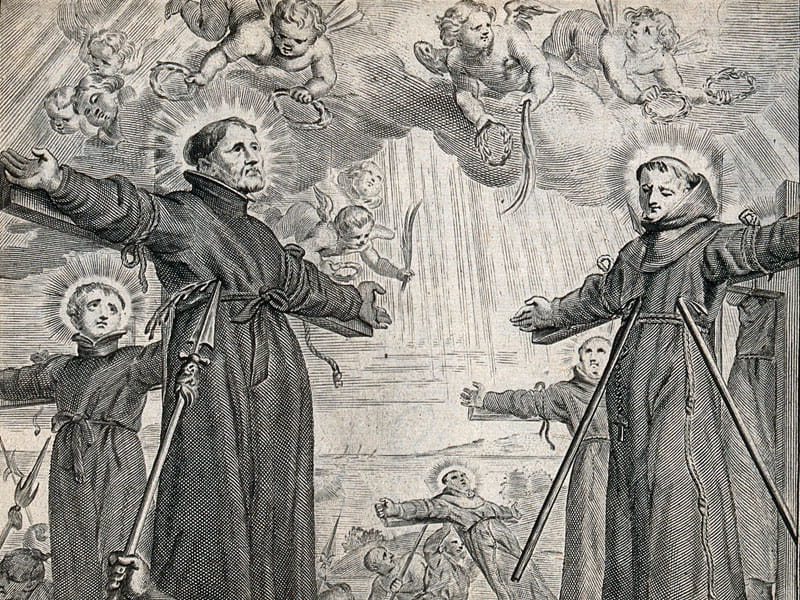
Memorial of Saint Paul Miki and Companions, Martyrs
Liturgical Color: Red
Rosary Mysteries: Sorrowful Mysteries
“I obey Christ. After Christ’s example I forgive my persecutors… I hope my blood will fall on my fellow men as a fruitful rain.”
Saint Paul Miki
est. 1562–1564 – February 5, 1597
Patron of Japan and the Twenty-six Martyrs of Japan

Daily Readings
First Reading: Sirach 47: 2-11
2 And as the fat taken away from the flesh, so was David chosen from among the children of Israel.
3 He played with lions as with lambs: and with bears he did in like manner as with the lambs of the flock, in his youth.
4 Did not he kill the giant, and take away reproach from his people?
5 In lifting up his hand, with the stone in the sling he beat down the boasting of Goliath:
6 For he called upon the Lord the Almighty, and he gave strength in his right hand, to take away the mighty warrior, and to set up the horn of his nation.
7 So in ten thousand did he glorify him, and praised him in the blessings of the Lord, in offering to him a crown of glory:
8 For he destroyed the enemies on every side, and extirpated the Philistines the adversaries unto this day: he broke their horn for ever.
9 In all his works he gave thanks to the holy one, and to the most High, with words of glory.
10 With his whole heart he praised the Lord, and loved God that made him: and he gave him power against his enemies:
11 And he set singers before the altar, and by their voices he made sweet melody.
2 Et quasi adeps separatus a carne,
sic David a filiis Israël.
3 Cum leonibus lusit quasi cum agnis,
et in ursis similiter fecit sicut in agnis ovium, in juventute sua.
4 Numquid non occidit gigantem,
et abstulit opprobrium de gente?
5 In tollendo manum,
saxo fundæ dejecit exsultationem Goliæ:
6 nam invocavit Dominum omnipotentem,
et dedit in dextera ejus tollere hominem fortem in bello,
et exaltare cornu gentis suæ.
7 Sic in decem millibus glorificavit eum:
et laudavit eum in benedictionibus Domini,
in offerendo illi coronam gloriæ:
8 contrivit enim inimicos undique,
et extirpavit Philisthiim contrarios usque in hodiernum diem:
contrivit cornu ipsorum usque in æternum.
9 In omni opere dedit confessionem Sancto,
et Excelso in verbo gloriæ.
10 De omni corde suo laudavit Dominum:
et dilexit Deum, qui fecit illum,
et dedit illi contra inimicos potentiam:
11 et stare fecit cantores contra altare,
et in sono eorum dulces fecit modos.
Gospel: Mark 6: 14-29
14 And king Herod heard, (for his name was made manifest,) and he said: John the Baptist is risen again from the dead, and therefore mighty works shew forth themselves in him.
15 And others said: It is Elias. But others said: It is a prophet, as one of the prophets.
16 Which Herod hearing, said: John whom I beheaded, he is risen again from the dead.
17 For Herod himself had sent and apprehended John, and bound him in prison for the sake of Herodias the wife of Philip his brother, because he had married her.
18 For John said to Herod: It is not lawful for thee to have thy brother’s wife.
19 Now Herodias laid snares for him: and was desirous to put him to death, and could not.
20 For Herod feared John, knowing him to be a just and holy man: and kept him, and when he heard him, did many things: and he heard him willingly.
21 And when a convenient day was come, Herod made a supper for his birthday, for the princes, and tribunes, and chief men of Galilee.
22 And when the daughter of the same Herodias had come in, and had danced, and pleased Herod, and them that were at table with him, the king said to the damsel: Ask of me what thou wilt, and I will give it thee.
23 And he swore to her: Whatsoever thou shalt ask I will give thee, though it be the half of my kingdom.
24 Who when she was gone out, said to her mother, What shall I ask? But she said: The head of John the Baptist.
25 And when she was come in immediately with haste to the king, she asked, saying: I will that forthwith thou give me in a dish, the head of John the Baptist.
26 And the king was struck sad. Yet because of his oath, and because of them that were with him at table, he would not displease her:
27 But sending an executioner, he commanded that his head should be brought in a dish.
28 And he beheaded him in the prison, and brought his head in a dish: and gave it to the damsel, and the damsel gave it to her mother.
29 Which his disciples hearing came, and took his body, and laid it in a tomb.
14 Et audivit rex Herodes (manifestum enim factum est nomen ejus), et dicebat: Quia Joannes Baptista resurrexit a mortuis: et propterea virtutes operantur in illo.
15 Alii autem dicebant: Quia Elias est; alii vero dicebant: Quia propheta est, quasi unus ex prophetis.
16 Quo audito Herodes ait: Quem ego decollavi Joannem, hic a mortuis resurrexit.
17 Ipse enim Herodes misit, ac tenuit Joannem, et vinxit eum in carcere propter Herodiadem uxorem Philippi fratris sui, quia duxerat eam.
18 Dicebat enim Joannes Herodi: Non licet tibi habere uxorem fratris tui.
19 Herodias autem insidiabatur illi: et volebat occidere eum, nec poterat.
20 Herodes enim metuebat Joannem, sciens eum virum justum et sanctum: et custodiebat eum, et audito eo multa faciebat, et libenter eum audiebat.
21 Et cum dies opportunus accidisset, Herodes natalis sui cœnam fecit principibus, et tribunis, et primis Galilææ:
22 cumque introisset filia ipsius Herodiadis, et saltasset, et placuisset Herodi, simulque recumbentibus, rex ait puellæ: Pete a me quod vis, et dabo tibi:
23 et juravit illi: Quia quidquid petieris dabo tibi, licet dimidium regni mei.
24 Quæ cum exisset, dixit matri suæ: Quid petam? At illa dixit: Caput Joannis Baptistæ.
25 Cumque introisset statim cum festinatione ad regem, petivit dicens: Volo ut protinus des mihi in disco caput Joannis Baptistæ.
26 Et contristatus est rex: propter jusjurandum, et propter simul discumbentes, noluit eam contristare:
27 sed misso speculatore præcepit afferri caput ejus in disco. Et decollavit eum in carcere,
28 et attulit caput ejus in disco: et dedit illud puellæ, et puella dedit matri suæ.
29 Quo audito, discipuli ejus venerunt, et tulerunt corpus ejus: et posuerunt illud in monumento.

A Daily Question from the Summa Theologica
Whether the sacramental character is the character of Christ? (Article 3 of 6 of Question 63. Of the Other Effect of the Sacrament Which is a Character from the Treatise on the Sacraments)
Objection 1: It seems that the sacramental character is not the character of Christ. For it is written (Eph. 4:30): “Grieve not the Holy Spirit of God, whereby you are sealed.” But a character consists essentially in some. thing that seals. Therefore the sacramental character should be attributed to the Holy Ghost rather than to Christ.
Objection 2: Further, a character has the nature of a sign. And it is a sign of the grace that is conferred by the sacrament. Now grace is poured forth into the soul by the whole Trinity; wherefore it is written (Ps. 83:12): “The Lord will give grace and glory.” Therefore it seems that the sacramental character should not be attributed specially to Christ.
Objection 3: Further, a man is marked with a character that he may be distinguishable from others. But the saints are distinguishable from others by charity, which, as Augustine says (De Trin. xv), “alone separates the children of the Kingdom from the children of perdition”: wherefore also the children of perdition are said to have “the character of the beast” (Rev. 13:16, 17). But charity is not attributed to Christ, but rather to the Holy Ghost according to Rom. 5:5: “The charity of God is poured forth in our hearts, by the Holy Ghost, Who is given to us”; or even to the Father, according to 2 Cor. 13:13: “The grace of our Lord Jesus Christ and the charity of God.” Therefore it seems that the sacramental character should not be attributed to Christ.
On the contrary, Some define character thus: “A character is a distinctive mark printed in a man’s rational soul by the eternal Character, whereby the created trinity is sealed with the likeness of the creating and re-creating Trinity, and distinguishing him from those who are not so enlikened, according to the state of faith.” But the eternal Character is Christ Himself, according to Heb. 1:3: “Who being the brightness of His glory and the figure,” or character, “of His substance.” It seems, therefore, that the character should properly be attributed to Christ.
I answer that, As has been made clear above (A[1]), a character is properly a kind of seal, whereby something is marked, as being ordained to some particular end: thus a coin is marked for use in exchange of goods, and soldiers are marked with a character as being deputed to military service. Now the faithful are deputed to a twofold end. First and principally to the enjoyment of glory. And for this purpose they are marked with the seal of grace according to Ezech. 9:4: “Mark Thou upon the foreheads of the men that sigh and mourn”; and Apoc. 7:3: “Hurt not the earth, nor the sea, nor the trees, till we sign the servants of our God in their foreheads.”
Secondly, each of the faithful is deputed to receive, or to bestow on others, things pertaining to the worship of God. And this, properly speaking, is the purpose of the sacramental character. Now the whole rite of the Christian religion is derived from Christ’s priesthood. Consequently, it is clear that the sacramental character is specially the character of Christ, to Whose character the faithful are likened by reason of the sacramental characters, which are nothing else than certain participations of Christ’s Priesthood, flowing from Christ Himself.
Reply to Objection 1: The Apostle speaks there of that sealing by which a man is assigned to future glory, and which is effected by grace. Now grace is attributed to the Holy Ghost, inasmuch as it is through love that God gives us something gratis, which is the very nature of grace: while the Holy Ghost is love. Wherefore it is written (1 Cor. 12:4): “There are diversities of graces, but the same Spirit.”
Reply to Objection 2: The sacramental character is a thing as regards the exterior sacrament, and a sacrament in regard to the ultimate effect. Consequently, something can be attributed to a character in two ways. First, if the character be considered as a sacrament: and thus it is a sign of the invisible grace which is conferred in the sacrament. Secondly, if it be considered as a character. And thus it is a sign conferring on a man a likeness to some principal person in whom is vested the authority over that to which he is assigned: thus soldiers who are assigned to military service, are marked with their leader’s sign, by which they are, in a fashion, likened to him. And in this way those who are deputed to the Christian worship, of which Christ is the author, receive a character by which they are likened to Christ. Consequently, properly speaking, this is Christ’s character.
Reply to Objection 3: A character distinguishes one from another, in relation to some particular end, to which he, who receives the character is ordained: as has been stated concerning the military character (A[1]) by which a soldier of the king is distinguished from the enemy’s soldier in relation to the battle. In like manner the character of the faithful is that by which the faithful of Christ are distinguished from the servants of the devil, either in relation to eternal life, or in relation to the worship of the Church that now is. Of these the former is the result of charity and grace, as the objection runs; while the latter results from the sacramental character. Wherefore the “character of the beast” may be understood by opposition, to mean either the obstinate malice for which some are assigned to eternal punishment, or the profession of an unlawful form of worship.
Continue reading the rest of the articles on Sacred Texts Archive website.