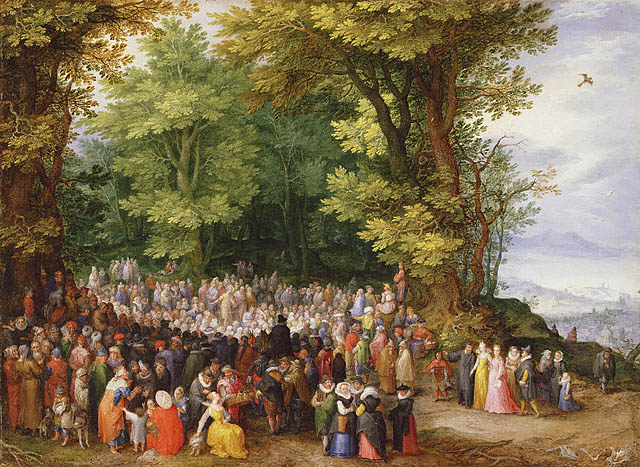
Fifth Sunday of Ordinary Time
Liturgical Color: Green
Rosary Mysteries: Glorious Mysteries

Daily Readings
First Reading: Isaiah 58: 7-10
7 Deal thy bread to the hungry, and bring the needy and the harbourless into thy house: when thou shalt see one naked, cover him, and despise not thy own flesh.
8 Then shall thy light break forth as the morning, and thy health shall speedily arise, and thy justice shall go before thy face, and the glory of the Lord shall gather thee up.
9 Then shalt thou call, and the Lord shall hear: thou shalt cry, and he shall say, Here I am. If thou wilt take away the chain out of the midst of thee, and cease to stretch out the finger, and to speak that which profiteth not.
10 When thou shalt pour out thy soul to the hungry, and shalt satisfy the afflicted soul then shall thy light rise up in darkness, and thy darkness shall be as the noonday.
7 frange esurienti panem tuum,
et egenos vagosque induc in domum tuam;
cum videris nudum, operi eum,
et carnem tuam ne despexeris.
8 Tunc erumpet quasi mane lumen tuum;
et sanitas tua citius orietur,
et anteibit faciem tuam justitia tua,
et gloria Domini colliget te.
9 Tunc invocabis, et Dominus exaudiet;
clamabis, et dicet: Ecce adsum.
Si abstuleris de medio tui catenam,
et desieris extendere digitum et loqui quod non prodest;
10 cum effuderis esurienti animam tuam,
et animam afflictam repleveris,
orietur in tenebris lux tua,
et tenebræ tuæ erunt sicut meridies.
Second Reading: 1 Corinthians 2: 1-5
1 And I, brethren, when I came to you, came not in loftiness of speech or of wisdom, declaring unto you the testimony of Christ.
2 For I judged not myself to know anything among you, but Jesus Christ, and him crucified.
3 And I was with you in weakness, and in fear, and in much trembling.
4 And my speech and my preaching was not in the persuasive words of human wisdom, but in shewing of the Spirit and power;
5 That your faith might not stand on the wisdom of men, but on the power of God.
1 Et ego, cum venissem ad vos, fratres, veni non in sublimitate sermonis, aut sapientiæ, annuntians vobis testimonium Christi.
2 Non enim judicavi me scire aliquid inter vos, nisi Jesum Christum, et hunc crucifixum.
3 Et ego in infirmitate, et timore, et tremore multo fui apud vos:
4 et sermo meus, et prædicatio mea non in persuasibilibus humanæ sapientiæ verbis, sed in ostensione spiritus et virtutis:
5 ut fides vestra non sit in sapientia hominum, sed in virtute Dei.
Gospel: Matthew 5: 13-16
13 You are the salt of the earth. But if the salt lose its savour, wherewith shall it be salted? It is good for nothing any more but to be cast out, and to be trodden on by men.
14 You are the light of the world. A city seated on a mountain cannot be hid.
15 Neither do men light a candle and put it under a bushel, but upon a candlestick, that it may shine to all that are in the house.
16 So let your light shine before men, that they may see your good works, and glorify your Father who is in heaven.
13 Vos estis sal terræ. Quod si sal evanuerit, in quo salietur? ad nihilum valet ultra, nisi ut mittatur foras, et conculcetur ab hominibus.
14 Vos estis lux mundi. Non potest civitas abscondi supra montem posita,
15 neque accendunt lucernam, et ponunt eam sub modio, sed super candelabrum, ut luceat omnibus qui in domo sunt.
16 Sic luceat lux vestra coram hominibus: ut videant opera vestra bona, et glorificent Patrem vestrum, qui in cælis est.

A Daily Question from the Summa Theologica
Whether a character can be blotted out from the soul? (Article 5 of 6 of Question 63. Of the Other Effect of the Sacrament Which is a Character from the Treatise on the Sacraments)
Objection 1: It seems that a character can be blotted out from the soul. Because the more perfect an accident is, the more firmly does it adhere to its subject. But grace is more perfect than a character; because a character is ordained unto grace as to a further end. Now grace is lost through sin. Much more, therefore, is a character so lost.
Objection 2: Further, by a character a man is deputed to the Divine worship, as stated above (AA[3],4). But some pass from the worship of God to a contrary worship by apostasy from the faith. It seems, therefore, that such lose the sacramental character.
Objection 3: Further, when the end ceases, the means to the end should cease also: thus after the resurrection there will be no marriage, because begetting will cease, which is the purpose of marriage. Now the exterior worship to which a character is ordained, will not endure in heaven, where there will be no shadows, but all will be truth without a veil. Therefore the sacramental character does not last in the soul for ever: and consequently it can be blotted out.
On the contrary, Augustine says (Contra Parmen. ii): “The Christian sacraments are not less lasting than the bodily mark” of military service. But the character of military service is not repeated, but is “recognized and approved” in the man who obtains the emperor’s forgiveness after offending him. Therefore neither can the sacramental character be blotted out.
I answer that, As stated above (A[3]), in a sacramental character Christ’s faithful have a share in His Priesthood; in the sense that as Christ has the full power of a spiritual priesthood, so His faithful are likened to Him by sharing a certain spiritual power with regard to the sacraments and to things pertaining to the Divine worship. For this reason it is unbecoming that Christ should have a character: but His Priesthood is compared to a character, as that which is complete and perfect is compared to some participation of itself. Now Christ’s Priesthood is eternal, according to Ps. 109:4: “Thou art a priest for ever, according to the order of Melchisedech.” Consequently, every sanctification wrought by His Priesthood, is perpetual, enduring as long as the thing sanctified endures. This is clear even in inanimate things; for the consecration of a church or an altar lasts for ever unless they be destroyed. Since, therefore, the subject of a character is the soul as to its intellective part, where faith resides, as stated above (A[4], ad 3); it is clear that, the intellect being perpetual and incorruptible, a character cannot be blotted out from the soul.
Reply to Objection 1: Both grace and character are in the soul, but in different ways. For grace is in the soul, as a form having complete existence therein: whereas a character is in the soul, as an instrumental power, as stated above (A[2]). Now a complete form is in its subject according to the condition of the subject. And since the soul as long as it is a wayfarer is changeable in respect of the free-will, it results that grace is in the soul in a changeable manner. But an instrumental power follows rather the condition of the principal agent: and consequently a character exists in the soul in an indelible manner, not from any perfection of its own, but from the perfection of Christ’s Priesthood, from which the character flows like an instrumental power.
Reply to Objection 2: As Augustine says (Contra Parmen. ii), “even apostates are not deprived of their baptism, for when they repent and return to the fold they do not receive it again; whence we conclude that it cannot be lost.” The reason of this is that a character is an instrumental power, as stated above (ad 1), and the nature of an instrument as such is to be moved by another, but not to move itself; this belongs to the will. Consequently, however much the will be moved in the contrary direction, the character is not removed, by reason of the immobility of the principal mover.
Reply to Objection 3: Although external worship does not last after this life, yet its end remains. Consequently, after this life the character remains, both in the good as adding to their glory, and in the wicked as increasing their shame: just as the character of the military service remains in the soldiers after the victory, as the boast of the conquerors, and the disgrace of the conquered.
Continue reading the rest of the articles on Sacred Texts Archive website.