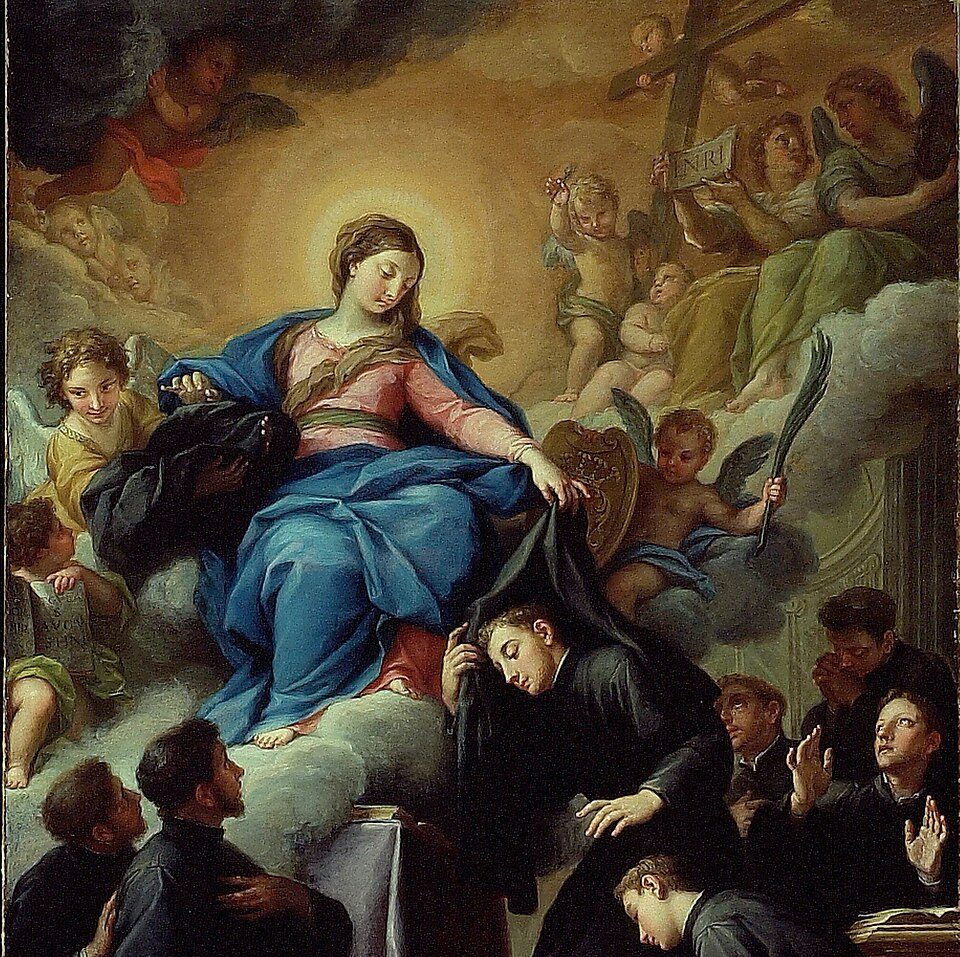
Optional Memorial of The Seven Holy Founders of the Servite Order
LITurgical Color: Green / White
Rosary Mysteries: Sorrowful Mysteries

Daily Readings
Gospel: Mark 8: 14-21
14 And they forgot to take bread: and they had but one loaf with them in the ship.
15 And he charged them saying: Take heed and beware of the leaven of the Pharisees and of the leaven of Herod.
16 And they reasoned among themselves, saying: Because we have no bread.
17 Which Jesus knowing, saith to them: Why do you reason, because you have no bread? Do you not yet know nor understand? Have you still your heart blinded?
18 Having eyes, see you not? And having ears, hear you not? Neither do you remember?
19 When I broke the five loves among five thousand, how many baskets full of fragments took you up? They say to him: Twelve.
20 When also the seven loaves among four thousand, how many baskets of fragments took you up? And they say to him: Seven.
21 And he said to them: How do you not yet understand?
14 Et obliti sunt panes sumere: et nisi unum panem non habebant secum in navi.
15 Et præcipiebat eis, dicens: Videte, et cavete a fermento pharisæorum, et fermento Herodis.
16 Et cogitabant ad alterutrum, dicentes: quia panes non habemus.
17 Quo cognito, ait illis Jesus: Quid cogitatis, quia panes non habetis? nondum cognoscetis nec intelligitis? adhuc cæcatum habetis cor vestrum?
18 oculos habentes non videtis? et aures habentes non auditis? nec recordamini,
19 quando quinque panes fregi in quinque millia: quot cophinos fragmentorum plenos sustulistis? Dicunt ei: Duodecim.
20 Quando et septem panes in quatuor millia: quot sportas fragmentorum tulistis? Et dicunt ei: Septem.
21 Et dicebat eis: Quomodo nondum intelligitis?
First Reading: James 1: 12-18
12 Blessed is the man that endureth temptation: for, when he hath been proved, he shall receive the crown of life which God hath promised to them that love him.
13 Let no man, when he is tempted, say that he is tempted by God. For God is not a tempter of evils: and he tempteth no man.
14 But every man is tempted by his own concupiscence, being drawn away and allured.
15 Then, when concupiscence hath conceived, it bringeth forth sin. But sin, when it is completed, begetteth death.
16 Do not err, therefore, my dearest brethren.
17 Every best gift and every perfect gift is from above, coming down from the Father of lights, with whom there is no change nor shadow of alteration.
18 For of his own will hath he begotten us by the word of truth, that we might be some beginning of his creature.
12 Beatus vir qui suffert tentationem: quoniam cum probatus fuerit, accipiet coronam vitæ, quam repromisit Deus diligentibus se.
13 Nemo cum tentatur, dicat quoniam a Deo tentatur: Deus enim intentator malorum est: ipse autem neminem tentat.
14 Unusquisque vero tentatur a concupiscentia sua abstractus, et illectus.
15 Deinde concupiscentia cum conceperit, parit peccatum: peccatum vero cum consummatum fuerit, generat mortem.
16 Nolite itaque errare, fratres mei dilectissimi.
17 Omne datum optimum, et omne donum perfectum desursum est, descendens a Patre luminum, apud quem non est transmutatio, nec vicissitudinis obumbratio.
18 Voluntarie enim genuit nos verbo veritatis, ut simus initium aliquod creaturæ ejus.

A Daily Question from the Summa Theologica
Whether Christ as man had the power of producing the inward sacramental effect? (Article 3 of 10 of Question 64. Of the Causes of the Sacraments from the Treatise on the Sacraments)
Objection 1: It seems that Christ as man had the power of producing the interior sacramental effect. For John the Baptist said (Jn. 1:33): “He, Who sent me to baptize in water, said to me: He upon Whom thou shalt see the Spirit descending and remaining upon Him, He it is that baptizeth with the Holy Ghost.” But to baptize with the Holy Ghost is to confer inwardly the grace of the Holy Ghost. And the Holy Ghost descended upon Christ as man, not as God: for thus He Himself gives the Holy Ghost. Therefore it seems that Christ, as man, had the power of producing the inward sacramental effect.
Objection 2: Further, our Lord said (Mat. 9:6): “That you may know that the Son of Man hath power on earth to forgive sins.” But forgiveness of sins is an inward sacramental effect. Therefore it seems that Christ as man produces the inward sacramental effect.
Objection 3: Further, the institution of the sacraments belongs to him who acts as principal agent in producing the inward sacramental effect. Now it is clear that Christ instituted the sacraments. Therefore it is He that produces the inward sacramental effect.
Objection 4: Further, no one can confer the sacramental effect without conferring the sacrament, except he produce the sacramental effect by his own power. But Christ conferred the sacramental effect without conferring the sacrament; as in the case of Magdalen to whom He said: “Thy sins are forgiven Thee” (Lk. 7:48). Therefore it seems that Christ, as man, produces the inward sacramental effect.
Objection 5: Further, the principal agent in causing the inward effect is that in virtue of which the sacrament operates. But the sacraments derive their power from Christ’s Passion and through the invocation of His Name; according to 1 Cor. 1:13: “Was Paul then crucified for you? or were you baptized in the name of Paul?” Therefore Christ, as man, produces the inward sacramental effect.
On the contrary, Augustine (Isidore, Etym. vi) says: “The Divine power in the sacraments works inwardly in producing their salutary effect.” Now the Divine power is Christ’s as God, not as man. Therefore Christ produces the inward sacramental effect, not as man but as God.
I answer that, Christ produces the inward sacramental effect, both as God and as man, but not in the same way. For, as God, He works in the sacraments by authority: but, as man, His operation conduces to the inward sacramental effects meritoriously and efficiently, but instrumentally. For it has been stated (Q[48], AA[1],6; Q[49], A[1]) that Christ’s Passion which belongs to Him in respect of His human nature, is the cause of justification, both meritoriously and efficiently, not as the principal cause thereof, or by His own authority, but as an instrument, in so far as His humanity is the instrument of His Godhead, as stated above (Q[13], AA[2],3; Q[19], A[1]).
Nevertheless, since it is an instrument united to the Godhead in unity of Person, it has a certain headship and efficiency in regard to extrinsic instruments, which are the ministers of the Church and the sacraments themselves, as has been explained above (A[1]). Consequently, just as Christ, as God, has power of “authority” over the sacraments, so, as man, He has the power of ministry in chief, or power of “excellence.” And this consists in four things. First in this, that the merit and power of His Passion operates in the sacraments, as stated above (Q[62], A[5]). And because the power of the Passion is communicated to us by faith, according to Rom. 3:25: “Whom God hath proposed to be a propitiation through faith in His blood,” which faith we proclaim by calling on the name of Christ: therefore, secondly, Christ’s power of excellence over the sacraments consists in this, that they are sanctified by the invocation of His name. And because the sacraments derive their power from their institution, hence, thirdly, the excellence of Christ’s power consists in this, that He, Who gave them their power, could institute the sacraments. And since cause does not depend on effect, but rather conversely, it belongs to the excellence of Christ’s power, that He could bestow the sacramental effect without conferring the exterior sacrament. Thus it is clear how to solve the objections; for the arguments on either side are true to a certain extent, as explained above.
Continue reading the rest of the articles on Sacred Texts Archive website.