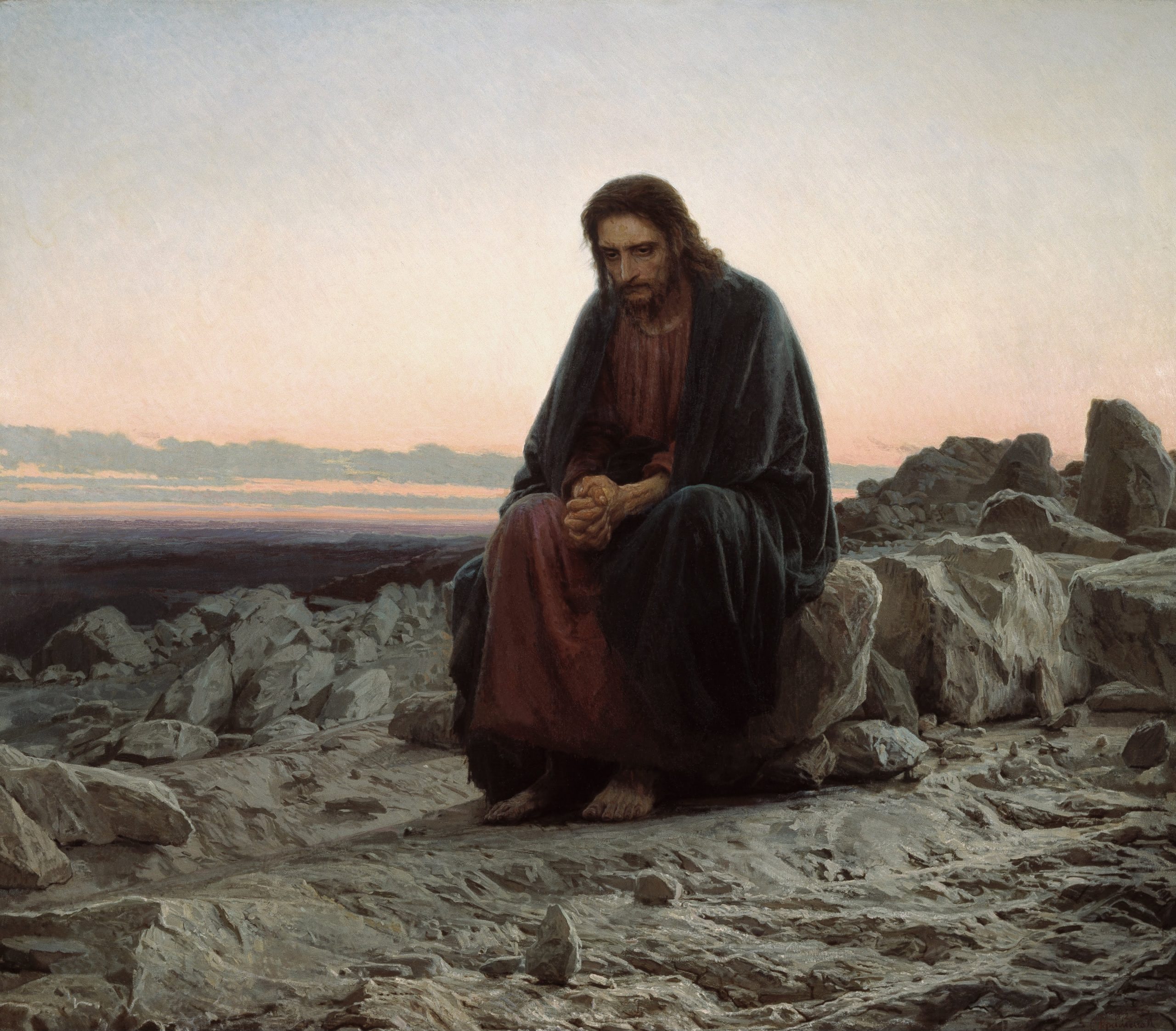
First Sunday of Lent
LITurgical Color: Violet
Rosary Mysteries: Glorious Mysteries

Daily Readings
Gospel: Matthew 4: 1-11
1 Then Jesus was led by the spirit into the desert, to be tempted by the devil.
2 And when he had fasted forty days and forty nights, afterwards he was hungry.
3 And the tempter coming said to him: If thou be the Son of God, command that these stones be made bread.
4 Who answered and said: It is written, Not in bread alone doth man live, but in every word that proceedeth from the mouth of God.
5 Then the devil took him up into the holy city, and set him upon the pinnacle of the temple,
6 And said to him: If thou be the Son of God, cast thyself down, for it is written: That he hath given his angels charge over thee, and in their hands shall they bear thee up, lest perhaps thou dash thy foot against a stone.
7 Jesus said to him: It is written again: Thou shalt not tempt the Lord thy God.
8 Again the devil took him up into a very high mountain, and shewed him all the kingdoms of the world, and the glory of them,
9 And said to him: All these will I give thee, if falling down thou wilt adore me.
10 Then Jesus saith to him: Begone, Satan: for it is written, The Lord thy God shalt thou adore, and him only shalt thou serve.
11 Then the devil left him; and behold angels came and ministered to him.
1 Tunc Jesus ductus est in desertum a Spiritu, ut tentaretur a diabolo.
2 Et cum jejunasset quadraginta diebus, et quadraginta noctibus, postea esuriit.
3 Et accedens tentator dixit ei: Si Filius Dei es, dic ut lapides isti panes fiant.
4 Qui respondens dixit: Scriptum est: Non in solo pane vivit homo, sed in omni verbo, quod procedit de ore Dei.
5 Tunc assumpsit eum diabolus in sanctam civitatem, et statuit eum super pinnaculum templi,
6 et dixit ei: Si Filius Dei es, mitte te deorsum. Scriptum est enim: Quia angelis suis mandavit de te, et in manibus tollent te, ne forte offendas ad lapidem pedem tuum.
7 Ait illi Jesus: Rursum scriptum est: Non tentabis Dominum Deum tuum.
8 Iterum assumpsit eum diabolus in montem excelsum valde: et ostendit ei omnia regna mundi, et gloriam eorum,
9 et dixit ei: Hæc omnia tibi dabo, si cadens adoraveris me.
10 Tunc dicit ei Jesus: Vade Satana: Scriptum est enim: Dominum Deum tuum adorabis, et illi soli servies.
11 Tunc reliquit eum diabolus: et ecce angeli accesserunt, et ministrabant ei.
First Reading: Genesis 2: 7-9; 3: 1-7
7 And the Lord God formed man of the slime of the earth: and breathed into his face the breath of life, and man became a living soul.
8 And the Lord God had planted a paradise of pleasure from the beginning: wherein he placed man whom he had formed.
9 And the Lord God brought forth of the ground all manner of trees, fair to behold, and pleasant to eat of: the tree of life also in the midst of paradise: and the tree of knowledge of good and evil.
1 Now the serpent was more subtle than any of the beasts of the earth which the Lord God had made. And he said to the woman: Why hath God commanded you, that you should not eat of every tree of paradise?
2 And the woman answered him, saying: Of the fruit of the trees that are in paradise we do eat:
3 But of the fruit of the tree which is in the midst of paradise, God hath commanded us that we should not eat; and that we should not touch it, lest perhaps we die.
4 And the serpent said to the woman: No, you shall not die the death.
5 For God doth know that in what day soever you shall eat thereof, your eyes shall be opened: and you shall be as Gods, knowing good and evil.
6 And the woman saw that the tree was good to eat, and fair to the eyes, and delightful to behold: and she took of the fruit thereof, and did eat, and gave to her husband who did eat.
7 And the eyes of them both were opened: and when they perceived themselves to be naked, they sewed together fig leaves, and made themselves aprons.
7 Formavit igitur Dominus Deus hominem de limo terræ, et inspiravit in faciem ejus spiraculum vitæ, et factus est homo in animam viventem.
8 Plantaverat autem Dominus Deus paradisum voluptatis a principio, in quo posuit hominem quem formaverat.
9 Produxitque Dominus Deus de humo omne lignum pulchrum visu, et ad vescendum suave lignum etiam vitæ in medio paradisi, lignumque scientiæ boni et mali.
1 Sed et serpens erat callidior cunctis animantibus terræ quæ fecerat Dominus Deus. Qui dixit ad mulierem: Cur præcepit vobis Deus ut non comederetis de omni ligno paradisi?
2 Cui respondit mulier: De fructu lignorum, quæ sunt in paradiso, vescimur:
3 de fructu vero ligni quod est in medio paradisi, præcepit nobis Deus ne comederemus, et ne tangeremus illud, ne forte moriamur.
4 Dixit autem serpens ad mulierem: Nequaquam morte moriemini.
5 Scit enim Deus quod in quocumque die comederitis ex eo, aperientur oculi vestri, et eritis sicut dii, scientes bonum et malum.
6 Vidit igitur mulier quod bonum esset lignum ad vescendum, et pulchrum oculis, aspectuque delectabile: et tulit de fructu illius, et comedit: deditque viro suo, qui comedit.
7 Et aperti sunt oculi amborum; cumque cognovissent se esse nudos, consuerunt folia ficus, et fecerunt sibi perizomata.
Second Reading: Romans 5: 12-19
12 Wherefore as by one man sin entered into this world, and by sin death; and so death passed upon all men, in whom all have sinned.
13 For until the law sin was in the world; but sin was not imputed, when the law was not.
14 But death reigned from Adam unto Moses, even over them also who have not sinned after the similitude of the transgression of Adam, who is a figure of him who was to come.
15 But not as the offence, so also the gift. For if by the offence of one, many died; much more the grace of God, and the gift, by the grace of one man, Jesus Christ, hath abounded unto many.
16 And not as it was by one sin, so also is the gift. For judgment indeed was by one unto condemnation; but grace is of many offences, unto justification.
17 For if by one man’s offence death reigned through one; much more they who receive abundance of grace, and of the gift, and of justice, shall reign in life through one, Jesus Christ.
18 Therefore, as by the offence of one, unto all men to condemnation; so also by the justice of one, unto all men to justification of life.
19 For as by the disobedience of one man, many were made sinners; so also by the obedience of one, many shall be made just.
20 Now the law entered in, that sin might abound. And where sin abounded, grace did more abound.
12 Propterea sicut per unum hominem peccatum in hunc mundum intravit, et per peccatum mors, et ita in omnes homines mors pertransiit, in quo omnes peccaverunt.
13 Usque ad legem enim peccatum erat in mundo: peccatum autem non imputabatur, cum lex non esset.
14 Sed regnavit mors ab Adam usque ad Moysen etiam in eos qui non peccaverunt in similitudinem prævaricationis Adæ, qui est forma futuri.
15 Sed non sicut delictum, ita et donum: si enim unius delicto multi mortui sunt: multo magis gratia Dei et donum in gratia unius hominis Jesu Christi in plures abundavit.
16 Et non sicut per unum peccatum, ita et donum. Nam judicium quidem ex uno in condemnationem: gratia autem ex multis delictis in justificationem.
17 Si enim unius delicto mors regnavit per unum: multo magis abundantiam gratiæ, et donationis, et justitiæ accipientes, in vita regnabunt per unum Jesum Christum.
18 Igitur sicut per unius delictum in omnes homines in condemnationem: sic et per unius justitiam in omnes homines in justificationem vitæ.
19 Sicut enim per inobedientiam unius hominis, peccatores constituti sunt multi: ita et per unius obeditionem, justi constituentur multi.

A Daily Question from the Summa Theologica
Whether the minister’s intention is required for the validity of a sacrament? (Article 8 of 10 of Question 64. Of the Causes of the Sacraments from the Treatise on the Sacraments)
Objection 1: It seems that the minister’s intention is not required for the validity of a sacrament. For the minister of a sacrament works instrumentally. But the perfection of an action does not depend on the intention of the instrument, but on that of the principal agent. Therefore the minister’s intention is not necessary for the perfecting of a sacrament.
Objection 2: Further, one man’s intention cannot be known to another. Therefore if the minister’s intention were required for the validity of a sacrament, he who approaches a sacrament could not know whether he has received the sacrament. Consequently he could have no certainty in regard to salvation; the more that some sacraments are necessary for salvation, as we shall state further on (Q[65], A[4]).
Objection 3: Further, a man’s intention cannot bear on that to which he does not attend. But sometimes ministers of sacraments do not attend to what they say or do, through thinking of something else. Therefore in this respect the sacrament would be invalid through want of intention.
On the contrary, What is unintentional happens by chance. But this cannot be said of the sacramental operation. Therefore the sacraments require the intention of the minister.
I answer that, When a thing is indifferent to many uses, it must needs be determined to one, if that one has to be effected. Now those things which are done in the sacraments, can be done with various intent; for instance, washing with water, which is done in baptism, may be ordained to bodily cleanliness, to the health of the body, to amusement, and many other similar things. Consequently, it needs to be determined to one purpose, i.e. the sacramental effect, by the intention of him who washes. And this intention is expressed by the words which are pronounced in the sacraments; for instance the words, “I baptize thee in the name of the Father,” etc.
Reply to Objection 1: An inanimate instrument has no intention regarding the effect; but instead of the intention there is the motion whereby it is moved by the principal agent. But an animate instrument, such as a minister, is not only moved, but in a sense moves itself, in so far as by his will he moves his bodily members to act. Consequently, his intention is required, whereby he subjects himself to the principal agent; that is, it is necessary that he intend to do that which Christ and the Church do.
Reply to Objection 2: On this point there are two opinions. For some hold that the mental intention of the minister is necessary; in the absence of which the sacrament is invalid: and that this defect in the case of children who have not the intention of approaching the sacrament, is made good by Christ, Who baptizes inwardly: whereas in adults, who have that intention, this defect is made good by their faith and devotion.
This might be true enough of the ultimate effect, i.e. justification from sins; but as to that effect which is both real and sacramental, viz. the character, it does not appear possible for it to be made good by the devotion of the recipient, since a character is never imprinted save by a sacrament.
Consequently, others with better reason hold that the minister of a sacrament acts in the person of the whole Church, whose minister he is; while in the words uttered by him, the intention of the Church is expressed; and that this suffices for the validity of the sacrament, except the contrary be expressed on the part either of the minister or of the recipient of the sacrament.
Reply to Objection 3: Although he who thinks of something else, has no actual intention, yet he has habitual intention, which suffices for the validity of the sacrament; for instance if, when a priest goes to baptize someone, he intends to do to him what the Church does. Wherefore if subsequently during the exercise of the act his mind be distracted by other matters, the sacrament is valid in virtue of his original intention. Nevertheless, the minister of a sacrament should take great care to have actual intention. But this is not entirely in man’s power, because when a man wishes to be very intent on something, he begins unintentionally to think of other things, according to Ps. 39:18: “My heart hath forsaken me.”
Continue reading the rest of the articles on Sacred Texts Archive website.