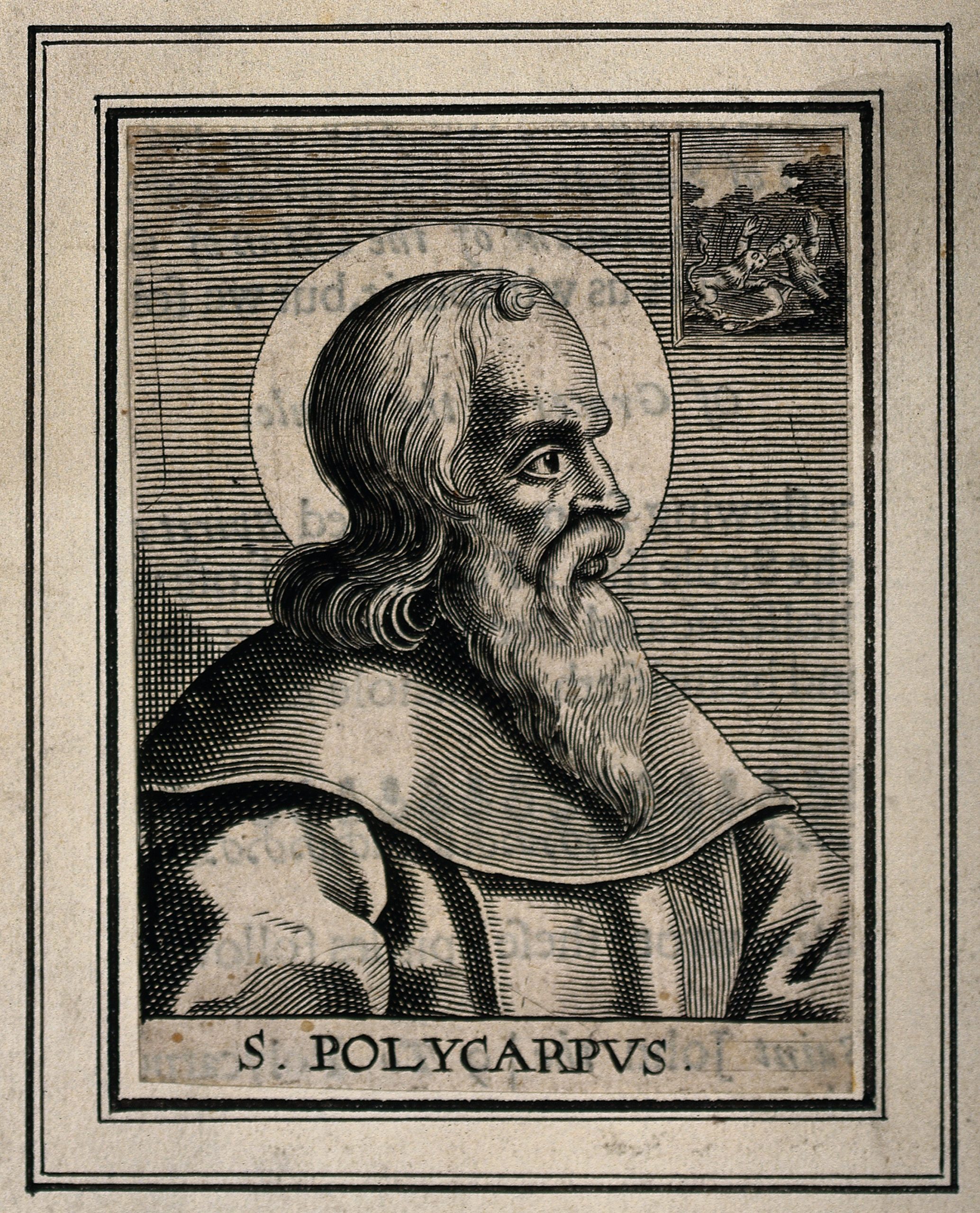
Optional Memorial of Saint Polycarp, Bishop and Martyr
LITurgical Color: Violet
Rosary Mysteries: Joyful Mysteries
“I bless you, Father, for judging me worthy of this hour, so that in the company of the martyrs I may share the cup of Christ.”
Saint Polycarp
est. 69 – est. 155
Patron of people suffering from earache, hearing issues, and dysentery

Daily Readings
Gospel: Matthew 25: 31-46
31 And when the Son of man shall come in his majesty, and all the angels with him, then shall he sit upon the seat of his majesty.
32 And all nations shall be gathered together before him, and he shall separate them one from another, as the shepherd separateth the sheep from the goats:
33 And he shall set the sheep on his right hand, but the goats on his left.
34 Then shall the king say to them that shall be on his right hand: Come, ye blessed of my Father, possess you the kingdom prepared for you from the foundation of the world.
35 For I was hungry, and you gave me to eat; I was thirsty, and you gave me to drink; I was a stranger, and you took me in:
36 Naked, and you covered me: sick, and you visited me: I was in prison, and you came to me.
37 Then shall the just answer him, saying: Lord, when did we see thee hungry, and fed thee; thirsty, and gave thee drink?
38 And when did we see thee a stranger, and took thee in? or naked, and covered thee?
39 Or when did we see thee sick or in prison, and came to thee?
40 And the king answering, shall say to them: Amen I say to you, as long as you did it to one of these my least brethren, you did it to me.
41 Then he shall say to them also that shall be on his left hand: Depart from me, you cursed, into everlasting fire which was prepared for the devil and his angels.
42 For I was hungry, and you gave me not to eat: I was thirsty, and you gave me not to drink.
43 I was a stranger, and you took me not in: naked, and you covered me not: sick and in prison, and you did not visit me.
44 Then they also shall answer him, saying: Lord, when did we see thee hungry, or thirsty, or a stranger, or naked, or sick, or in prison, and did not minister to thee?
45 Then he shall answer them, saying: Amen I say to you, as long as you did it not to one of these least, neither did you do it to me.
46 And these shall go into everlasting punishment: but the just, into life everlasting.
31 Cum autem venerit Filius hominis in majestate sua, et omnes angeli cum eo, tunc sedebit super sedem majestatis suæ:
32 et congregabuntur ante eum omnes gentes, et separabit eos ab invicem, sicut pastor segregat oves ab hædis:
33 et statuet oves quidem a dextris suis, hædos autem a sinistris.
34 Tunc dicet rex his qui a dextris ejus erunt: Venite benedicti Patris mei, possidete paratum vobis regnum a constitutione mundi:
35 esurivi enim, et dedistis mihi manducare: sitivi, et dedistis mihi bibere: hospes eram, et collegistis me:
36 nudus, et cooperuistis me: infirmus, et visitastis me: in carcere eram, et venistis ad me.
37 Tunc respondebunt ei justi, dicentes: Domine, quando te vidimus esurientem, et pavimus te: sitientem, et dedimus tibi potum?
38 quando autem te vidimus hospitem, et collegimus te: aut nudum, et cooperuimus te?
39 aut quando te vidimus infirmum, aut in carcere, et venimus ad te?
40 Et respondens rex, dicet illis: Amen dico vobis, quamdiu fecistis uni ex his fratribus meis minimis, mihi fecistis.
41 Tunc dicet et his qui a sinistris erunt: Discedite a me maledicti in ignem æternum, qui paratus est diabolo, et angelis ejus:
42 esurivi enim, et non dedistis mihi manducare: sitivi, et non desistis mihi potum:
43 hospes eram, et non collegistis me: nudus, et non cooperuistis me: infirmus, et in carcere, et non visitastis me.
44 Tunc respondebunt ei et ipsi, dicentes: Domine, quando te vidimus esurientem, aut sitientem, aut hospitem, aut nudum, aut infirmum, aut in carcere, et non ministravimus tibi?
45 Tunc respondebit illis, dicens: Amen dico vobis: Quamdiu non fecistis uni de minoribus his, nec mihi fecistis.
46 Et ibunt hi in supplicium æternum: justi autem in vitam æternam.
First Reading: Leviticus 19: 1-2, 11-18
1 The Lord spoke to Moses, saying:
2 Speak to all the congregation of the children of Israel, and thou shalt say to them: Be ye holy, because I the Lord your God am holy.
11 You shall not steal. You shall not lie, neither shall any man deceive his neighbour.
12 Thou shalt not swear falsely by my name, nor profane the name of thy God. I am the Lord.
13 Thou shalt not calumniate thy neighbour, nor oppress him by violence. The wages of him that hath been hired by thee shall not abide with thee until the morning.
14 Thou shalt not speak evil of the deaf, nor put a stumblingblock before the blind: but thou shalt fear the Lord thy God, because I am the Lord.
15 Thou shalt not do that which is unjust, nor judge unjustly. Respect not the person of the poor, nor honour the countenance of the mighty. But judge thy neighbour according to justice.
16 Thou shalt not be a detractor nor a whisperer among the people. Thou shalt not stand against the blood of thy neighbour. I am the Lord.
17 Thou shalt not hate thy brother in thy heart, but reprove him openly, lest thou incur sin through him.
18 Seek not revenge, nor be mindful of the injury of thy citizens. Thou shalt love thy friend as thyself. I am the Lord.
1 Locutus est Dominus ad Moysen, dicens:
2 Loquere ad omnem cœtum filiorum Israël, et dices ad eos: Sancti estote, quia ego sanctus sum, Dominus Deus vester.
11 Non facietis furtum. Non mentiemini, nec decipiet unusquisque proximum suum.
12 Non perjurabis in nomine meo, nec pollues nomen Dei tui. Ego Dominus.
13 Non facies calumniam proximo tuo nec vi opprimes eum. Non morabitur opus mercenarii tui apud te usque mane.
14 Non maledices surdo, nec coram cæco pones offendiculum: sed timebis Dominum Deum tuum, quia ego sum Dominus.
15 Non facies quod iniquum est, nec injuste judicabis. Non consideres personam pauperis, nec honores vultum potentis. Juste judica proximo tuo.
16 Non eris criminator, nec susurro in populo. Non stabis contra sanguinem proximi tui. Ego Dominus.
17 Non oderis fratrem tuum in corde tuo, sed publice argue eum, ne habeas super illo peccatum.
18 Non quæras ultionem, nec memor eris injuriæ civium tuorum. Diliges amicum tuum sicut teipsum. Ego Dominus.

A Daily Question from the Summa Theologica
Whether faith is required of necessity in the minister of a sacrament? (Article 9 of 10 of Question 64. Of the Causes of the Sacraments from the Treatise on the Sacraments)
Objection 1: It seems that faith is required of necessity in the minister of a sacrament. For, as stated above (A[8]), the intention of the minister is necessary for the validity of a sacrament. But “faith directs in intention” as Augustine says against Julian (In Psalm xxxi, cf. Contra Julian iv). Therefore, if the minister is without the true faith, the sacrament is invalid.
Objection 2: Further, if a minister of the Church has not the true faith, it seems that he is a heretic. But heretics, seemingly, cannot confer sacraments. For Cyprian says in an epistle against heretics (lxxiii): “Everything whatsoever heretics do, is carnal, void and counterfeit, so that nothing that they do should receive our approval.” And Pope Leo says in his epistle to Leo Augustus (clvi): “It is a matter of notoriety that the light of all the heavenly sacraments is extinguished in the see of Alexandria, by an act of dire and senseless cruelty. The sacrifice is no longer offered, the chrism is no longer consecrated, all the mysteries of religion have fled at the touch of the parricide hands of ungodly men.” Therefore a sacrament requires of necessity that the minister should have the true faith.
Objection 3: Further, those who have not the true faith seem to be separated from the Church by excommunication: for it is written in the second canonical epistle of John (10): “If any man come to you, and bring not this doctrine, receive him not into the house, nor say to him; God speed you”: and (Titus 3:10): “A man that is a heretic, after the first and second admonition avoid.” But it seems that an excommunicate cannot confer a sacrament of the Church: since he is separated from the Church, to whose ministry the dispensation of the sacraments belongs. Therefore a sacrament requires of necessity that the minister should have the true faith.
On the contrary, Augustine says against the Donatist Petilian: “Remember that the evil lives of wicked men are not prejudicial to God’s sacraments, by rendering them either invalid or less holy.”
I answer that, As stated above (A[5]), since the minister works instrumentally in the sacraments, he acts not by his own but by Christ’s power. Now just as charity belongs to a man’s own power so also does faith. Wherefore, just as the validity of a sacrament does not require that the minister should have charity, and even sinners can confer sacraments, as stated above (A[5]); so neither is it necessary that he should have faith, and even an unbeliever can confer a true sacrament, provided that the other essentials be there.
Reply to Objection 1: It may happen that a man’s faith is defective in regard to something else, and not in regard to the reality of the sacrament which he confers: for instance, he may believe that it is unlawful to swear in any case whatever, and yet he may believe that baptism is an efficient cause of salvation. And thus such unbelief does not hinder the intention of conferring the sacrament. But if his faith be defective in regard to the very sacrament that he confers, although he believe that no inward effect is caused by the thing done outwardly, yet he does know that the Catholic Church intends to confer a sacrament by that which is outwardly done. Wherefore, his unbelief notwithstanding, he can intend to do what the Church does, albeit he esteem it to be nothing. And such an intention suffices for a sacrament: because as stated above (A[8], ad 2) the minister of a sacrament acts in the person of the Church by whose faith any defect in the minister’s faith is made good.
Reply to Objection 2: Some heretics in conferring sacraments do not observe the form prescribed by the Church: and these confer neither the sacrament nor the reality of the sacrament. But some do observe the form prescribed by the Church: and these confer indeed the sacrament but not the reality. I say this in the supposition that they are outwardly cut off from the Church; because from the very fact that anyone receives the sacraments from them, he sins; and consequently is hindered from receiving the effect of the sacrament. Wherefore Augustine (Fulgentius, De Fide ad Pet.) says: “Be well assured and have no doubt whatever that those who are baptized outside the Church, unless they come back to the Church, will reap disaster from their Baptism.” In this sense Pope Leo says that “the light of the sacraments was extinguished in the Church of Alexandria”; viz. in regard to the reality of the sacrament, not as to the sacrament itself.
Cyprian, however, thought that heretics do not confer even the sacrament: but in this respect we do not follow his opinion. Hence Augustine says (De unico Baptismo xiii): “Though the martyr Cyprian refused to recognize Baptism conferred by heretics or schismatics, yet so great are his merits, culminating in the crown of martyrdom, that the light of his charity dispels the darkness of his fault, and if anything needed pruning, the sickle of his passion cut it off.”
Reply to Objection 3: The power of administering the sacraments belongs to the spiritual character which is indelible, as explained above (Q[63], A[3] ). Consequently, if a man be suspended by the Church, or excommunicated or degraded, he does not lose the power of conferring sacraments, but the permission to use this power. Wherefore he does indeed confer the sacrament, but he sins in so doing. He also sins that receives a sacrament from such a man: so that he does not receive the reality of the sacrament, unless ignorance excuses him.
Continue reading the rest of the articles on Sacred Texts Archive website.