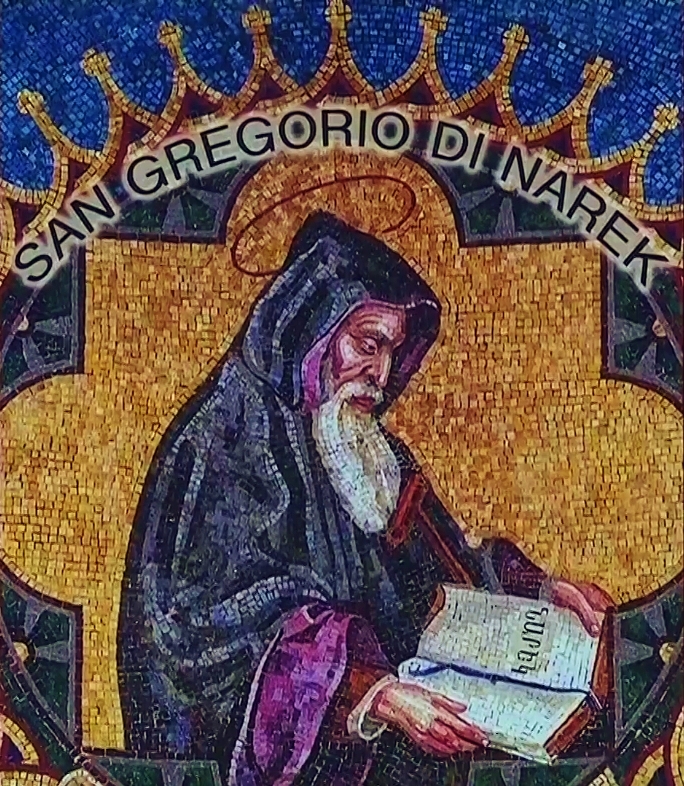
Optional Memorial of Saint Gregory of Narek, Abbot and Doctor of the Church
LITurgical Color: Violet
Rosary Mysteries: Sorrowful Mysteries
“Speaking with God from the Depths of the Heart. The voice of a sighing heart, its sobs and mournful cries, I offer up to you, O Seer of Secrets, placing the fruits of my wavering mind as a savory sacrifice on the fire of my grieving soul to be delivered to you in the censer of my will.”
Saint Gregory of Narek
est. 951 – est. 1003
Patron of young people and novices in religious orders

Daily Readings
Gospel: Matthew 5: 20-26
20 For I tell you, that unless your justice abound more than that of the scribes and Pharisees, you shall not enter into the kingdom of heaven.
21 You have heard that it was said to them of old: Thou shalt not kill. And whosoever shall kill shall be in danger of the judgment.
22 But I say to you, that whosoever is angry with his brother, shall be in danger of the judgment. And whosoever shall say to his brother, Raca, shall be in danger of the council. And whosoever shall say, Thou Fool, shall be in danger of hell fire.
23 If therefore thou offer thy gift at the altar, and there thou remember that thy brother hath any thing against thee;
24 Leave there thy offering before the altar, and go first to be reconciled to thy brother: and then coming thou shalt offer thy gift.
25 Be at agreement with thy adversary betimes, whilst thou art in the way with him: lest perhaps the adversary deliver thee to the judge, and the judge deliver thee to the officer, and thou be cast into prison.
26 Amen I say to thee, thou shalt not go out from thence till thou repay the last farthing.
20 Dico enim vobis, quia nisi abundaverit justitia vestra plus quam scribarum et pharisæorum, non intrabitis in regnum cælorum.
21 Audistis quia dictum est antiquis: Non occides: qui autem occiderit, reus erit judicio.
22 Ego autem dico vobis: quia omnis qui irascitur fratri suo, reus erit judicio. Qui autem dixerit fratri suo, raca: reus erit concilio. Qui autem dixerit, fatue: reus erit gehennæ ignis.
23 Si ergo offers munus tuum ad altare, et ibi recordatus fueris quia frater tuus habet aliquid adversum te:
24 relinque ibi munus tuum ante altare, et vade prius reconciliari fratri tuo: et tunc veniens offeres munus tuum.
25 Esto consentiens adversario tuo cito dum es in via cum eo: ne forte tradat te adversarius judici, et judex tradat te ministro: et in carcerem mittaris.
26 Amen dico tibi, non exies inde, donec reddas novissimum quadrantem.
First Reading: Ezekiel 18: 21-28
21 But if the wicked do penance for all his sins which he hath committed, and keep all my commandments, and do judgment, and justice, living he shall live, and shall not die.
22 I will not remember all his iniquities that he hath done: in his justice which he hath wrought, he shall live.
23 Is it my will that a sinner should die, saith the Lord God, and not that he should be converted from his ways, and live?
24 But if the just man turn himself away from his justice, and do iniquity according to all the abominations which the wicked man useth to work, shall he live? all his justices which he hath done, shall not be remembered: in the prevarication, by which he hath prevaricated, and in his sin, which he hath committed, in them he shall die.
25 And you have said: The way of the Lord is not right. Hear ye, therefore, O house of Israel: Is it my way that is not right, and are not rather your ways perverse?
26 For when the just turneth himself away from his justice, and committeth iniquity, he shall die therein: in the injustice that he hath wrought he shall die.
27 And when the wicked turneth himself away from his wickedness, which he hath wrought, and doeth judgment, and justice: he shall save his soul alive.
28 Because he considereth and turneth away himself from all his iniquities which he hath wrought, he shall surely live, and not die.
21 Si autem impius egerit pœnitentiam ab omnibus peccatis suis quæ operatus est, et custodierit omnia præcepta mea, et fecerit judicium et justitiam, vita vivet, et non morietur.
22 Omnium iniquitatum ejus quas operatus est, non recordabor: in justitia sua quam operatus est, vivet.
23 Numquid voluntatis meæ est mors impii, dicit Dominus Deus, et non ut convertatur a viis suis, et vivat?
24 Si autem averterit se justus a justitia sua, et fecerit iniquitatem secundum omnes abominationes quas operari solet impius, numquid vivet? Omnes justitiæ ejus quas fecerat, non recordabuntur: in prævaricatione qua prævaricatus est, et in peccato suo quod peccavit, in ipsis morietur.
25 Et dixistis: Non est æqua via Domini! Audite ergo, domus Israël: numquid via mea non est æqua, et non magis viæ vestræ pravæ sunt?
26 Cum enim averterit se justus a justitia sua, et fecerit iniquitatem, morietur in eis: in injustitia quam operatus est morietur.
27 Et cum averterit se impius ab impietate sua quam operatus est, et fecerit judicium et justitiam, ipse animam suam vivificabit:
28 considerans enim, et avertens se ab omnibus iniquitatibus suis quas operatus est, vita vivet, et non morietur.

A Daily Question from the Summa Theologica
Whether the Eucharist is necessary for salvation? (Article 3 of 6 of Question 73. Of the Sacrifice of the Eucharist from the Treatise on the Sacraments)
Objection 1: It seems that this sacrament is necessary for salvation. For our Lord said (Jn. 6:54): “Except you eat the flesh of the Son of Man, and drink His blood, you shall not have life in you.” But Christ’s flesh is eaten and His blood drunk in this sacrament. Therefore, without this sacrament man cannot have the health of spiritual life.
Objection 2: Further, this sacrament is a kind of spiritual food. But bodily food is requisite for bodily health. Therefore, also is this sacrament, for spiritual health.
Objection 3: Further, as Baptism is the sacrament of our Lord’s Passion, without which there is no salvation, so also is the Eucharist. For the Apostle says (1 Cor. 11:26): “For as often as you shall eat this bread, and drink the chalice, you shall show the death of the Lord, until He come.” Consequently, as Baptism is necessary for salvation, so also is this sacrament.
On the contrary, Augustine writes (Ad Bonifac. contra Pelag. I): “Nor are you to suppose that children cannot possess life, who are deprived of the body and blood of Christ.”
I answer that, Two things have to be considered in this sacrament, namely, the sacrament itself, and what is contained in it. Now it was stated above (A[1], OBJ[2]) that the reality of the sacrament is the unity of the mystical body, without which there can be no salvation; for there is no entering into salvation outside the Church, just as in the time of the deluge there was none outside the Ark, which denotes the Church, according to 1 Pet. 3:20, 21 And it has been said above (Q[68], A[2]), that before receiving a sacrament, the reality of the sacrament can be had through the very desire of receiving the sacrament. Accordingly, before actual reception of this sacrament, a man can obtain salvation through the desire of receiving it, just as he can before Baptism through the desire of Baptism, as stated above (Q[68], A[2]). Yet there is a difference in two respects. First of all, because Baptism is the beginning of the spiritual life, and the door of the sacraments; whereas the Eucharist is, as it were, the consummation of the spiritual life, and the end of all the sacraments, as was observed above (Q[63], A[6]): for by the hallowings of all the sacraments preparation is made for receiving or consecrating the Eucharist. Consequently, the reception of Baptism is necessary for starting the spiritual life, while the receiving of the Eucharist is requisite for its consummation; by partaking not indeed actually, but in desire, as an end is possessed in desire and intention. Another difference is because by Baptism a man is ordained to the Eucharist, and therefore from the fact of children being baptized, they are destined by the Church to the Eucharist; and just as they believe through the Church’s faith, so they desire the Eucharist through the Church’s intention, and, as a result, receive its reality. But they are not disposed for Baptism by any previous sacrament, and consequently before receiving Baptism, in no way have they Baptism in desire; but adults alone have: consequently, they cannot have the reality of the sacrament without receiving the sacrament itself. Therefore this sacrament is not necessary for salvation in the same way as Baptism is.
Reply to Objection 1: As Augustine says, explaining Jn. 6:54, “This food and this drink,” namely, of His flesh and blood: “He would have us understand the fellowship of His body and members, which is the Church in His predestinated, and called, and justified, and glorified, His holy and believing ones.” Hence, as he says in his Epistle to Boniface (Pseudo-Beda, in 1 Cor. 10:17): “No one should entertain the slightest doubt, that then every one of the faithful becomes a partaker of the body and blood of Christ, when in Baptism he is made a member of Christ’s body; nor is he deprived of his share in that body and chalice even though he depart from this world in the unity of Christ’s body, before he eats that bread and drinks of that chalice.”
Reply to Objection 2: The difference between corporeal and spiritual food lies in this, that the former is changed into the substance of the person nourished, and consequently it cannot avail for supporting life except it be partaken of; but spiritual food changes man into itself, according to that saying of Augustine (Confess. vii), that he heard the voice of Christ as it were saying to him: “Nor shalt thou change Me into thyself, as food of thy flesh, but thou shalt be changed into Me.” But one can be changed into Christ, and be incorporated in Him by mental desire, even without receiving this sacrament. And consequently the comparison does not hold.
Reply to Objection 3: Baptism is the sacrament of Christ’s death and Passion, according as a man is born anew in Christ in virtue of His Passion; but the Eucharist is the sacrament of Christ’s Passion according as a man is made perfect in union with Christ Who suffered. Hence, as Baptism is called the sacrament of Faith, which is the foundation of the spiritual life, so the Eucharist is termed the sacrament of Charity, which is “the bond of perfection” (Col. 3:14).
Continue reading the rest of the articles on Sacred Texts Archive website.