Lenten Weekday
LITurgical Color: Violet
Rosary Mysteries: Joyful Mysteries

Daily Readings
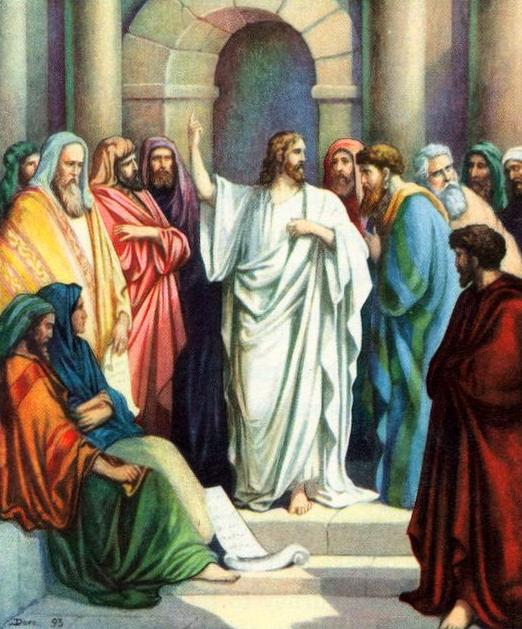
Gospel: Matthew 5: 43-48
43 You have heard that it hath been said, Thou shalt love thy neighbour, and hate thy enemy.
44 But I say to you, Love your enemies: do good to them that hate you: and pray for them that persecute and calumniate you:
45 That you may be the children of your Father who is in heaven, who maketh his sun to rise upon the good, and bad, and raineth upon the just and the unjust.
46 For if you love them that love you, what reward shall you have? do not even the publicans this?
47 And if you salute your brethren only, what do you more? do not also the heathens this?
48 Be you therefore perfect, as also your heavenly Father is perfect.
43 Audistis quia dictum est: Diliges proximum tuum, et odio habebis inimicum tuum.
44 Ego autem dico vobis: diligite inimicos vestros, benefacite his qui oderunt vos, et orate pro persequentibus et calumniantibus vos:
45 ut sitis filii Patris vestri, qui in cælis est: qui solem suum oriri facit super bonos et malos: et pluit super justos et injustos.
46 Si enim diligitis eos qui vos diligunt, quam mercedem habebitis? nonne et publicani hoc faciunt?
47 Et si salutaveritis fratres vestros tantum, quid amplius facitis? nonne et ethnici hoc faciunt?
48 Estote ergo vos perfecti, sicut et Pater vester cælestis perfectus est.
First Reading: Deuteronomy 26: 16-19
16 This day the Lord thy God hath commanded thee to do these commandments and judgments: and to keep and fulfill them with all thy heart, and with all thy soul.
17 Thou hast chosen the Lord this day to be thy God, and to walk in his ways and keep his ceremonies, and precepts, and judgments, and obey his command.
18 And the Lord hath chosen thee this day, to be his peculiar people, as he hath spoken to thee, and to keep all his commandments:
19 And to make thee higher than all nations which he hath created, to his own praise, and name, and glory: that thou mayst be a holy people of the Lord thy God, as he hath spoken.
16 Hodie Dominus Deus tuus præcepit tibi ut facias mandata hæc atque judicia: et custodias et impleas ex toto corde tuo, et ex tota anima tua.
17 Dominum elegisti hodie, ut sit tibi Deus, et ambules in viis ejus, et custodias cæremonias illius, et mandata atque judicia, et obedias ejus imperio.
18 Et Dominus elegit te hodie ut sis ei populus peculiaris, sicut locutus est tibi, et custodias omnia præcepta illius:
19 et faciat te excelsiorem cunctis gentibus quas creavit, in laudem, et nomen, et gloriam suam: ut sis populus sanctus Domini Dei tui, sicut locutus est.

A Daily Question from the Summa Theologica
Whether this sacrament is suitably called by various names? (Article 4 of 6 of Question 73. Of the Sacrifice of the Eucharist from the Treatise on the Sacraments)
Objection 1: It seems that this sacrament is not suitably called by various names. For names should correspond with things. But this sacrament is one, as stated above (A[2]). Therefore, it ought not to be called by various names.
Objection 2: Further, a species is not properly denominated by what is common to the whole genus. But the Eucharist is a sacrament of the New Law; and it is common to all the sacraments for grace to be conferred by them, which the name “Eucharist” denotes, for it is the same thing as “good grace.” Furthermore, all the sacraments bring us help on our journey through this present life, which is the notion conveyed by “Viaticum.” Again something sacred is done in all the sacraments, which belongs to the notion of “Sacrifice”; and the faithful intercommunicate through all the sacraments, which this Greek word and the Latin “Communio” express. Therefore, these names are not suitably adapted to this sacrament.
Objection 3: Further, a host [*From Latin “hostia,” a victim] seems to be the same as a sacrifice. Therefore, as it is not properly called a sacrifice, so neither is it properly termed a “Host.”
On the contrary, is the use of these expressions by the faithful.
I answer that, This sacrament has a threefold significance. one with regard to the past, inasmuch as it is commemorative of our Lord’s Passion, which was a true sacrifice, as stated above (Q[48], A[3]), and in this respect it is called a “Sacrifice.”
With regard to the present it has another meaning, namely, that of Ecclesiastical unity, in which men are aggregated through this Sacrament; and in this respect it is called “Communion” or . For Damascene says (De Fide Orth. iv) that “it is called Communion because we communicate with Christ through it, both because we partake of His flesh and Godhead, and because we communicate with and are united to one another through it.”
With regard to the future it has a third meaning, inasmuch as this sacrament foreshadows the Divine fruition, which shall come to pass in heaven; and according to this it is called “Viaticum,” because it supplies the way of winning thither. And in this respect it is also called the “Eucharist,” that is, “good grace,” because “the grace of God is life everlasting” (Rom. 6:23); or because it really contains Christ, Who is “full of grace.”
In Greek, moreover, it is called , i.e. “Assumption,” because, as Damascene says (De Fide Orth. iv), “we thereby assume the Godhead of the Son.”
Reply to Objection 1: There is nothing to hinder the same thing from being called by several names, according to its various properties or effects.
Reply to Objection 2: What is common to all the sacraments is attributed antonomastically to this one on account of its excellence.
Reply to Objection 3: This sacrament is called a “Sacrifice” inasmuch as it represents the Passion of Christ; but it is termed a “Host” inasmuch as it contains Christ, Who is “a host (Douay: ‘sacrifice’) . . . of sweetness” (Eph. 5:2).
Continue reading the rest of the articles on Sacred Texts Archive website.