SECOND SUNDAY OF LENT
LITurgical Color: Violet
Rosary Mysteries: Glorious Mysteries

Daily Readings
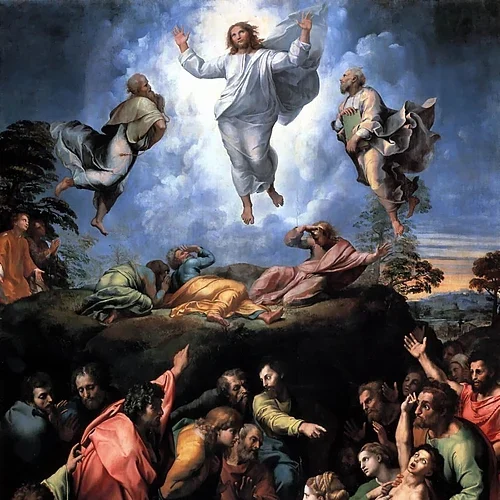
Gospel: Matthew 17: 1-9
1 And after six days Jesus taketh unto him Peter and James, and John his brother, and bringeth them up into a high mountain apart:
2 And he was transfigured before them. And his face did shine as the sun: and his garments became white as snow.
3 And behold there appeared to them Moses and Elias talking with him.
4 And Peter answering, said to Jesus: Lord, it is good for us to be here: if thou wilt, let us make here three tabernacles, one for thee, and one for Moses, and one for Elias.
5 And as he was yet speaking, behold a bright cloud overshadowed them. And lo, a voice out of the cloud, saying: This is my beloved Son, in whom I am well pleased: hear ye him.
6 And the disciples hearing, fell upon their face, and were very much afraid.
7 And Jesus came and touched them: and said to them, Arise, and fear not.
8 And they lifting up their eyes saw no one but only Jesus.
9 And as they came down from the mountain, Jesus charged them, saying: Tell the vision to no man, till the Son of man be risen from the dead.
1 Et post dies sex assumit Jesus Petrum, et Jacobum, et Joannem fratrem ejus, et ducit illos in montem excelsum seorsum:
2 et transfiguratus est ante eos. Et resplenduit facies ejus sicut sol: vestimenta autem ejus facta sunt alba sicut nix.
3 Et ecce apparuerunt illis Moyses et Elias cum eo loquentes.
4 Respondens autem Petrus, dixit ad Jesum: Domine, bonum est nos hic esse: si vis, faciamus tria tabernacula, tibi unum, Moysi unum, et Eliæ unum.
5 Adhuc eo loquente, ecce nubes lucida obumbravit eos. Et ecce vox de nube, dicens: Hic est Filius meus dilectus, in quo mihi bene complacui: ipsum audite.
6 Et audientes discipuli ceciderunt in faciem suam, et timuerunt valde.
7 Et accessit Jesus, et tetigit eos: dixitque eis: Surgite, et nolite timere.
8 Levantes autem oculos suos, neminem viderunt, nisi solum Jesum.
9 Et descendentibus illis de monte, præcepit eis Jesus, dicens: Nemini dixeritis visionem, donec Filius hominis a mortuis resurgat.
First Reading: Genesis 12: 1-4
1 And the Lord said to Abram: Go forth out of thy country, and from thy kindred, and out of thy father’s house, and come into the land which I shall shew thee.
2 And I will make of thee a great nation, and I will bless thee, and magnify thy name, and thou shalt be blessed.
3 I will bless them that bless thee, and curse them that curse thee, and IN THEE shall all the kindred of the earth be blessed:
4 So Abram went out as the Lord had commanded him, and Lot went with him: Abram was seventy-five years old when he went forth from Haran.
1 Dixit autem Dominus ad Abram: Egredere de terra tua, et de cognatione tua, et de domo patris tui, et veni in terram quam monstrabo tibi.
2 Faciamque te in gentem magnam, et benedicam tibi, et magnificabo nomen tuum, erisque benedictus.
3 Benedicam benedicentibus tibi, et maledicam maledicentibus tibi, atque in te benedicentur universæ cognationes terræ.
4 Egressus est itaque Abram sicut præceperat ei Dominus, et ivit cum eo Lot: septuaginta quinque annorum erat Abram cum egrederetur de Haran.
Second Reading: 2 Timothy 1: 8-10
8 Be not thou therefore ashamed of the testimony of our Lord, nor of me his prisoner: but labour with the gospel, according to the power of God,
9 Who hath delivered us and called us by his holy calling, not according to our works, but according to his own purpose and grace, which was given us in Christ Jesus before the times of the world.
10 But is now made manifest by the illumination of our Saviour Jesus Christ, who hath destroyed death, and hath brought to light life and incorruption by the gospel:
8 Noli itaque erubescere testimonium Domini nostri, neque me vinctum ejus: sed collabora Evangelio secundum virtutem Dei:
9 qui nos liberavit, et vocavit vocatione sua sancta, non secundum opera nostra, sed secundum propositum suum, et gratiam, quæ data est nobis in Christo Jesu ante tempora sæcularia.
10 Manifestata est autem nunc per illuminationem Salvatoris nostri Jesu Christi, qui destruxit quidem mortem, illuminavit autem vitam, et incorruptionem per Evangelium:

A Daily Question from the Summa Theologica
Whether the institution of this sacrament was appropriate? (Article 5 of 6 of Question 73. Of the Sacrifice of the Eucharist from the Treatise on the Sacraments)
Objection 1: It seems that the institution of this sacrament was not appropriate, because as the Philosopher says (De Gener. ii): “We are nourished by the things from whence we spring.” But by Baptism, which is spiritual regeneration, we receive our spiritual being, as Dionysius says (Eccl. Hier. ii). Therefore we are also nourished by Baptism. Consequently there was no need to institute this sacrament as spiritual nourishment.
Objection 2: Further, men are united with Christ through this sacrament as the members with the head. But Christ is the Head of all men, even of those who have existed from the beginning of the world, as stated above (Q[8], AA[3],6). Therefore the institution of this sacrament should not have been postponed till the Lord’s supper.
Objection 3: Further, this sacrament is called the memorial of our Lord’s Passion, according to Mat. 26 (Lk. 22:19): “Do this for a commemoration of Me.” But a commemoration is of things past. Therefore, this sacrament should not have been instituted before Christ’s Passion.
Objection 4: Further, a man is prepared by Baptism for the Eucharist, which ought to be given only to the baptized. But Baptism was instituted by Christ after His Passion and Resurrection, as is evident from Mat. 28:19. Therefore, this sacrament was not suitably instituted before Christ’s Passion.
On the contrary, This sacrament was instituted by Christ, of Whom it is said (Mk. 7:37) that “He did all things well.”
I answer that, This sacrament was appropriately instituted at the supper, when Christ conversed with His disciples for the last time. First of all, because of what is contained in the sacrament: for Christ is Himself contained in the Eucharist sacramentally. Consequently, when Christ was going to leave His disciples in His proper species, He left Himself with them under the sacramental species; as the Emperor’s image is set up to be reverenced in his absence. Hence Eusebius says: “Since He was going to withdraw His assumed body from their eyes, and bear it away to the stars, it was needful that on the day of the supper He should consecrate the sacrament of His body and blood for our sakes, in order that what was once offered up for our ransom should be fittingly worshiped in a mystery.”
Secondly, because without faith in the Passion there could never be any salvation, according to Rom. 3:25: “Whom God hath proposed to be a propitiation, through faith in His blood.” It was necessary accordingly that there should be at all times among men something to show forth our Lord’s Passion; the chief sacrament of which in the old Law was the Paschal Lamb. Hence the Apostle says (1 Cor. 5:7): “Christ our Pasch is sacrificed.” But its successor under the New Testament is the sacrament of the Eucharist, which is a remembrance of the Passion now past, just as the other was figurative of the Passion to come. And so it was fitting that when the hour of the Passion was come, Christ should institute a new Sacrament after celebrating the old, as Pope Leo I says (Serm. lviii).
Thirdly, because last words, chiefly such as are spoken by departing friends, are committed most deeply to memory; since then especially affection for friends is more enkindled, and the things which affect us most are impressed the deepest in the soul. Consequently, since, as Pope Alexander I says, “among sacrifices there can be none greater than the body and blood of Christ, nor any more powerful oblation”; our Lord instituted this sacrament at His last parting with His disciples, in order that it might be held in the greater veneration. And this is what Augustine says (Respons. ad Januar. i): “In order to commend more earnestly the death of this mystery, our Saviour willed this last act to be fixed in the hearts and memories of the disciples whom He was about to quit for the Passion.”
Reply to Objection 1: We are nourished from the same things of which we are made, but they do not come to us in the same way; for those out of which we are made come to us through generation, while the same, as nourishing us, come to us through being eaten. Hence, as we are new-born in Christ through Baptism, so through the Eucharist we eat Christ.
Reply to Objection 2: The Eucharist is the perfect sacrament of our Lord’s Passion, as containing Christ crucified; consequently it could not be instituted before the Incarnation; but then there was room for only such sacraments as were prefigurative of the Lord’s Passion.
Reply to Objection 3: This sacrament was instituted during the supper, so as in the future to be a memorial of our Lord’s Passion as accomplished. Hence He said expressively: “As often as ye shall do these things” [*Cf. Canon of the Mass], speaking of the future.
Reply to Objection 4: The institution responds to the order of intention. But the sacrament of the Eucharist, although after Baptism in the receiving, is yet previous to it in intention; and therefore it behooved to be instituted first. or else it can be said that Baptism was already instituted in Christ’s Baptism; hence some were already baptized with Christ’s Baptism, as we read in Jn. 3:22.
Continue reading the rest of the articles on Sacred Texts Archive website.