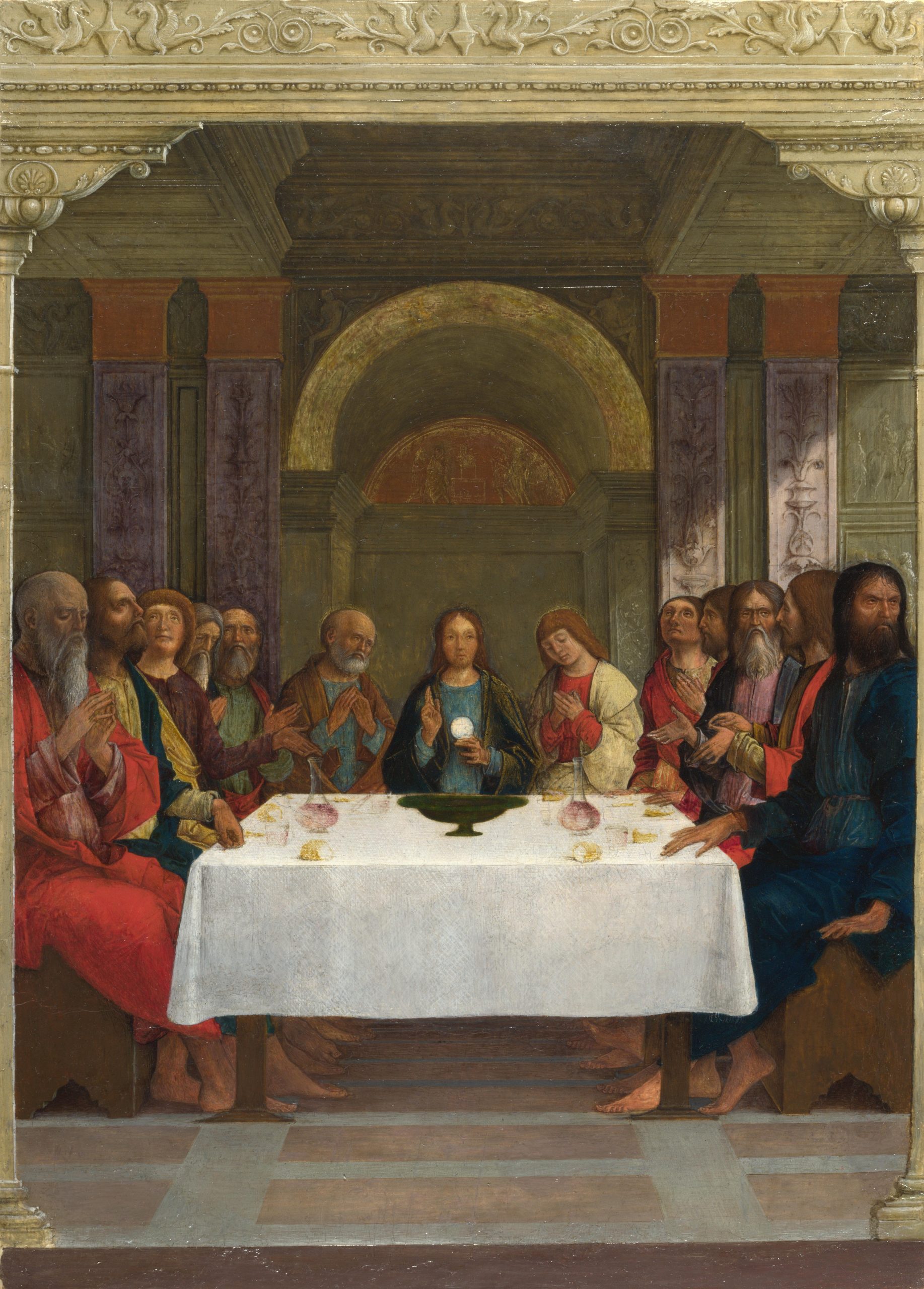
Optional Memorial of Saint Katharine Drexel, Virgin
LITurgical Color: Violet
Rosary Mysteries: Sorrowful Mysteries

Daily Readings
Gospel: Matthew 23: 1-12
1 Then Jesus spoke to the multitudes and to his disciples,
2 Saying: The scribes and the Pharisees have sitten on the chair of Moses.
3 All things therefore whatsoever they shall say to you, observe and do: but according to their works do ye not; for they say, and do not.
4 For they bind heavy and insupportable burdens, and lay them on men’s shoulders; but with a finger of their own they will not move them.
5 And all their works they do for to be seen of men. For they make their phylacteries broad, and enlarge their fringes.
6 And they love the first places at feasts, and the first chairs in the synagogues,
7 And salutations in the market place, and to be called by men, Rabbi.
8 But be not you called Rabbi. For one is your master; and all you are brethren.
9 And call none your father upon earth; for one is your father, who is in heaven.
10 Neither be ye called masters; for one is your master, Christ.
11 He that is the greatest among you shall be your servant.
12 And whosoever shall exalt himself shall be humbled: and he that shall humble himself shall be exalted.
1 Tunc Jesus locutus est ad turbas, et ad discipulos suos,
2 dicens: Super cathedram Moysi sederunt scribæ et pharisæi.
3 Omnia ergo quæcumque dixerint vobis, servate, et facite: secundum opera vero eorum nolite facere: dicunt enim, et non faciunt.
4 Alligant enim onera gravia, et importabilia, et imponunt in humeros hominum: digito autem suo nolunt ea movere.
5 Omnia vero opera sua faciunt ut videantur ab hominibus: dilatant enim phylacteria sua, et magnificant fimbrias.
6 Amant autem primos recubitus in cœnis, et primas cathedras in synagogis,
7 et salutationes in foro, et vocari ab hominibus Rabbi.
8 Vos autem nolite vocari Rabbi: unus est enim magister vester, omnes autem vos fratres estis.
9 Et patrem nolite vocare vobis super terram: unus est enim pater vester qui in cælis est.
10 Nec vocemini magistri: quia magister vester unus est, Christus.
11 Qui major est vestrum, erit minister vester.
12 Qui autem se exaltaverit, humiliabitur: et qui se humiliaverit, exaltabitur.
First Reading: Isaiah 1: 10, 16-20
10 Hear the word of the Lord, ye rulers of Sodom, give ear to the law of our God, ye people of Gomorrha.
16 Wash yourselves, be clean, take away the evil of your devices from my eyes: cease to do perversely,
17 Learn to do well: seek judgment, relieve the oppressed, judge for the fatherless, defend the widow.
18 And then come, and accuse me, saith the Lord: if your sins be as scarlet, they shall be made as white as snow: and if they be red as crimson, they shall be white as wool.
19 If you be willing, and will hearken to me, you shall eat the good things of the land.
20 But if you will not, and will provoke me to wrath: the sword shall devour you because the mouth of the Lord hath spoken it.
10 Audite verbum Domini,
principes Sodomorum;
percipite auribus legem Dei nostri,
populus Gomorrhæ.
16 Lavamini, mundi estote;
auferte malum cogitationum vestrarum
ab oculis meis:
quiescite agere perverse,
17 discite benefacere;
quærite judicium, subvenite oppresso,
judicate pupillo, defendite viduam.]
18 [Et venite, et arguite me, dicit Dominus.
Si fuerint peccata vestra ut coccinum,
quasi nix dealbabuntur;
et si fuerint rubra quasi vermiculus,
velut lana alba erunt.
19 Si volueritis, et audieritis me,
bona terræ comeditis.
20 Quod si nolueritis, et me ad iracundiam provocaveritis,
gladius devorabit vos,
quia os Domini locutum est.

A Daily Question from the Summa Theologica
Whether the matter of this sacrament is bread and wine? (Article 1 of 8 of Question 74. Of the Matter of This Sacrament from the Treatise on the Sacraments)
Objection 1: It seems that the matter of this sacrament is not bread and wine. Because this sacrament ought to represent Christ’s Passion more fully than did the sacraments of the Old Law. But the flesh of animals, which was the matter of the sacraments under the Old Law, shows forth Christ’s Passion more fully than bread and wine. Therefore the matter of this sacrament ought rather to be the flesh of animals than bread and wine.
Objection 2: Further, this sacrament is to be celebrated in every place. But in many lands bread is not to be found, and in many places wine is not to be found. Therefore bread and wine are not a suitable matter for this sacrament.
Objection 3: Further, this sacrament is for both hale and weak. But to some weak persons wine is hurtful. Therefore it seems that wine ought not to be the matter of this sacrament.
On the contrary, Pope Alexander I says (Ep. ad omnes orth. i): “In oblations of the sacraments only bread and wine mixed with water are to be offered.”
I answer that, Some have fallen into various errors about the matter of this sacrament. Some, known as the Artotyrytae, as Augustine says (De Haeres. xxviii), “offer bread and cheese in this sacrament, contending that oblations were celebrated by men in the first ages, from fruits of the earth and sheep.” Others, called Cataphrygae and Pepuziani, “are reputed to have made their Eucharistic bread with infants’ blood drawn from tiny punctures over the entire body, and mixed with flour.” Others, styled Aquarii, under guise of sobriety, offer nothing but water in this sacrament.
Now all these and similar errors are excluded by the fact that Christ instituted this sacrament under the species of bread and wine, as is evident from Mat. 26. Consequently, bread and wine are the proper matter of this sacrament. And the reasonableness of this is seen first, in the use of this sacrament, which is eating: for, as water is used in the sacrament of Baptism for the purpose of spiritual cleansing, since bodily cleansing is commonly done with water; so bread and wine, wherewith men are commonly fed, are employed in this sacrament for the use of spiritual eating.
Secondly, in relation to Christ’s Passion, in which the blood was separated from the body. And therefore in this sacrament, which is the memorial of our Lord’s Passion, the bread is received apart as the sacrament of the body, and the wine as the sacrament of the blood.
Thirdly, as to the effect, considered in each of the partakers. For, as Ambrose (Mag. Sent. iv, D, xi) says on 1 Cor. 11:20, this sacrament “avails for the defense of soul and body”; and therefore “Christ’s body is offered” under the species of bread “for the health of the body, and the blood” under the species of wine “for the health of the soul,” according to Lev. 17:14: “The life of the animal [Vulg.: ‘of all flesh’] is in the blood.”
Fourthly, as to the effect with regard to the whole Church, which is made up of many believers, just “as bread is composed of many grains, and wine flows from many grapes,” as the gloss observes on 1 Cor. 10:17: “We being many are . . . one body,” etc.
Reply to Objection 1: Although the flesh of slaughtered animals represents the Passion more forcibly, nevertheless it is less suitable for the common use of this sacrament, and for denoting the unity of the Church.
Reply to Objection 2: Although wheat and wine are not produced in every country, yet they can easily be conveyed to every land, that is, as much as is needful for the use of this sacrament: at the same time one is not to be consecrated when the other is lacking, because it would not be a complete sacrament.
Reply to Objection 3: Wine taken in small quantity cannot do the sick much harm: yet if there be fear of harm, it is not necessary for all who take Christ’s body to partake also of His blood, as will be stated later (Q[80], A[12]).
Continue reading the rest of the articles on Sacred Texts Archive website.