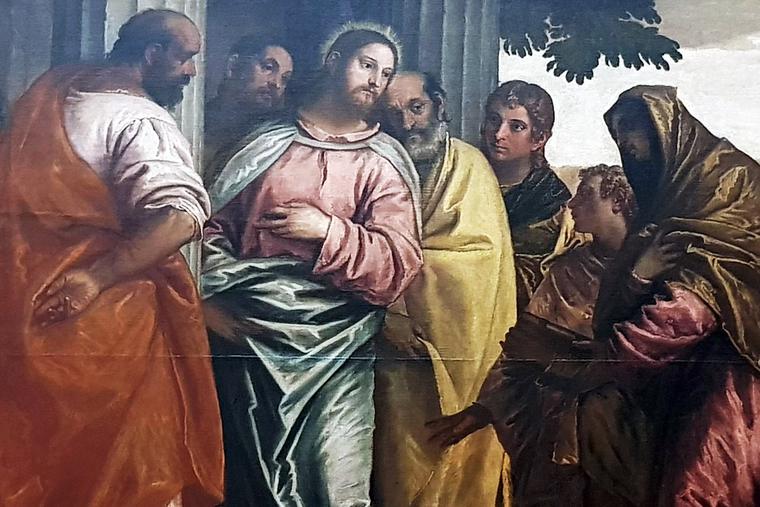
Optional Memorial of Saint Casimir
LITurgical Color: Violet
Rosary Mysteries: Glorious Mysteries

Daily Readings
Gospel: Matthew 20: 17-28
17 And Jesus going up to Jerusalem, took the twelve disciples apart, and said to them:
18 Behold we go up to Jerusalem, and the Son of man shall be betrayed to the chief priests and the scribes, and they shall condemn him to death.
19 And shall deliver him to the Gentiles to be mocked, and scourged, and crucified, and the third day he shall rise again.
20 Then came to him the mother of the sons of Zebedee with her sons, adoring and asking something of him.
21 Who said to her: What wilt thou? She saith to him: Say that these my two sons may sit, the one on thy right hand, and the other on thy left, in thy kingdom.
22 And Jesus answering, said: You know not what you ask. Can you drink the chalice that I shall drink? They say to him: We can.
23 He saith to them: My chalice indeed you shall drink; but to sit on my right or left hand, is not mine to give to you, but to them for whom it is prepared by my Father.
24 And the ten hearing it, were moved with indignation against the two brethren.
25 But Jesus called them to him, and said: You know that the princes of the Gentiles lord it over them; and they that are the greater, exercise power upon them.
26 It shall not be so among you: but whosoever will be the greater among you, let him be your minister:
27 And he that will be first among you, shall be your servant.
28 Even as the Son of man is not come to be ministered unto, but to minister, and to give his life a redemption for many.
17 Et ascendens Jesus Jerosolymam, assumpsit duodecim discipulos secreto, et ait illis:
18 Ecce ascendimus Jerosolymam, et Filius hominis tradetur principibus sacerdotum, et scribis, et condemnabunt eum morte,
19 et tradent eum gentibus ad illudendum, et flagellandum, et crucifigendum, et tertia die resurget.
20 Tunc accessit ad eum mater filiorum Zebedæi cum filiis suis, adorans et petens aliquid ab eo.
21 Qui dixit ei: Quid vis? Ait illi: Dic ut sedeant hi duo filii mei, unus ad dexteram tuam, et unus ad sinistram in regno tuo.
22 Respondens autem Jesus, dixit: Nescitis quid petatis. Potestis bibere calicem, quem ego bibiturus sum? Dicunt ei: Possumus.
23 Ait illis: Calicem quidem meum bibetis: sedere autem ad dexteram meam vel sinistram non est meum dare vobis, sed quibus paratum est a Patre meo.
24 Et audientes decem, indignati sunt de duobus fratribus.
25 Jesus autem vocavit eos ad se, et ait: Scitis quia principes gentium dominantur eorum: et qui majores sunt, potestatem exercent in eos.
26 Non ita erit inter vos: sed quicumque voluerit inter vos major fieri, sit vester minister:
27 et qui voluerit inter vos primus esse, erit vester servus.
28 Sicut Filius hominis non venit ministrari, sed ministrare, et dare animam suam redemptionem pro multis.
First Reading: Jeremiah 18: 18-20
18 And they said: Come, and let us invent devices against Jeremias: for the law shall not perish from the priest, nor counsel from the wise, nor the word from the prophet: come, and let us strike him with the tongue, and let us give no heed to all his words.
19 Give heed to me, O Lord, and hear the voice of my adversaries.
20 Shall evil be rendered for good, because they have digged a pit for my soul? Remember that I have stood in thy sight, to speak good for them, and to turn away thy indignation from them.
18 Et dixerunt: [Venite, et cogitemus contra Jeremiam cogitationes:
non enim peribit lex a sacerdote,
neque consilium a sapiente,
nec sermo a propheta:
venite, et percutiamus eum lingua,
et non attendamus ad universos sermones ejus.]
19 [Attende, Domine, ad me,
et audi vocem adversariorum meorum.
20 Numquid redditur pro bono malum,
quia foderunt foveam animæ meæ?
Recordare quod steterim in conspectu tuo
ut loquerer pro eis bonum,
et averterem indignationem tuam ab eis.

A Daily Question from the Summa Theologica
Whether a determinate quantity of bread and wine is required for the matter of this sacrament? (Article 2 of 8 of Question 74. Of the Matter of This Sacrament from the Treatise on the Sacraments)
Objection 1: It seems that a determinate quantity of bread and wine is required for the matter of this sacrament. Because the effects of grace are no less set in order than those of nature. But, “there is a limit set by nature upon all existing things, and a reckoning of size and development” (De Anima ii). Consequently, in this sacrament, which is called “Eucharist,” that is, “a good grace,” a determinate quantity of the bread and wine is required.
Objection 2: Further, Christ gave no power to the ministers of the Church regarding matters which involve derision of the faith and of His sacraments, according to 2 Cor. 10:8: “Of our power which the Lord hath given us unto edification, and not for your destruction.” But it would lead to mockery of this sacrament if the priest were to wish to consecrate all the bread which is sold in the market and all the wine in the cellar. Therefore he cannot do this.
Objection 3: Further, if anyone be baptized in the sea, the entire sea-water is not sanctified by the form of baptism, but only the water wherewith the body of the baptized is cleansed. Therefore, neither in this sacrament can a superfluous quantity of bread be consecrated.
On the contrary, Much is opposed to little, and great to small. But there is no quantity, however small, of the bread and wine which cannot be consecrated. Therefore, neither is there any quantity, however great, which cannot be consecrated.
I answer that, Some have maintained that the priest could not consecrate an immense quantity of bread and wine, for instance, all the bread in the market or all the wine in a cask. But this does not appear to be true, because in all things containing matter, the reason for the determination of the matter is drawn from its disposition to an end, just as the matter of a saw is iron, so as to adapt it for cutting. But the end of this sacrament is the use of the faithful. Consequently, the quantity of the matter of this sacrament must be determined by comparison with the use of the faithful. But this cannot be determined by comparison with the use of the faithful who are actually present; otherwise the parish priest having few parishioners could not consecrate many hosts. It remains, then, for the matter of this sacrament to be determined in reference to the number of the faithful absolutely. But the number of the faithful is not a determinate one. Hence it cannot be said that the quantity of the matter of this sacrament is restricted.
Reply to Objection 1: The matter of every natural object has its determinate quantity by comparison with its determinate form. But the number of the faithful, for whose use this sacrament is ordained, is not a determinate one. Consequently there is no comparison.
Reply to Objection 2: The power of the Church’s ministers is ordained for two purposes: first for the proper effect, and secondly for the end of the effect. But the second does not take away the first. Hence, if the priest intends to consecrate the body of Christ for an evil purpose, for instance, to make mockery of it, or to administer poison through it, he commits sin by his evil intention, nevertheless, on account of the power committed to him, he accomplishes the sacrament.
Reply to Objection 3: The sacrament of Baptism is perfected in the use of the matter: and therefore no more of the water is hallowed than what is used. But this sacrament is wrought in the consecration of the matter. Consequently there is no parallel.
Continue reading the rest of the articles on Sacred Texts Archive website.