Lenten Weekday
LITurgical Color: Violet
Rosary Mysteries: Luminous Mysteries

Daily Readings
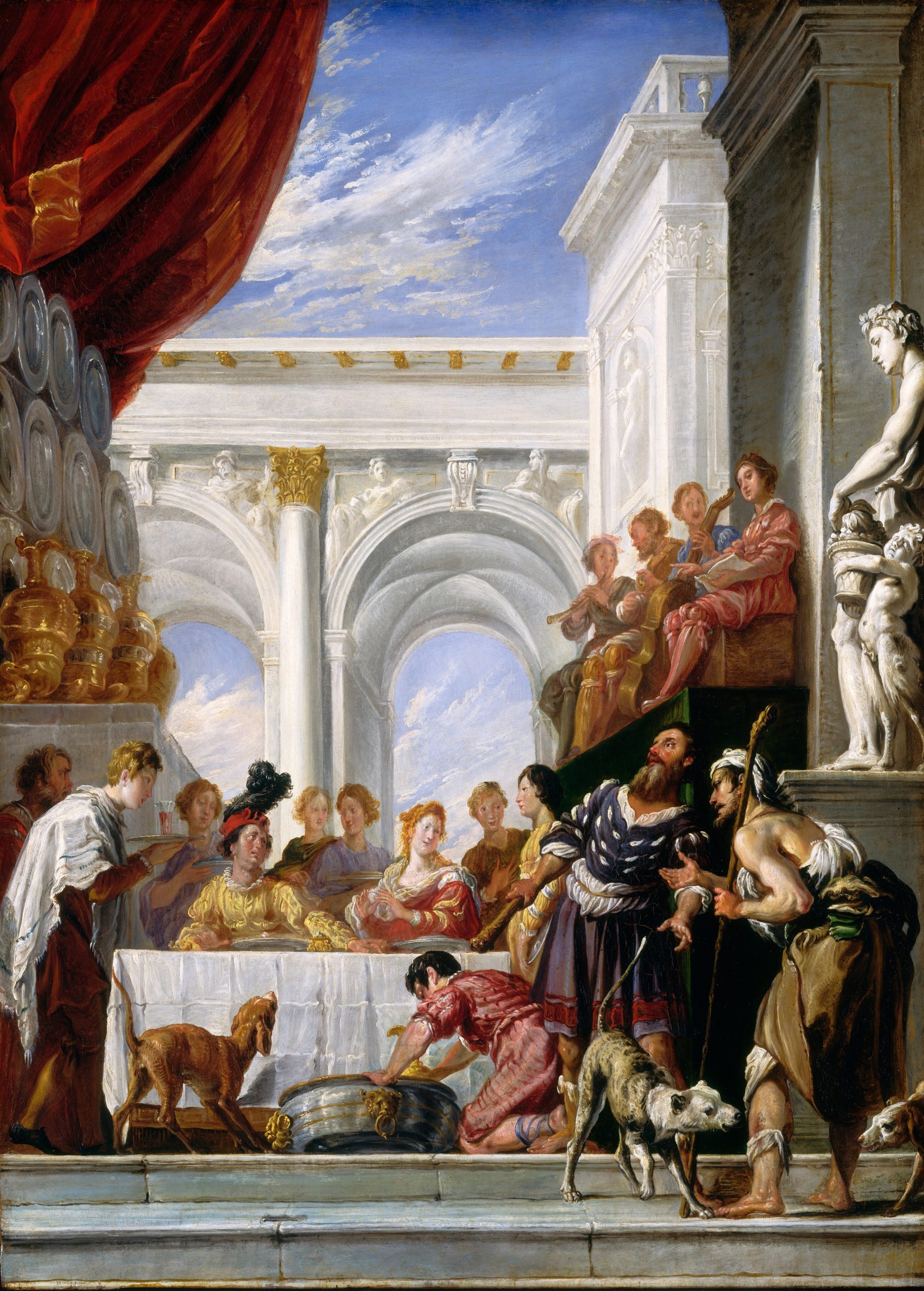
Gospel: Luke 16: 19-31
19 There was a certain rich man, who was clothed in purple and fine linen; and feasted sumptuously every day.
20 And there was a certain beggar, named Lazarus, who lay at his gate, full of sores,
21 Desiring to be filled with the crumbs that fell from the rich man’s table, and no one did give him; moreover the dogs came, and licked his sores.
22 And it came to pass, that the beggar died, and was carried by the angels into Abraham’s bosom. And the rich man also died: and he was buried in hell.
23 And lifting up his eyes when he was in torments, he saw Abraham afar off, and Lazarus in his bosom:
24 And he cried, and said: Father Abraham, have mercy on me, and send Lazarus, that he may dip the tip of his finger in water, to cool my tongue: for I am tormented in this flame.
25 And Abraham said to him: Son, remember that thou didst receive good things in thy lifetime, and likewise Lazarus evil things, but now he is comforted; and thou art tormented.
26 And besides all this, between us and you, there is fixed a great chaos: so that they who would pass from hence to you, cannot, nor from thence come hither.
27 And he said: Then, father, I beseech thee, that thou wouldst send him to my father’s house, for I have five brethren,
28 That he may testify unto them, lest they also come into this place of torments.
29 And Abraham said to him: They have Moses and the prophets; let them hear them.
30 But he said: No, father Abraham: but if one went to them from the dead, they will do penance.
31 And he said to him: If they hear not Moses and the prophets, neither will they believe, if one rise again from the dead.
19 Homo quidam erat dives, qui induebatur purpura et bysso, et epulabatur quotidie splendide.
20 Et erat quidam mendicus, nomine Lazarus, qui jacebat ad januam ejus, ulceribus plenus,
21 cupiens saturari de micis quæ cadebant de mensa divitis, et nemo illi dabat: sed et canes veniebant, et lingebant ulcera ejus.
22 Factum est autem ut moreretur mendicus, et portaretur ab angelis in sinum Abrahæ. Mortuus est autem et dives, et sepultus est in inferno.
23 Elevans autem oculos suos, cum esset in tormentis, vidit Abraham a longe, et Lazarum in sinu ejus:
24 et ipse clamans dixit: Pater Abraham, miserere mei, et mitte Lazarum ut intingat extremum digiti sui in aquam, ut refrigeret linguam meam, quia crucior in hac flamma.
25 Et dixit illi Abraham: Fili, recordare quia recepisti bona in vita tua, et Lazarus similiter mala: nunc autem hic consolatur, tu vero cruciaris:
26 et in his omnibus inter nos et vos chaos magnum firmatum est: ut hi qui volunt hinc transire ad vos, non possint, neque inde huc transmeare.
27 Et ait: Rogo ergo te, pater, ut mittas eum in domum patris mei:
28 habeo enim quinque fratres: ut testetur illis, ne et ipsi veniant in hunc locum tormentorum.
29 Et ait illi Abraham: Habent Moysen et prophetas: audiant illos.
30 At ille dixit: Non, pater Abraham: sed si quis ex mortuis ierit ad eos, pœnitentiam agent.
31 Ait autem illi: Si Moysen et prophetas non audiunt, neque si quis ex mortuis resurrexerit, credent.
First Reading: Jeremiah 17: 5-10
5 Thus saith the Lord: Cursed be the man that trusteth in man, and maketh flesh his arm, and whose heart departeth from the Lord.
6 For he shall be like tamaric in the desert, and he shall not see when good shall come: but he shall dwell in dryness in the desert in a salt land, and not inhabited.
7 Blessed be the man that trusteth in the Lord, and the Lord shall be his confidence.
8 And he shall be as a tree that is planted by the waters, that spreadeth out its roots towards moisture: and it shall not fear when the heat cometh. And the leaf thereof shall be green, and in the time of drought it shall not be solicitous, neither shall it cease at any time to bring forth fruit.
9 The heart is perverse above all things, and unsearchable, who can know it?
10 I am the Lord who search the heart and prove the reins: who give to every one according to his way, and according to the fruit of his devices.
5 [Hæc dicit Dominus:
Maledictus homo qui confidit in homine,
et ponit carnem brachium suum,
et a Domino recedit cor ejus.
6 Erit enim quasi myricæ in deserto,
et non videbit cum venerit bonum:
sed habitabit in siccitate in deserto,
in terra salsuginis et inhabitabili.
7 Benedictus vir qui confidit in Domino,
et erit Dominus fiducia ejus.
8 Et erit quasi lignum quod transplantatur super aquas,
quod ad humorem mittit radices suas,
et non timebit cum venerit æstus:
et erit folium ejus viride,
et in tempore siccitatis non erit sollicitum,
nec aliquando desinet facere fructum.
9 Pravum est cor omnium, et inscrutabile:
quis cognoscet illud?
10 Ego Dominus scrutans cor,
et probans renes:
qui do unicuique juxta viam suam,
et juxta fructum adinventionum suarum.

A Daily Question from the Summa Theologica
Whether wheaten bread is required for the matter of this sacrament? (Article 3 of 8 of Question 74. Of the Matter of This Sacrament from the Treatise on the Sacraments)
Objection 1: It seems that wheaten bread is not requisite for the matter of this sacrament, because this sacrament is a reminder of our Lord’s Passion. But barley bread seems to be more in keeping with the Passion than wheaten bread, as being more bitter, and because Christ used it to feed the multitudes upon the mountain, as narrated in Jn. 6. Therefore wheaten bread is not the proper matter of this sacrament.
Objection 2: Further, in natural things the shape is a sign of species. But some cereals resemble wheat, such as spelt and maize, from which in some localities bread is made for the use of this sacrament. Therefore wheaten bread is not the proper matter of this sacrament.
Objection 3: Further, mixing dissolves species. But wheaten flour is hardly to be found unmixed with some other species of grain, except in the instance of specially selected grain. Therefore it does not seem that wheaten bread is the proper matter for this sacrament.
Objection 4: Further, what is corrupted appears to be of another species. But some make the sacrament from bread which is corrupted, and which no longer seems to be wheaten bread. Therefore, it seems that such bread is not the proper matter of this sacrament.
On the contrary, Christ is contained in this sacrament, and He compares Himself to a grain of wheat, saying (Jn. 12:24): “Unless the grain of wheat falling into the ground die, itself remaineth alone.” Therefore bread from corn, i.e. wheaten bread, is the matter of this sacrament.
I answer that, As stated above (A[1]), for the use of the sacraments such matter is adopted as is commonly made use of among men. Now among other breads wheaten bread is more commonly used by men; since other breads seem to be employed when this fails. And consequently Christ is believed to have instituted this sacrament under this species of bread. Moreover this bread strengthens man, and so it denotes more suitably the effect of this sacrament. Consequently, the proper matter for this sacrament is wheaten bread.
Reply to Objection 1: Barley bread serves to denote the hardness of the Old Law; both on account of the hardness of the bread, and because, as Augustine says (Q[83]): “The flour within the barley, wrapped up as it is within a most tenacious fibre, denotes either the Law itself, which was given in such manner as to be vested in bodily sacraments; or else it denotes the people themselves, who were not yet despoiled of carnal desires, which clung to their hearts like fibre.” But this sacrament belongs to Christ’s “sweet yoke,” and to the truth already manifested, and to a spiritual people. Consequently barley bread would not be a suitable matter for this sacrament.
Reply to Objection 2: A begetter begets a thing like to itself in species. yet there is some unlikeness as to the accidents, owing either to the matter, or to weakness within the generative power. And therefore, if there be any cereals which can be grown from the seed of the wheat (as wild wheat from wheat seed grown in bad ground), the bread made from such grain can be the matter of this sacrament: and this does not obtain either in barley, or in spelt, or even in maize, which is of all grains the one most resembling the wheat grain. But the resemblance as to shape in such seems to denote closeness of species rather than identity; just as the resemblance in shape between the dog and the wolf goes to show that they are allied but not of the same species. Hence from such grains, which cannot in any way be generated from wheat grain, bread cannot be made such as to be the proper matter of this sacrament.
Reply to Objection 3: A moderate mixing does not alter the species, because that little is as it were absorbed by the greater. Consequently, then, if a small quantity of another grain be mixed with a much greater quantity of wheat, bread may be made therefrom so as to be the proper matter of this sacrament; but if the mixing be notable, for instance, half and half; or nearly so, then such mixing alters the species; consequently, bread made therefrom will not be the proper matter of this sacrament.
Reply to Objection 4: Sometimes there is such corruption of the bread that the species of bread is lost, as when the continuity of its parts is destroyed, and the taste, color, and other accidents are changed; hence the body of Christ may not be made from such matter. But sometimes there is not such corruption as to alter the species, but merely disposition towards corruption, which a slight change in the savor betrays, and from such bread the body of Christ may be made: but he who does so, sins from irreverence towards the sacrament. And because starch comes of corrupted wheat, it does not seem as if the body of Christ could be made of the bread made therefrom, although some hold the contrary.
Continue reading the rest of the articles on Sacred Texts Archive website.