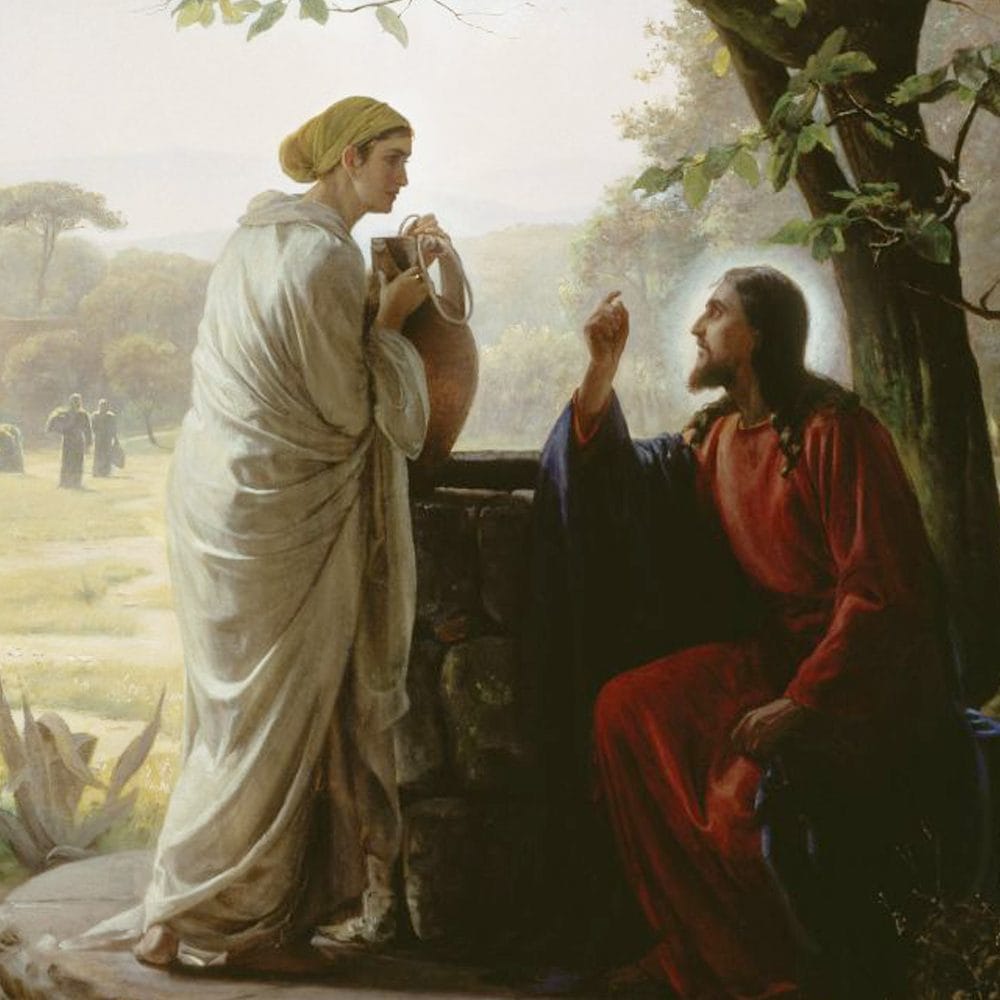
Third Sunday of Lent
LITurgical Color: Violet
Rosary Mysteries: Glorious Mysteries

Daily Readings
Gospel: John 4: 5-42
5 And the light shineth in darkness, and the darkness did not comprehend it.
6 There was a man sent from God, whose name was John.
7 This man came for a witness, to give testimony of the light, that all men might believe through him.
8 He was not the light, but was to give testimony of the light.
9 That was the true light, which enlighteneth every man that cometh into this world.
10 He was in the world, and the world was made by him, and the world knew him not.
11 He came unto his own, and his own received him not.
12 But as many as received him, he gave them power to be made the sons of God, to them that believe in his name.
13 Who are born, not of blood, nor of the will of the flesh, nor of the will of man, but of God.
14 And the Word was made flesh, and dwelt among us, (and we saw his glory, the glory as it were of the only begotten of the Father,) full of grace and truth.
15 John beareth witness of him, and crieth out, saying: This was he of whom I spoke: He that shall come after me, is preferred before me: because he was before me.
16 And of his fulness we all have received, and grace for grace.
17 For the law was given by Moses; grace and truth came by Jesus Christ.
18 No man hath seen God at any time: the only begotten Son who is in the bosom of the Father, he hath declared him.
19 And this is the testimony of John, when the Jews sent from Jerusalem priests and Levites to him, to ask him: Who art thou?
20 And he confessed, and did not deny: and he confessed: I am not the Christ.
21 And they asked him: What then? Art thou Elias? And he said: I am not. Art thou the prophet? And he answered: No.
22 They said therefore unto him: Who art thou, that we may give an answer to them that sent us? What sayest thou of thyself?
23 He said: I am the voice of one crying out in the wilderness, make straight the way of the Lord, as said the prophet Isaias.
24 And they that were sent, were of the Pharisees.
25 And they asked him, and said to him: Why then dost thou baptize, if thou be not Christ, nor Elias, nor the prophet?
26 John answered them, saying: I baptize with water; but there hath stood one in the midst of you, whom you know not.
27 The same is he that shall come after me, who is preferred before me: the latchet of whose shoe I am not worthy to loose.
28 These things were done in Bethania, beyond the Jordan, where John was baptizing.
29 The next day, John saw Jesus coming to him, and he saith: Behold the Lamb of God, behold him who taketh away the sin of the world.
30 This is he, of whom I said: After me there cometh a man, who is preferred before me: because he was before me.
31 And I knew him not, but that he may be made manifest in Israel, therefore am I come baptizing with water.
32 And John gave testimony, saying: I saw the Spirit coming down, as a dove from heaven, and he remained upon him.
33 And I knew him not; but he who sent me to baptize with water, said to me: He upon whom thou shalt see the Spirit descending, and remaining upon him, he it is that baptizeth with the Holy Ghost.
34 And I saw, and I gave testimony, that this is the Son of God.
35 The next day again John stood, and two of his disciples
36 And beholding Jesus walking, he saith: Behold the Lamb of God.
37 And the two disciples heard him speak, and they followed Jesus.
38 And Jesus turning, and seeing them following him, saith to them: What seek you? Who said to him, Rabbi, (which is to say, being interpreted, Master,) where dwellest thou?
39 He saith to them: Come and see. They came, and saw where he abode, and they stayed with him that day: now it was about the tenth hour.
40 And Andrew, the brother of Simon Peter, was one of the two who had heard of John, and followed him.
41 He findeth first his brother Simon, and saith to him: We have found the Messias, which is, being interpreted, the Christ.
42 And he brought him to Jesus. And Jesus looking upon him, said: Thou art Simon the son of Jona: thou shalt be called Cephas, which is interpreted Peter.
5 Venit ergo in civitatem Samariæ, quæ dicitur Sichar, juxta prædium quod dedit Jacob Joseph filio suo.
6 Erat autem ibi fons Jacob. Jesus ergo fatigatus ex itinere, sedebat sic supra fontem. Hora erat quasi sexta.
7 Venit mulier de Samaria haurire aquam. Dicit ei Jesus: Da mihi bibere.
8 (Discipuli enim ejus abierant in civitatem ut cibos emerent.)
9 Dicit ergo ei mulier illa Samaritana: Quomodo tu, Judæus cum sis, bibere a me poscis, quæ sum mulier Samaritana? non enim coutuntur Judæi Samaritanis.
10 Respondit Jesus, et dixit ei: Si scires donum Dei, et quis est qui dicit tibi: Da mihi bibere, tu forsitan petisses ab eo, et dedisset tibi aquam vivam.
11 Dicit ei mulier: Domine, neque in quo haurias habes, et puteus altus est: unde ergo habes aquam vivam
12 Numquid tu major es patre nostro Jacob, qui dedit nobis puteum, et ipse ex eo bibit, et filii ejus, et pecora ejus?
13 Respondit Jesus, et dixit ei: Omnis qui bibit ex aqua hac, sitiet iterum; qui autem biberit ex aqua quam ego dabo ei, non sitiet in æternum:
14 sed aqua quam ego dabo ei, fiet in eo fons aquæ salientis in vitam æternam.
15 Dicit ad eum mulier: Domine, da mihi hanc aquam, ut non sitiam, neque veniam huc haurire.
16 Dicit ei Jesus: Vade, voca virum tuum, et veni huc.
17 Respondit mulier, et dixit: Non habeo virum. Dicit ei Jesus: Bene dixisti, quia non habeo virum;
18 quinque enim viros habuisti, et nunc, quem habes, non est tuus vir: hoc vere dixisti.
19 Dicit ei mulier: Domine, video quia propheta es tu.
20 Patres nostri in monte hoc adoraverunt, et vos dicitis, quia Jerosolymis est locus ubi adorare oportet.
21 Dicit ei Jesus: Mulier, crede mihi, quia venit hora, quando neque in monte hoc, neque in Jerosolymis adorabitis Patrem.
22 Vos adoratis quod nescitis: nos adoramus quod scimus, quia salus ex Judæis est.
23 Sed venit hora, et nunc est, quando veri adoratores adorabunt Patrem in spiritu et veritate. Nam et Pater tales quærit, qui adorent eum.
24 Spiritus est Deus: et eos qui adorant eum, in spiritu et veritate oportet adorare.
25 Dicit ei mulier: Scio quia Messias venit (qui dicitur Christus): cum ergo venerit ille, nobis annuntiabit omnia.
26 Dicit ei Jesus: Ego sum, qui loquor te.
27 Et continuo venerunt discipuli ejus, et mirabantur quia cum muliere loquebatur. Nemo tamen dixit: Quid quæris? aut, Quid loqueris cum ea?
28 Reliquit ergo hydriam suam mulier, et abiit in civitatem, et dicit illis hominibus:
29 Venite, et videte hominem qui dixit mihi omnia quæcumque feci: numquid ipse est Christus?
30 Exierunt ergo de civitate et veniebant ad eum.
31 Interea rogabant eum discipuli, dicentes: Rabbi, manduca.
32 Ille autem dicit eis: Ego cibum habeo manducare, quem vos nescitis.
33 Dicebant ergo discipuli ad invicem: Numquid aliquis attulit ei manducare?
34 Dicit eis Jesus: Meus cibus est ut faciam voluntatem ejus qui misit me, ut perficiam opus ejus.
35 Nonne vos dicitis quod adhuc quatuor menses sunt, et messis venit? Ecce dico vobis: levate oculos vestros, et videte regiones, quia albæ sunt jam ad messem.
36 Et qui metit, mercedem accipit, et congregat fructum in vitam æternam: ut et qui seminat, simul gaudeat, et qui metit.
37 In hoc enim est verbum verum: quia alius est qui seminat, et alius est qui metit.
38 Ego misi vos metere quod vos non laborastis: alii laboraverunt, et vos in labores eorum introistis.
39 Ex civitate autem illa multi crediderunt in eum Samaritanorum, propter verbum mulieris testimonium perhibentis: Quia dixit mihi omnia quæcumque feci.
40 Cum venissent ergo ad illum Samaritani, rogaverunt eum ut ibi maneret. Et mansit ibi duos dies.
41 Et multo plures crediderunt in eum propter sermonem ejus.
42 Et mulieri dicebant: Quia jam non propter tuam loquelam credimus: ipsi enim audivimus, et scimus quia hic est vere Salvator mundi.
First Reading: Exodus 17: 3-7
3 So the people were thirsty there for want of water, and murmured against Moses, saying: Why didst thou make us go forth out of Egypt, to kill us and our children, and our beasts with thirst?
4 And Moses cried to the Lord, saying: What shall I do to this people? Yet a little more and they will stone me.
5 And the Lord said to Moses: Go before the people, and take with thee of the ancients of Israel: and take in thy hand the rod wherewith thou didst strike the river, and go.
6 Behold I will stand there before thee, upon the rock Horeb: and thou shalt strike the rock, and water shall come out of it that the people may drink. Moses did so before the ancients of Israel:
7 And he called the name of that place Temptation, because of the chiding of the children of Israel, and for that they tempted the Lord, saying: Is the Lord amongst us or not?
3 Sitivit ergo ibi populus præ aquæ penuria, et murmuravit contra Moysen, dicens: Cur fecisti nos exire de Ægypto, ut occideres nos, et liberos nostros, ac jumenta siti?
4 Clamavit autem Moyses ad Dominum, dicens: Quid faciam populo huic? adhuc paululum, et lapidabit me.
5 Et ait Dominus ad Moysen: Antecede populum, et sume tecum de senioribus Israël: et virgam qua percussisti fluvium, tolle in manu tua, et vade.
6 En ego stabo ibi coram te, supra petram Horeb: percutiesque petram, et exibit ex ea aqua, ut bibat populus. Fecit Moyses ita coram senioribus Israël:
7 et vocavit nomen loci illius, Tentatio, propter jurgium filiorum Israël, et quia tentaverunt Dominum, dicentes: Estne Dominus in nobis, an non?
Second Reading: Romans 5: 1-2, 5-8
1. Being justified therefore by faith, let us have peace with God, through our Lord Jesus Christ:
2 By whom also we have access through faith into this grace wherein we stand: and glory in the hope of the glory of the sons of God.
5 And hope confoundeth not: because the charity of God is poured forth in our hearts, by the Holy Ghost who is given to us.
6 For why did Christ, when as yet we were weak, according to the time, die for the ungodly?
7 For scarce for a just man will one die: yet perhaps for a good man some one would dare to die.
8 But God commendeth his charity towards us: because when as yet we were sinners according to the time.
1 Justificati ergo ex fide, pacem habeamus ad Deum per Dominum nostrum Jesum Christum:
2 per quem et habemus accessum per fidem in gratiam istam, in qua stamus, et gloriamur in spe gloriæ filiorum Dei.
5 spes autem non confundit: quia caritas Dei diffusa est in cordibus nostris per Spiritum Sanctum, qui datus est nobis.
6 Ut quid enim Christus, cum adhuc infirmi essemus, secundum tempus, pro impiis mortuus est?
7 vix enim pro justo quis moritur: nam pro bono forsitan quis audeat mori.
8 Commendat autem caritatem suam Deus in nobis: quoniam cum adhuc peccatores essemus, secundum tempus

A Daily Question from the Summa Theologica
Whether wine of the grape is the proper matter of this sacrament?(Article 5 of 8 of Question 74. Of the Matter of This Sacrament from the Treatise on the Sacraments)
Objection 1: It seems that wine of the grape is not the proper matter of this sacrament. Because, as water is the matter of Baptism, so is wine the matter of this sacrament. But Baptism can be conferred with any kind of water. Therefore this sacrament can be celebrated in any kind of wine, such as of pomegranates, or of mulberries; since vines do not grow in some countries.
Objection 2: Further, vinegar is a kind of wine drawn from the grape, as Isidore says (Etym. xx). But this sacrament cannot be celebrated with vinegar. Therefore, it seems that wine from the grape is not the proper matter of this sacrament.
Objection 3: Further, just as the clarified wine is drawn from grapes, so also are the juice of unripe grapes and must. But it does not appear that this sacrament may be made from such, according to what we read in the Sixth Council (Trull., Can. 28): “We have learned that in some churches the priests add grapes to the sacrifice of the oblation; and so they dispense both together to the people. Consequently we give order that no priest shall do this in future.” And Pope Julius I rebukes some priests “who offer wine pressed from the grape in the sacrament of the Lord’s chalice.” Consequently, it seems that wine from the grape is not the proper matter of this sacrament.
On the contrary, As our Lord compared Himself to the grain of wheat, so also He compared Himself to the vine, saying (Jn. 15:1): “I am the true vine.” But only bread from wheat is the matter of this sacrament, as stated above (A[3]). Therefore, only wine from the grape is the proper matter of this sacrament.
I answer that, This sacrament can only be performed with wine from the grape. First of all on account of Christ’s institution, since He instituted this sacrament in wine from the grape, as is evident from His own words, in instituting this sacrament (Mat. 26:29): “I will not drink from henceforth of this fruit of the vine.” Secondly, because, as stated above (A[3]), that is adopted as the matter of the sacraments which is properly and universally considered as such. Now that is properly called wine, which is drawn from the grape, whereas other liquors are called wine from resemblance to the wine of the grape. Thirdly, because the wine from the grape is more in keeping with the effect of this sacrament, which is spiritual; because it is written (Ps. 103:15): “That wine may cheer the heart of man.”
Reply to Objection 1: Such liquors are called wine, not properly but only from their resemblance thereto. But genuine wine can be conveyed to such countries wherein the grape-vine does not flourish, in a quantity sufficient for this sacrament.
Reply to Objection 2: Wine becomes vinegar by corruption; hence there is no returning from vinegar to wine, as is said in Metaph. viii. And consequently, just as this sacrament may not be made from bread which is utterly corrupt, so neither can it be made from vinegar. It can, however, be made from wine which is turning sour, just as from bread turning corrupt, although he who does so sins, as stated above (A[3]).
Reply to Objection 3: The juice of unripe grapes is at the stage of incomplete generation, and therefore it has not yet the species of wine: on which account it may not be used for this sacrament. Must, however, has already the species of wine, for its sweetness [*”Aut dulcis musti Vulcano decoquit humorem”; Virgil, Georg. i, 295] indicates fermentation which is “the result of its natural heat” (Meteor. iv); consequently this sacrament can be made from must. Nevertheless entire grapes ought not to be mixed with this sacrament, because then there would be something else besides wine. It is furthermore forbidden to offer must in the chalice, as soon as it has been squeezed from the grape, since this is unbecoming owing to the impurity of the must. But in case of necessity it may be done: for it is said by the same Pope Julius, in the passage quoted in the argument: “If necessary, let the grape be pressed into the chalice.”
Continue reading the rest of the articles on Sacred Texts Archive website.