Advent weekday
Liturgical Color: Violet
Rosary Mysteries: Sorrowful Mysteries

Daily Readings
First Reading: Isaiah 29:17-24
Redemption
17 Surely, in a very little while,
Lebanon shall be changed into an orchard,
and the orchard be considered a forest!
18 On that day the deaf shall hear
the words of a scroll;
And out of gloom and darkness,
the eyes of the blind shall see.
19 The lowly shall again find joy in the LORD
the poorest rejoice in the Holy One of Israel.
20 For the tyrant shall be no more,
the scoffer shall cease to be;
All who are ready for evil shall be cut off,
21 those who condemn with a mere word,
Who ensnare the defender at the gate,
and leave the just with an empty claim.
22 Therefore thus says the LORD,
the God of the house of Jacob,
who redeemed Abraham:
No longer shall Jacob be ashamed,
no longer shall his face grow pale.
23 For when his children see
the work of my hands in his midst,
They shall sanctify my name;
they shall sanctify the Holy One of Jacob,
be in awe of the God of Israel.
24 Those who err in spirit shall acquire understanding,
those who find fault shall receive instruction.
17 Nonne adhuc in modico et in brevi
convertetur Libanus in carmel,
et carmel in saltum reputabitur?
18 Et audient in die illa surdi verba libri,
et de tenebris et caligine oculi cæcorum videbunt.
19 Et addent mites in Domino lætitiam,
et pauperes homines in Sancto Israël exsultabunt;
20 quoniam defecit qui prævalebat, consummatus est illusor,
et succisi sunt omnes qui vigilabant super iniquitatem,
21 qui peccare faciebant homines in verbo,
et arguentem in porta supplantabant,
et declinaverunt frustra a justo.
22 Propter hoc, hæc dicit Dominus ad domum Jacob,
qui redemit Abraham:
Non modo confundetur Jacob,
nec modo vultus ejus erubescet;
23 sed cum viderit filios suos,
opera manuum mearum in medio sui
sanctificantes nomen meum,
et sanctificabunt Sanctum Jacob,
et Deum Israël prædicabunt;
24 et scient errantes spiritu intellectum,
et mussitatores discent legem.]
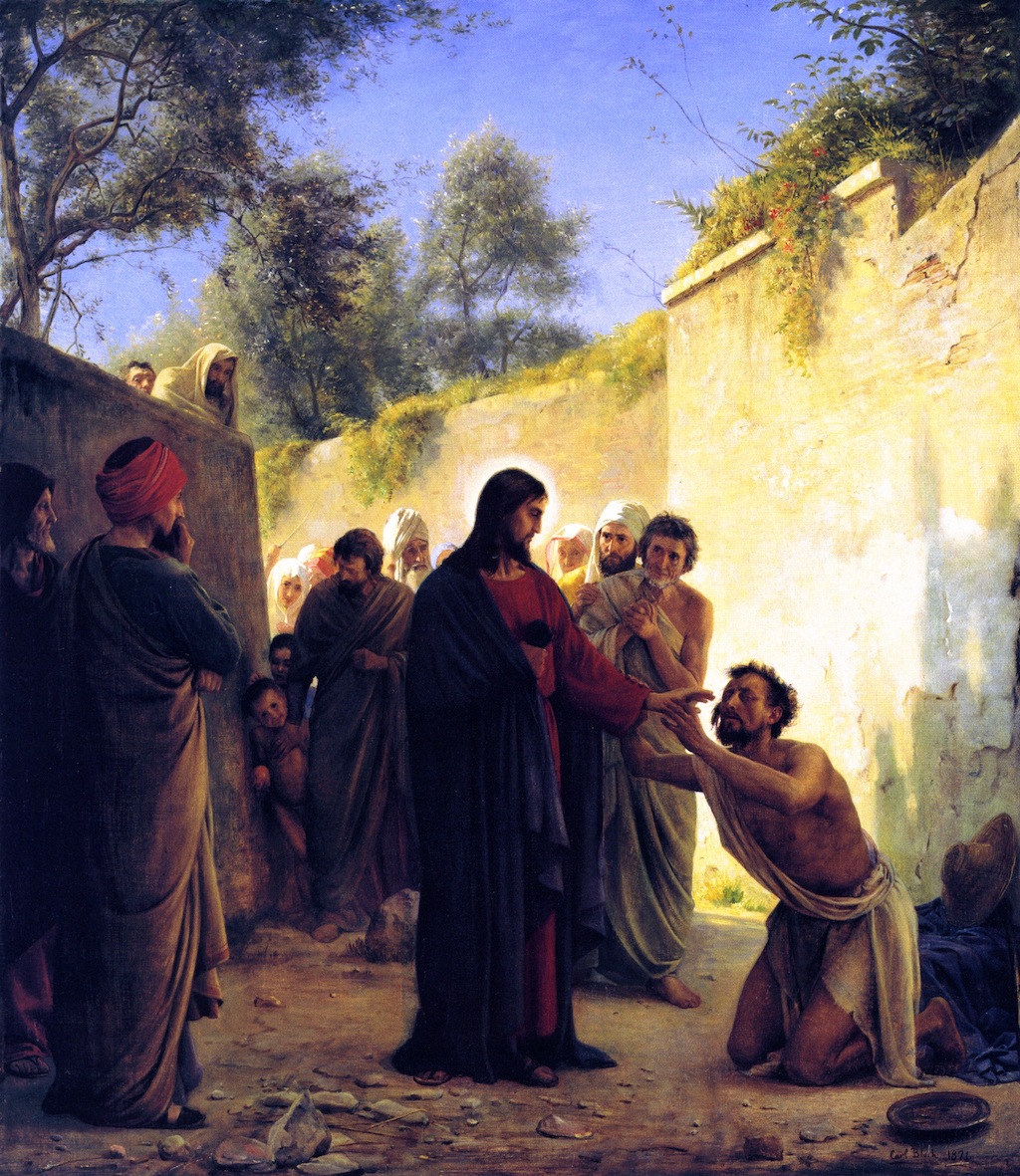
Gospel: Matthew 9:27-31
The Healing of Two Blind Men
27 And as Jesus passed on from there, two blind men followed [him], crying out, “Son of David, have pity on us!”
28 When he entered the house, the blind men approached him and Jesus said to them, “Do you believe that I can do this?” “Yes, Lord,” they said to him.
29 Then he touched their eyes and said, “Let it be done for you according to your faith.”
30 And their eyes were opened. Jesus warned them sternly, “See that no one knows about this.”
31 But they went out and spread word of him through all that land.
27 Et transeunte inde Jesu, secuti sunt eum duo cæci, clamantes, et dicentes: Miserere nostri, fili David.
28 Cum autem venisset domum, accesserunt ad eum cæci. Et dicit eis Jesus: Creditis quia hoc possum facere vobis? Dicunt ei: Utique, Domine.
29 Tunc tetigit oculos eorum, dicens: Secundum fidem vestram, fiat vobis.
30 Et aperti sunt oculi eorum: et comminatus est illis Jesus, dicens: Videte ne quis sciat.
31 Illi autem exeuntes, diffamaverunt eum in tota terra illa.

A Daily Question from the Summa Theologica
Whether the number of the predestined is certain? (Article 7 of 8 of Question 23. OF PREDESTINATION from the Treatise on The One God)
Objection 1: It seems that the number of the predestined is not certain. For a number to which an addition can be made is not certain. But there can be an addition to the number of the predestined as it seems; for it is written (Dt. 1:11): “The Lord God adds to this number many thousands,” and a gloss adds, “fixed by God, who knows those who belong to Him.” Therefore the number of the predestined is not certain.
Objection 2: Further, no reason can be assigned why God pre-ordains to salvation one number of men more than another. But nothing is arranged by God without a reason. Therefore the number to be saved pre-ordained by God cannot be certain.
Objection 3: Further, the operations of God are more perfect than those of nature. But in the works of nature, good is found in the majority of things; defect and evil in the minority. If, then, the number of the saved were fixed by God at a certain figure, there would be more saved than lost. Yet the contrary follows fromMatt. 7:13, 14: “For wide is the gate, and broad the way that leadeth to destruction, and many there are who go in thereat. How narrow is the gate, and strait is the way that leadeth to life; and few there are who find it!” Therefore the number of those pre-ordained by God to be saved is not certain.
On the contrary, Augustine says (De Corr. et Grat. 13): “The number of the predestined is certain, and can neither be increased nor diminished.”
I answer that, The number of the predestined is certain. Some have said that it was formally, but not materially certain; as if we were to say that it was certain that a hundred or a thousand would be saved; not however these or those individuals. But this destroys the certainty of predestination; of which we spoke above (A[6]). Therefore we must say that to God the number of the predestined is certain, not only formally, but also materially. It must, however, be observed that the number of the predestined is said to be certain to God, not by reason of His knowledge, because, that is to say, He knows how many will be saved (for in this way the number of drops of rain and the sands of the sea are certain to God); but by reason of His deliberate choice and determination. For the further evidence of which we must remember that every agent intends to make something finite, as is clear from what has been said above when we treated of the infinite (Q[7], AA[2],3). Now whosoever intends some definite measure in his effect thinks out some definite number in the essential parts, which are by their very nature required for the perfection of the whole. For of those things which are required not principally, but only on account of something else, he does not select any definite number “per se”; but he accepts and uses them in such numbers as are necessary on account of that other thing. For instance, a builder thinks out the definite measurements of a house, and also the definite number of rooms which he wishes to make in the house; and definite measurements of the walls and roof; he does not, however, select a definite number of stones, but accepts and uses just so many as are sufficient for the required measurements of the wall. So also must we consider concerning God in regard to the whole universe, which is His effect. For He pre-ordained the measurements of the whole of the universe, and what number would befit the essential parts of that universe—that is to say, which have in some way been ordained in perpetuity; how many spheres, how many stars, how many elements, and how many species. Individuals, however, which undergo corruption, are not ordained as it were chiefly for the good of the universe, but in a secondary way, inasmuch as the good of the species is preserved through them. Whence, although God knows the total number of individuals, the number of oxen, flies and such like, is not pre-ordained by God “per se”; but divine providence produces just so many as are sufficient for the preservation of the species. Now of all creatures the rational creature is chiefly ordained for the good of the universe, being as such incorruptible; more especially those who attain to eternal happiness, since they more immediately reach the ultimate end. Whence the number of the predestined is certain to God; not only by way of knowledge, but also by way of a principal pre-ordination.
It is not exactly the same thing in the case of the number of the reprobate, who would seem to be pre-ordained by God for the good of the elect, in whose regard “all things work together unto good” (Rom. 8:28). Concerning the number of all the predestined, some say that so many men will be saved as angels fell; some, so many as there were angels left; others, as many as the number of angels created by God. It is, however, better to say that, “to God alone is known the number for whom is reserved eternal happiness [*From the ‘secret’ prayer of the missal, ‘pro vivis et defunctis.’]”
Reply to Objection 1: These words of Deuteronomy must be taken as applied to those who are marked out by God beforehand in respect to present righteousness. For their number is increased and diminished, but not the number of the predestined.
Reply to Objection 2: The reason of the quantity of any one part must be judged from the proportion of that part of the whole. Thus in God the reason why He has made so many stars, or so many species of things, or predestined so many, is according to the proportion of the principal parts to the good of the whole universe.
Reply to Objection 3: The good that is proportionate to the common state of nature is to be found in the majority; and is wanting in the minority. The good that exceeds the common state of nature is to be found in the minority, and is wanting in the majority. Thus it is clear that the majority of men have a sufficient knowledge for the guidance of life; and those who have not this knowledge are said to be half-witted or foolish; but they who attain to a profound knowledge of things intelligible are a very small minority in respect to the rest. Since their eternal happiness, consisting in the vision of God, exceeds the common state of nature, and especially in so far as this is deprived of grace through the corruption of original sin, those who are saved are in the minority. In this especially, however, appears the mercy of God, that He has chosen some for that salvation, from which very many in accordance with the common course and tendency of nature fall short.
Continue reading the rest of the articles on Sacred Texts Archive website.
Scripture texts in this work are taken from the New American Bible, revised edition © 2010, 1991, 1986, 1970 Confraternity of Christian Doctrine, Washington, D.C.