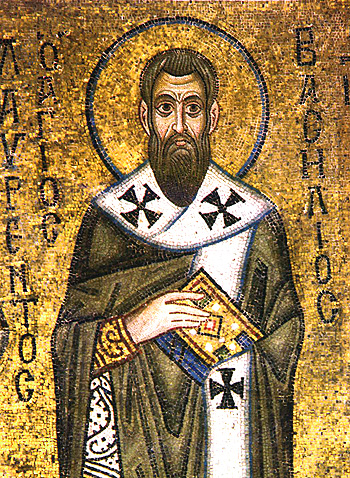
Memorial of Saints Basil the Great and Gregory Nazianzen, Bishops and Doctors of the Church
Liturgical Color: White
Rosary Mysteries: Sorrowful Mysteries
“The bread which you hold back belongs to the hungry; the coat, which you guard in your locked storage-chests, belongs to the naked; the footwear mouldering in your closet belongs to those without shoes. The silver that you keep hidden in a safe place belongs to the one in need. Thus, however many are those whom you could have provided for, so many are those whom you wrong.”
Saint Basil the Great
est. 329 – January 1, 379
Patron of Russia, Turkey, hospital administrators, church reformers, and monks
“He wants you to become a living force for all mankind, lights shining in the world. You are to be radiant lights as you stand beside Christ, the Great Light, bathed in the glory of Him who is the Light of Heaven.”
Saint Gregory Nazianzen
est. 330 – est. 389
Patron of poets, students, teachers, and orthodoxy

Daily Readings
First Reading: 1 John 2: 22-28
22 Who is a liar, but he who denieth that Jesus is the Christ? This is Antichrist, who denieth the Father, and the Son.
23 Whosoever denieth the Son, the same hath not the Father. He that confesseth the Son, hath the Father also.
24 As for you, let that which you have heard from the beginning, abide in you. If that abide in you, which you have heard from the beginning, you also shall abide in the Son, and in the Father.
25 And this is the promise which he hath promised us, life everlasting.
26 These things have I written to you, concerning them that seduce you.
27 And as for you, let the unction, which you have received from him, abide in you. And you have no need that any man teach you; but as his unction teacheth you of all things, and is truth, and is no lie. And as it hath taught you, abide in him.
28 And now, little children, abide in him, that when he shall appear, we may have confidence, and not be confounded by him at his coming.
22 Quis est mendax, nisi is qui negat quoniam Jesus est Christus? Hic est antichristus, qui negat Patrem, et Filium.
23 Omnis qui negat Filium, nec Patrem habet: qui confitetur Filium, et Patrem habet.
24 Vos quod audistis ab initio, in vobis permaneat: si in vobis permanserit quod audistis ab initio, et vos in Filio et Patre manebitis.
25 Et hæc est repromissio, quam ipse pollicitus est nobis, vitam æternam.
26 Hæc scripsi vobis de his, qui seducant vos.
27 Et vos unctionem, quam accepistis ab eo, maneat in vobis. Et non necesse habetis ut aliquis doceat vos: sed sicut unctio ejus docet vos de omnibus, et verum est, et non est mendacium. Et sicut docuit vos: manete in eo.
28 Et nunc, filioli, manete in eo: ut cum apparuerit, habeamus fiduciam, et non confundamur ab eo in adventu ejus.
Gospel: John 1: 19-28
19 And this is the testimony of John, when the Jews sent from Jerusalem priests and Levites to him, to ask him: Who art thou?
20 And he confessed, and did not deny: and he confessed: I am not the Christ.
21 And they asked him: What then? Art thou Elias? And he said: I am not. Art thou the prophet? And he answered: No.
22 They said therefore unto him: Who art thou, that we may give an answer to them that sent us? What sayest thou of thyself?
23 He said: I am the voice of one crying out in the wilderness, make straight the way of the Lord, as said the prophet Isaias.
24 And they that were sent, were of the Pharisees.
25 And they asked him, and said to him: Why then dost thou baptize, if thou be not Christ, nor Elias, nor the prophet?
26 John answered them, saying: I baptize with water; but there hath stood one in the midst of you, whom you know not.
27 The same is he that shall come after me, who is preferred before me: the latchet of whose shoe I am not worthy to loose.
28 These things were done in Bethania, beyond the Jordan, where John was baptizing.
19 Et hoc est testimonium Joannis, quando miserunt Judæi ab Jerosolymis sacerdotes et Levitas ad eum ut interrogarent eum: Tu quis es?
20 Et confessus est, et non negavit, et confessus est: Quia non sum ego Christus.
21 Et interrogaverunt eum: Quid ergo? Elias es tu? Et dixit: Non sum. Propheta es tu? Et respondit: Non.
22 Dixerunt ergo ei: Quis es ut responsum demus his qui miserunt nos? quid dicis de teipso?
23 Ait: Ego vox clamantis in deserto: Dirigite viam Domini, sicut dixit Isaias propheta.
24 Et qui missi fuerant, erant ex pharisæis.
25 Et interrogaverunt eum, et dixerunt ei: Quid ergo baptizas, si tu non es Christus, neque Elias, neque propheta?
26 Respondit eis Joannes, dicens: Ego baptizo in aqua: medius autem vestrum stetit, quem vos nescitis.
27 Ipse est qui post me venturus est, qui ante me factus est: cujus ego non sum dignus ut solvam ejus corrigiam calceamenti.
28 Hæc in Bethania facta sunt trans Jordanem, ubi erat Joannes baptizans.

A Daily Question from the Summa Theologica
Whether it was becoming that the Magi should come to adore Christ and pay homage to Him? (Article 8 of 8 of Question 36. Of the Manifestation of the Newly Born Christ from the Treatise on the Incarnation)
Objection 1: It would seem that it was unbecoming that the Magi should come to adore Christ and pay homage to Him. For reverence is due to a king from his subjects. But the Magi did not belong to the kingdom of the Jews. Therefore, since they knew by seeing the star that He that was born was the “King of the Jews,” it seems unbecoming that they should come to adore Him.
Objection 2: Further, it seems absurd during the reign of one king to proclaim a stranger. But in Judea Herod was reigning. Therefore it was foolish of the Magi to proclaim the birth of a king.
Objection 3: Further, a heavenly sign is more certain than a human sign. But the Magi had come to Judea from the east, under the guidance of a heavenly sign. Therefore it was foolish of them to seek human guidance besides that of the star, saying: “Where is He that is born King of the Jews?”
Objection 4: Further, the offering of gifts and the homage of adoration are not due save to kings already reigning. But the Magi did not find Christ resplendent with kingly grandeur. Therefore it was unbecoming for them to offer Him gifts and homage.
On the contrary, It is written (Is. 60:3): “[The Gentiles] shall walk in the light, and kings in the brightness of thy rising.” But those who walk in the Divine light do not err. Therefore the Magi were right in offering homage to Christ.
I answer that, As stated above (A[3], ad 1), the Magi are the “first-fruits of the Gentiles” that believed in Christ; because their faith was a presage of the faith and devotion of the nations who were to come to Christ from afar. And therefore, as the devotion and faith of the nations is without any error through the inspiration of the Holy Ghost, so also we must believe that the Magi, inspired by the Holy Ghost, did wisely in paying homage to Christ.
Reply to Objection 1: As Augustine says in a sermon on the Epiphany (cc.): “Though many kings of the Jews had been born and died, none of them did the Magi seek to adore. And so they who came from a distant foreign land to a kingdom that was entirely strange to them, had no idea of showing such great homage to such a king as the Jews were wont to have. But they had learnt that such a King was born that by adoring Him they might be sure of obtaining from Him the salvation which is of God.”
Reply to Objection 2: By proclaiming [Christ King] the Magi foreshadowed the constancy of the Gentiles in confessing Christ even until death. Whence Chrysostom says (Hom. ii in Matth.) that, while they thought of the King who was to come, the Magi feared not the king who was actually present. They had not yet seen Christ, and they were already prepared to die for Him.
Reply to Objection 3: As Augustine says in a sermon on the Epiphany (cc.): “The star which led the Magi to the place where the Divine Infant was with His Virgin-Mother could bring them to the town of Bethlehem, in which Christ was born. Yet it hid itself until the Jews also bore testimony of the city in which Christ was to be born: so that, being encouraged by a twofold witness,” as Pope Leo says (Serm. xxxiv), “they might seek with more ardent faith Him, whom both the brightness of the star and the authority of prophecy revealed.” Thus they “proclaim” that Christ is born, and “inquire where; they believe and ask, as it were, betokening those who walk by faith and desire to see,” as Augustine says in a sermon on the Epiphany (cxcix). But the Jews, by indicating to them the place of Christ’s birth, “are like the carpenters who built the Ark of Noe, who provided others with the means of escape, and themselves perished in the flood. Those who asked, heard and went their way: the teachers spoke and stayed where they were; like the milestones that point out the way but walk not” (Augustine, Serm. cclxxiii). It was also by God’s will that, when they no longer saw the star, the Magi, by human instinct, went to Jerusalem, to seek in the royal city the new-born King, in order that Christ’s birth might be publicly proclaimed first in Jerusalem, according to Is. 2:3: “The Law shall come forth from Sion, and the Word of the Lord from Jerusalem”; and also “in order that by the zeal of the Magi who came from afar, the indolence of the Jews who lived near at hand, might be proved worthy of condemnation” (Remig., Hom. in Matth. ii, 1).
Reply to Objection 4: As Chrysostom says (Hom. ii in Matth. [*From the supposititious Opus Imperfectum]): “If the Magi had come in search of an earthly King, they would have been disconcerted at finding that they had taken the trouble to come such a long way for nothing. Consequently they would have neither adored nor offered gifts. But since they sought a heavenly King, though they found in Him no signs of royal pre-eminence, yet, content with the testimony of the star alone, they adored: for they saw a man, and they acknowledged a God.” Moreover, they offer gifts in keeping with Christ’s greatness: “gold, as to the great King; they offer up incense as to God, because it is used in the Divine Sacrifice; and myrrh, which is used in embalming the bodies of the dead, is offered as to Him who is to die for the salvation of all” (Gregory, Hom. x in Evang.). And hereby, as Gregory says (Hom. x in Evang.), we are taught to offer gold, “which signifies wisdom, to the new-born King, by the luster of our wisdom in His sight.” We offer God incense, “which signifies fervor in prayer, if our constant prayers mount up to God with an odor of sweetness”; and we offer myrrh, “which signifies mortification of the flesh, if we mortify the ill-deeds of the flesh by refraining from them.”
Continue reading the rest of the articles on Sacred Texts Archive website.