Christmas Weekday
Liturgical Color: White
Rosary Mysteries: Sorrowful Mysteries

Daily Readings
First Reading: 1 John 5: 5-13
5 Who is he that overcometh the world, but he that believeth that Jesus is the Son of God?
6 This is he that came by water and blood, Jesus Christ: not by water only, but by water and blood. And it is the Spirit which testifieth, that Christ is the truth.
7 And there are three who give testimony in heaven, the Father, the Word, and the Holy Ghost. And these three are one.
8 And there are three that give testimony on earth: the spirit, and the water, and the blood: and these three are one.
9 If we receive the testimony of men, the testimony of God is greater. For this is the testimony of God, which is greater, because he hath testified of his Son.
10 He that believeth in the Son of God, hath the testimony of God in himself. He that believeth not the Son, maketh him a liar: because he believeth not in the testimony which God hath testified of his Son.
11 And this is the testimony, that God hath given to us eternal life. And this life is in his Son.
12 He that hath the Son, hath life. He that hath not the Son, hath not life.
13 These things I write to you, that you may know that you have eternal life, you who believe in the name of the Son of God.
5 Quis est, qui vincit mundum, nisi qui credit quoniam Jesus est Filius Dei?
6 Hic est, qui venit per aquam et sanguinem, Jesus Christus: non in aqua solum, sed in aqua et sanguine. Et Spiritus est, qui testificatur quoniam Christus est veritas.
7 Quoniam tres sunt, qui testimonium dant in cælo: Pater, Verbum, et Spiritus Sanctus: et hi tres unum sunt.
8 Et tres sunt, qui testimonium dant in terra: spiritus, et aqua, et sanguis: et hi tres unum sunt.
9 Si testimonium hominum accipimus, testimonium Dei majus est: quoniam hoc est testimonium Dei, quod majus est, quoniam testificatus est de Filio suo.
10 Qui credit in Filium Dei, habet testimonium Dei in se. Qui non credit Filio, mendacem facit eum: quia non credit in testimonium quod testificatus est Deus de Filio suo.
11 Et hoc est testimonium, quoniam vitam æternam dedit nobis Deus: et hæc vita in Filio ejus est.
12 Qui habet Filium, habet vitam: qui non habet Filium, vitam non habet.
13 Hæc scribo vobis ut sciatis quoniam vitam habetis æternam, qui creditis in nomine Filii Dei.
Gospel: Luke 5: 12-16
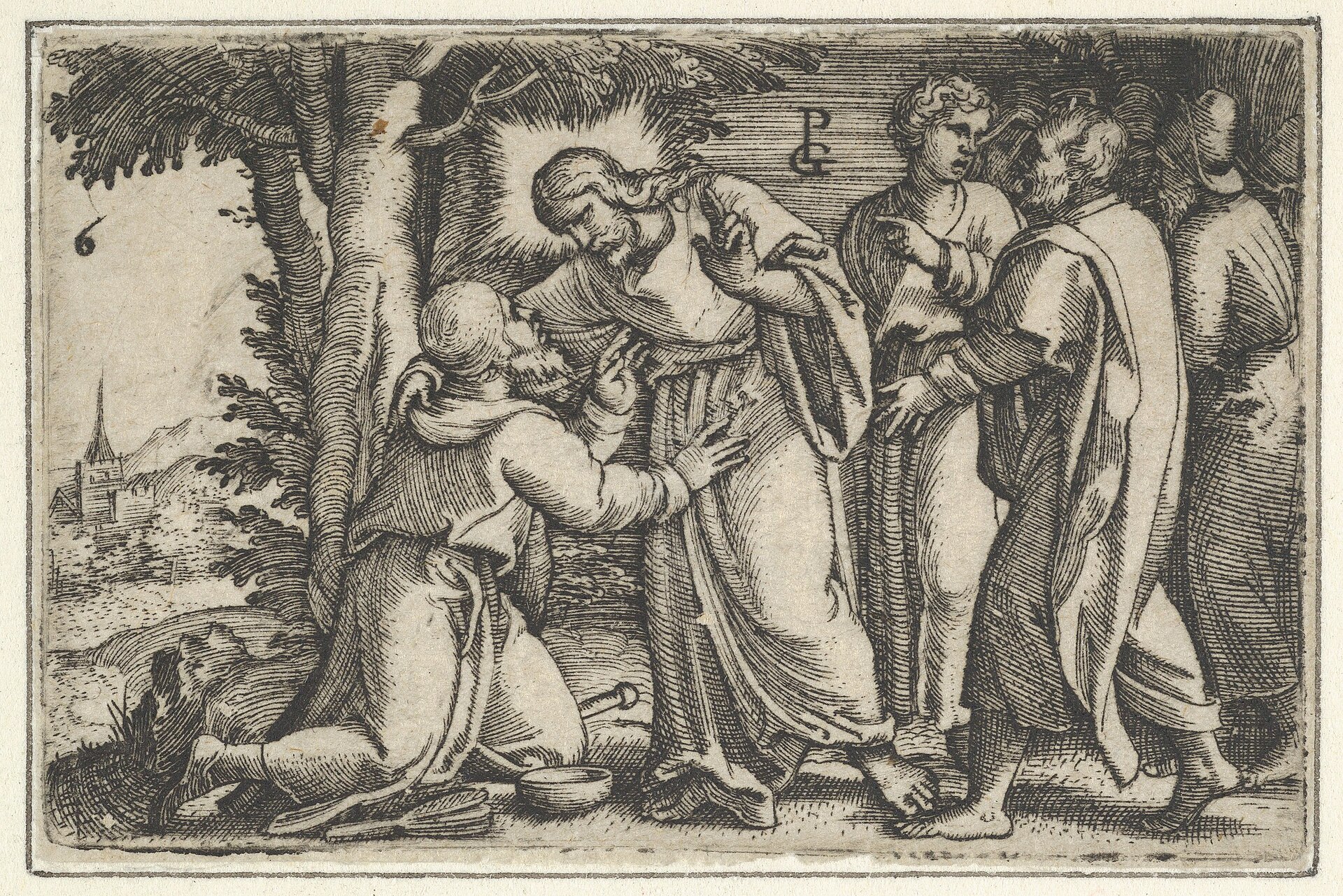
12 And it came to pass, when he was in a certain city, behold a man full of leprosy, who seeing Jesus, and falling on his face, besought him, saying: Lord, if thou wilt, thou canst make me clean.
13 And stretching forth his hand, he touched him, saying: I will. Be thou cleansed. And immediately the leprosy departed from him.
14 And he charged him that he should tell no man, but, Go, shew thyself to the priest, and offer for thy cleansing according as Moses commanded, for a testimony to them.
15 But the fame of him went abroad the more, and great multitudes came together to hear, and to be healed by him of their infirmities.
16 And he retired into the desert, and prayed.
12 Et factum est, cum esset in una civitatum, et ecce vir plenus lepra, et videns Jesum, et procidens in faciem, rogavit eum, dicens: Domine, si vis, potes me mundare.
13 Et extendens manum, tetigit eum dicens: Volo: mundare. Et confestim lepra discessit ab illo.
14 Et ipse præcepit illi ut nemini diceret: sed, Vade, ostende te sacerdoti, et offer pro emundatione tua, sicut præcepit Moyses, in testimonium illis.
15 Perambulabat autem magis sermo de illo: et conveniebant turbæ multæ ut audirent, et curarentur ab infirmitatibus suis.
16 Ipse autem secedebat in desertum, et orabat.

A Daily Question from the Summa Theologica
Whether grace was given in the baptism of John? (Article 3 of 6 of Question 38. Of the Baptism of John from the Treatise on the Incarnation)
Objection 1: It would seem that grace was given in the baptism of John. For it is written (Mk. 1:4): “John was in the desert baptizing and preaching the baptism of penance unto remission of sins.” But penance and remission of sins are the effect of grace. Therefore the baptism of John conferred grace.
Objection 2: Further, those who were about to be baptized by John “confessed their sins,” as related Mat. 3:6 and Mk. 1:5. But the confession of sins is ordered to their remission, which is effected by grace. Therefore grace was conferred in the baptism of John.
Objection 3: Further, the baptism of John was more akin than circumcision to the baptism of Christ. But original sin was remitted through circumcision: because, as Bede says (Hom. x in Circumcis.), “under the Law, circumcision brought the same saving aid to heal the wound of original sin as baptism is wont to bring now that grace is revealed.” Much more, therefore, did the baptism of John effect the remission of sins, which cannot be accomplished without grace.
On the contrary, It is written (Mat. 3:11): “I indeed baptize you in water unto penance.” Which words Gregory thus expounds in a certain homily (Hom. vii in Evang.): “John baptized, not in the Spirit, but in water: because he could not forgive sins.” But grace is given by the Holy Ghost, and by means thereof sins are taken away. Therefore the baptism of John did not confer grace.
I answer that, As stated above (A[2], ad 2), the whole teaching and work of John was in preparation for Christ: just as it is the duty of the servant and of the under-craftsman to prepare the matter for the form which is accomplished by the head-craftsman. Now grace was to be conferred on men through Christ, according to Jn. 1:17: “Grace and truth came through Jesus Christ.” Therefore the baptism of John did not confer grace, but only prepared the way for grace; and this in three ways: first, by John’s teaching, which led men to faith in Christ; secondly, by accustoming men to the rite of Christ’s baptism; thirdly, by penance, preparing men to receive the effect of Christ’s baptism.
Reply to Objection 1: In these words, as Bede says (on Mk. 1:4), a twofold baptism of penance may be understood. one is that which John conferred by baptizing, which is called “a baptism of penance,” etc., by reason of its inducing men to do penance, and of its being a kind of protestation by which men avowed their purpose of doing penance. The other is the baptism of Christ, by which sins are remitted, and which John could not give, but only preach, saying: “He will baptize you in the Holy Ghost.”
Or it may be said that he preached the “baptism of penance,” i.e. which induced men to do penance, which penance leads men on to “the remission of sins.”
Or again, it may be said with Jerome [*Another author on Mk. 1 (inter op. Hier.)] that “by the baptism of Christ grace is given, by which sins are remitted gratis; and that what is accomplished by the bridegroom is begun by the bridesman,” i.e. by John. Consequently it is said that “he baptized and preached the baptism of penance unto remission of sins,” not as though he accomplished this himself, but because he began it by preparing the way for it.
Reply to Objection 2: That confession of sins was not made unto the remission of sins, to be realized immediately through the baptism of John, but to be obtained through subsequent penance and through the baptism of Christ, for which that penance was a preparation.
Reply to Objection 3: Circumcision was instituted as a remedy for original sin. Whereas the baptism of John was not instituted for this purpose, but was merely in preparation for the baptism of Christ, as stated above; whereas the sacraments attain their effect through the force of their institution.
Continue reading the rest of the articles on Sacred Texts Archive website.