Lenten Weekday
LITurgical Color: Violet
Rosary Mysteries: Sorrowful Mysteries

Daily Readings
Gospel: Matthew 21: 33-43, 45-46
33 Hear ye another parable. There was a man an householder, who planted a vineyard, and made a hedge round about it, and dug in it a press, and built a tower, and let it out to husbandmen; and went into a strange country.
34 And when the time of the fruits drew nigh, he sent his servants to the husbandmen that they might receive the fruits thereof.
35 And the husbandmen laying hands on his servants, beat one, and killed another, and stoned another.
36 Again he sent other servants more than the former; and they did to them in like manner.
37 And last of all he sent to them his son, saying: They will reverence my son.
38 But the husbandmen seeing the son, said among themselves: This is the heir: come, let us kill him, and we shall have his inheritance.
39 And taking him, they cast him forth out of the vineyard, and killed him.
40 When therefore the lord of the vineyard shall come, what will he do to those husbandmen?
41 They say to him: He will bring those evil men to an evil end; and will let out his vineyard to other husbandmen, that shall render him the fruit in due season.
42 Jesus saith to them: Have you never read in the Scriptures: The stone which the builders rejected, the same is become the head of the corner? By the Lord this has been done; and it is wonderful in our eyes.
43 Therefore I say to you, that the kingdom of God shall be taken from you, and shall be given to a nation yielding the fruits thereof.
45 And when the chief priests and Pharisees had heard his parables, they knew that he spoke of them.
46 And seeking to lay hands on him, they feared the multitudes: because they held him as a prophet.
33 Aliam parabolam audite: Homo erat paterfamilias, qui plantavit vineam, et sepem circumdedit ei, et fodit in ea torcular, et ædificavit turrim, et locavit eam agricolis, et peregre profectus est.
34 Cum autem tempus fructuum appropinquasset, misit servos suos ad agricolas, ut acciperent fructus ejus.
35 Et agricolæ, apprehensis servis ejus, alium ceciderunt, alium occiderunt, alium vero lapidaverunt.
36 Iterum misit alios servos plures prioribus, et fecerunt illis similiter.
37 Novissime autem misit ad eos filium suum, dicens: Verebuntur filium meum.
38 Agricolæ autem videntes filium dixerunt intra se: Hic est hæres, venite, occidamus eum, et habebimus hæreditatem ejus.
39 Et apprehensum eum ejecerunt extra vineam, et occiderunt.
40 Cum ergo venerit dominus vineæ, quid faciet agricolis illis?
41 Aiunt illi: Malos male perdet: et vineam suam locabit aliis agricolis, qui reddant ei fructum temporibus suis.
42 Dicit illis Jesus: Numquam legistis in Scripturis: [Lapidem quem reprobaverunt ædificantes,
hic factus est in caput anguli:
a Domino factum est istud,
et est mirabile in oculis nostris?]
43 Ideo dico vobis, quia auferetur a vobis regnum Dei, et dabitur genti facienti fructus ejus.
45 Et cum audissent principes sacerdotum et pharisæi parabolas ejus, cognoverunt quod de ipsis diceret.
46 Et quærentes eum tenere, timuerunt turbas: quoniam sicut prophetam eum habebant.
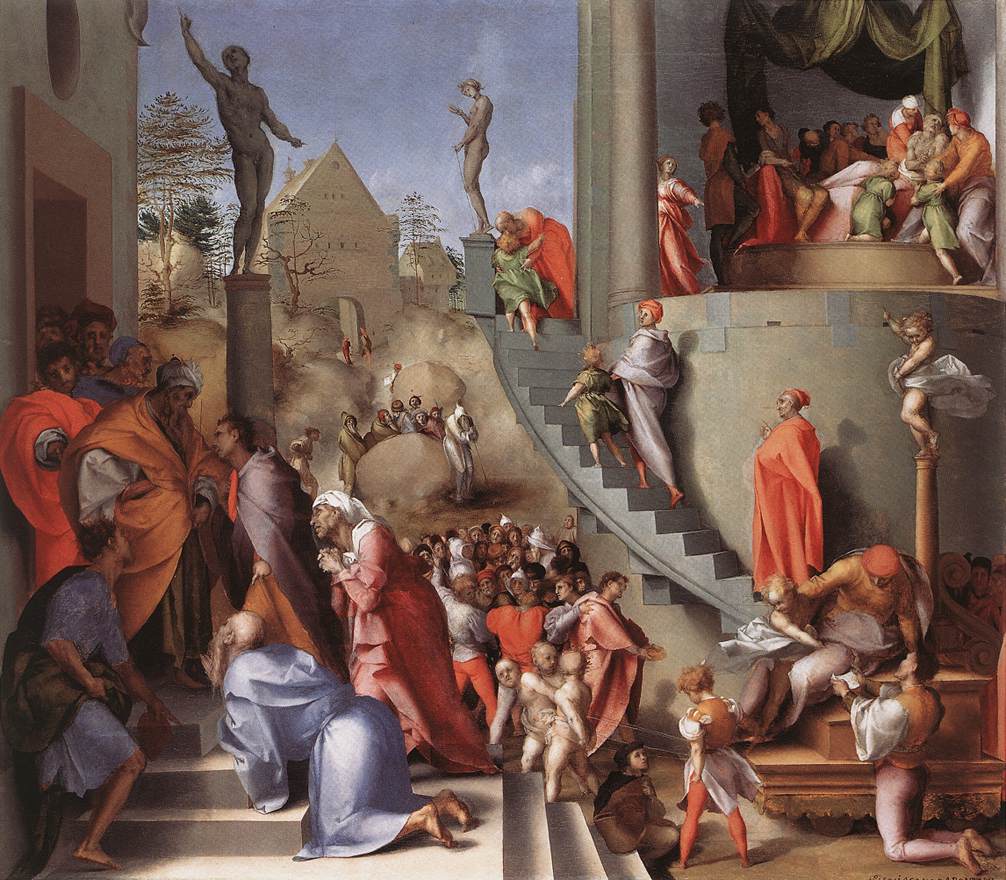
First Reading: Genesis 37: 3-4, 12-13a, 17b-28a
3 Now Israel loved Joseph above all his sons, because he had him in his old age: and he made him a coat of divers colours.
4 And his brethren seeing that he was loved by his father, more than all his sons, hated him, and could not speak peaceably to him.
12 And when his brethren abode in Sichem feeding their father’s flocks,
13 Israel said to him: Thy brethren feed the sheep in Sichem: come, I will send thee to them. And when he answered:
17 And the man said to him: They are departed from this place: for I heard them say: Let us go to Dothain. And Joseph went forward after his brethren, and found them in Dothain.
18 And when they saw him afar off, before he came nigh them, they thought to kill him.
19 And said one to another: Behold the dreamer cometh.
20 Come, let us kill him, and cast him into some old pit: and we will say: Some evil beast hath devoured him: and then it shall appear what his dreams avail him:
21 And Ruben hearing this, endeavoured to deliver him out of their hands, and said:
22 Do not take away his life, nor shed his blood: but cast him into this pit, that is in the wilderness, and keep your hands harmless: now he said this, being desirous to deliver him out of their hands and to restore him to his father.
23 And as soon as he came to his brethren, they forthwith stript him of his outside coat, that was of divers colours:
24 And cast him into an old pit, where there was no water.
25 And sitting down to eat bread, they saw some Ismaelites on their way coming from Galaad, with their camels, carrying spices, and balm, and myrrh to Egypt.
26 And Juda said to his brethren: What will it profit us to kill our brother, and conceal his blood?
27 It is better that he be sold to the Ismaelites, and that our hands be not defiled: for he is our brother and our flesh. His brethren agreed to his words.
28 And when the Madianite merchants passed by, they drew him out of the pit, and sold him to the Ismaelites, for twenty pieces of silver: and they led him into Egypt.
3 Israël autem diligebat Joseph super omnes filios suos, eo quod in senectute genuisset eum: fecitque ei tunicam polymitam.
4 Videntes autem fratres ejus quod a patre plus cunctis filiis amaretur, oderant eum, nec poterant ei quidquam pacifice loqui.
12 Cumque fratres illius in pascendis gregibus patris morarentur in Sichem,
13 dixit ad eum Israël: Fratres tui pascunt oves in Sichimis: veni, mittam te ad eos. Quo respondente,
17 Dixitque ei vir: Recesserunt de loco isto: audivi autem eos dicentes: Eamus in Dothain. Perrexit ergo Joseph post fratres suos, et invenit eos in Dothain.
18 Qui cum vidissent eum procul, antequam accederet ad eos, cogitaverunt illum occidere:
19 et mutuo loquebantur: Ecce somniator venit:
20 venite, occidamus eum, et mittamus in cisternam veterem: dicemusque: Fera pessima devoravit eum: et tunc apparebit quid illi prosint somnia sua.
21 Audiens autem hoc Ruben, nitebatur liberare eum de manibus eorum, et dicebat:
22 Non interficiatis animam ejus, nec effundatis sanguinem: sed projicite eum in cisternam hanc, quæ est in solitudine, manusque vestras servate innoxias: hoc autem dicebat, volens eripere eum de manibus eorum, et reddere patri suo.
23 Confestim igitur ut pervenit ad fratres suos, nudaverunt eum tunica talari et polymita:
24 miseruntque eum in cisternam veterem, quæ non habebat aquam.
25 Et sedentes ut comederent panem, viderunt Ismaëlitas viatores venire de Galaad, et camelos eorum portantes aromata, et resinam, et stacten in Ægyptum.
26 Dixit ergo Judas fratribus suis: Quid nobis prodest si occiderimus fratrem nostrum, et celaverimus sanguinem ipsius?
27 melius est ut venundetur Ismaëlitis, et manus nostræ non polluantur: frater enim et caro nostra est. Acquieverunt fratres sermonibus illius.
28 Et prætereuntibus Madianitis negotiatoribus, extrahentes eum de cisterna, vendiderunt eum Ismaëlitis, viginti argenteis: qui duxerunt eum in Ægyptum.

A Daily Question from the Summa Theologica
Whether this sacrament ought to be made of unleavened bread? (Article 4 of 8 of Question 74. Of the Matter of This Sacrament from the Treatise on the Sacraments)
Objection 1: It seems that this sacrament ought not to be made of unleavened bread. because in this sacrament we ought to imitate Christ’s institution. But Christ appears to have instituted this sacrament in fermented bread, because, as we have read in Ex. 12, the Jews, according to the Law, began to use unleavened bread on the day of the Passover which is celebrated on the fourteenth day of the moon; and Christ instituted this sacrament at the supper which He celebrated “before the festival day of the Pasch” (John 13:1, 4). Therefore we ought likewise to celebrate this sacrament with fermented bread.
Objection 2: Further, legal observances ought not to be continued in the time of grace. But the use of unleavened bread was a ceremony of the Law, as is clear from Ex. 12. Therefore we ought not to use unfermented bread in this sacrament of grace.
Objection 3: Further, as stated above (Q[65], A[1]; Q[73], A[3]), the Eucharist is the sacrament of charity just as Baptism is the sacrament of faith. But the fervor of charity is signified by fermented bread, as is declared by the gloss on Mat. 13:33: “The kingdom of heaven is like unto leaven,” etc. Therefore this sacrament ought to be made of leavened bread.
Objection 4: Further, leavened or unleavened are mere accidents of bread, which do not vary the species. But in the matter for the sacrament of Baptism no difference is observed regarding the variation of the accidents, as to whether it be salt or fresh, warm or cold water. Therefore neither ought any distinction to be observed, as to whether the bread be unleavened or leavened.
On the contrary, According to the Decretals (Extra, De Celebr. Miss.), a priest is punished “for presuming to celebrate, using fermented bread and a wooden cup.”
I answer that, Two things may be considered touching the matter of this sacrament namely, what is necessary, and what is suitable. It is necessary that the bread be wheaten, without which the sacrament is not valid, as stated above (A[3]). It is not, however, necessary for the sacrament that the bread be unleavened or leavened, since it can be celebrated in either.
But it is suitable that every priest observe the rite of his Church in the celebration of the sacrament. Now in this matter there are various customs of the Churches: for, Gregory says: “The Roman Church offers unleavened bread, because our Lord took flesh without union of sexes: but the Greek Churches offer leavened bread, because the Word of the Father was clothed with flesh; as leaven is mixed with the flour.” Hence, as a priest sins by celebrating with fermented bread in the Latin Church, so a Greek priest celebrating with unfermented bread in a church of the Greeks would also sin, as perverting the rite of his Church. Nevertheless the custom of celebrating with unleavened bread is more reasonable. First, on account of Christ’s institution: for He instituted this sacrament “on the first day of the Azymes” (Mat. 26:17; Mk. 14:12; Lk. 22:7), on which day there ought to be nothing fermented in the houses of the Jews, as is stated inExod. 12:15, 19 Secondly, because bread is properly the sacrament of Christ’s body, which was conceived without corruption, rather than of His Godhead, as will be seen later (Q[76], A[1], ad 1). Thirdly, because this is more in keeping with the sincerity of the faithful, which is required in the use of this sacrament, according to 1 Cor. 5:7: “Christ our Pasch is sacrificed: therefore let us feast . . . with the unleavened bread of sincerity and truth.”
However, this custom of the Greeks is not unreasonable both on account of its signification, to which Gregory refers, and in detestation of the heresy of the Nazarenes, who mixed up legal observances with the Gospel.
Reply to Objection 1: As we read in Ex. 12, the paschal solemnity began on the evening of the fourteenth day of the moon. So, then, after immolating the Paschal Lamb, Christ instituted this sacrament: hence this day is said by John to precede the day of the Pasch, while the other three Evangelists call it “the first day of the Azymes,” when fermented bread was not found in the houses of the Jews, as stated above. Fuller mention was made of this in the treatise on our Lord’s Passion (Q[46], A[9], ad 1).
Reply to Objection 2: Those who celebrate the sacrament with unleavened bread do not intend to follow the ceremonial of the Law, but to conform to Christ’s institution; so they are not Judaizing; otherwise those celebrating in fermented bread would be Judaizing, because the Jews offered up fermented bread for the first-fruits.
Reply to Objection 3: Leaven denotes charity on account of one single effect, because it makes the bread more savory and larger; but it also signifies corruption from its very nature.
Reply to Objection 4: Since whatever is fermented partakes of corruption, this sacrament may not be made from corrupt bread, as stated above (A[3], ad 4); consequently, there is a wider difference between unleavened and leavened bread than between warm and cold baptismal water: because there might be such corruption of fermented bread that it could not be validly used for the sacrament.
Continue reading the rest of the articles on Sacred Texts Archive website.