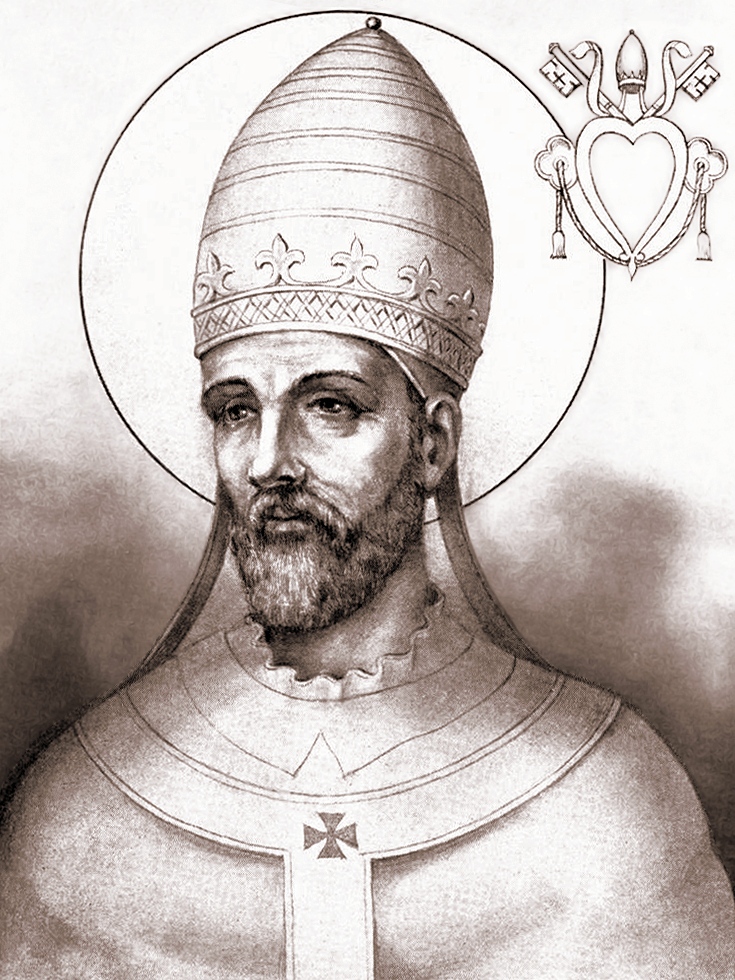
Optional Memorial of Saint Martin I, Pope and Martyr
LITurgical Color: White / red
Rosary Mysteries: Joyful Mysteries
“I fear not exile or death; I fear only failing the truth.”
Saint Martin I
between 590 and 600 – September 16, 655
Patron of Rome

Daily Readings
John 1: 1-14
1 IN the beginning was the Word, and the Word was with God, and the Word was God.
2 The same was in the beginning with God.
3 All things were made by him: and without him was made nothing that was made.
4 In him was life, and the life was the light of men.
5 And the light shineth in darkness, and the darkness did not comprehend it.
6 There was a man sent from God, whose name was John.
7 This man came for a witness, to give testimony of the light, that all men might believe through him.
8 He was not the light, but was to give testimony of the light.
9 That was the true light, which enlighteneth every man that cometh into this world.
10 He was in the world, and the world was made by him, and the world knew him not.
11 He came unto his own, and his own received him not.
12 But as many as received him, he gave them power to be made the sons of God, to them that believe in his name.
13 Who are born, not of blood, nor of the will of the flesh, nor of the will of man, but of God.
14 And the Word was made flesh, and dwelt among us, (and we saw his glory, the glory as it were of the only begotten of the Father,) full of grace and truth.
1 [In principio erat Verbum, et Verbum erat apud Deum, et Deus erat Verbum.
2 Hoc erat in principio apud Deum.
3 Omnia per ipsum facta sunt: et sine ipso factum est nihil, quod factum est.
4 In ipso vita erat, et vita erat lux hominum:
5 et lux in tenebris lucet, et tenebræ eam non comprehenderunt.
6 Fuit homo missus a Deo, cui nomen erat Joannes.
7 Hic venit in testimonium ut testimonium perhiberet de lumine, ut omnes crederent per illum.
8 Non erat ille lux, sed ut testimonium perhiberet de lumine.
9 Erat lux vera, quæ illuminat omnem hominem
venientem in hunc mundum.
10 In mundo erat, et mundus per ipsum factus est,
et mundus eum non cognovit.
11 In propria venit, et sui eum non receperunt.
12 Quotquot autem receperunt eum, dedit eis potestatem filios Dei fieri, his qui credunt in nomine ejus:
13 qui non ex sanguinibus, neque ex voluntate carnis, neque ex voluntate viri, sed ex Deo nati sunt.
14 Et Verbum caro factum est, et habitavit in nobis: et vidimus gloriam ejus, gloriam quasi unigeniti a Patre plenum gratiæ et veritatis.

A Daily Question from the Summa Theologica
Whether it was necessary for Christ to rise again? (Article 1 of 4 of Question 53. Of Christ’s Resurrection from the Treatise on the Incarnation)
Objection 1: It would seem that it was not necessary for Christ to rise again. For Damascene says (De Fide Orth. iv): “Resurrection is the rising again of an animate being, which was disintegrated and fallen.” But Christ did not fall by sinning, nor was His body dissolved, as is manifest from what was stated above (Q[51], A[3]). Therefore, it does not properly belong to Him to rise again.
Objection 2: Further, whoever rises again is promoted to a higher state, since to rise is to be uplifted. But after death Christ’s body continued to be united with the Godhead, hence it could not be uplifted to any higher condition. Therefore, it was not due to it to rise again.
Objection 3: Further, all that befell Christ’s humanity was ordained for our salvation. But Christ’s Passion sufficed for our salvation, since by it we were loosed from guilt and punishment, as is clear from what was said above (Q[49], A[1],3). Consequently, it was not necessary for Christ to rise again from the dead.
On the contrary, It is written (Lk. 24:46): “It behooved Christ to suffer and to rise again from the dead.”
I answer that, It behooved Christ to rise again, for five reasons. First of all; for the commendation of Divine Justice, to which it belongs to exalt them who humble themselves for God’s sake, according to Lk. 1:52: “He hath put down the mighty from their seat, and hath exalted the humble.” Consequently, because Christ humbled Himself even to the death of the Cross, from love and obedience to God, it behooved Him to be uplifted by God to a glorious resurrection; hence it is said in His Person (Ps. 138:2): “Thou hast known,” i.e. approved, “my sitting down,” i.e. My humiliation and Passion, “and my rising up,” i.e. My glorification in the resurrection; as the gloss expounds.
Secondly, for our instruction in the faith, since our belief in Christ’s Godhead is confirmed by His rising again, because, according to 2 Cor. 13:4, “although He was crucified through weakness, yet He liveth by the power of God.” And therefore it is written (1 Cor. 15:14): “If Christ be not risen again, then is our preaching vain, and our [Vulg.: ‘your’] faith is also vain”: and (Ps. 29:10): “What profit is there in my blood?” that is, in the shedding of My blood, “while I go down,” as by various degrees of evils, “into corruption?” As though He were to answer: “None. ‘For if I do not at once rise again but My body be corrupted, I shall preach to no one, I shall gain no one,’” as the gloss expounds.
Thirdly, for the raising of our hope, since through seeing Christ, who is our head, rise again, we hope that we likewise shall rise again. Hence it is written (1 Cor. 15:12): “Now if Christ be preached that He rose from the dead, how do some among you say, that there is no resurrection of the dead?” And (Job 19:25, 27): “I know,” that is with certainty of faith, “that my Redeemer,” i.e. Christ, “liveth,” having risen from the dead; “and” therefore “in the last day I shall rise out of the earth . . . this my hope is laid up in my bosom.”
Fourthly, to set in order the lives of the faithful: according to Rom. 6:4: “As Christ is risen from the dead by the glory of the Father, so we also may walk in newness of life”: and further on; “Christ rising from the dead dieth now no more; so do you also reckon that you are dead to sin, but alive to God.”
Fifthly, in order to complete the work of our salvation: because, just as for this reason did He endure evil things in dying that He might deliver us from evil, so was He glorified in rising again in order to advance us towards good things; according to Rom. 4:25: “He was delivered up for our sins, and rose again for our justification.”
Reply to Objection 1: Although Christ did not fall by sin, yet He fell by death, because as sin is a fall from righteousness, so death is a fall from life: hence the words of Mic. 7:8 can be taken as though spoken by Christ: “Rejoice not thou, my enemy, over me, because I am fallen: I shall rise again.” Likewise, although Christ’s body was not disintegrated by returning to dust, yet the separation of His soul and body was a kind of disintegration.
Reply to Objection 2: The Godhead was united with Christ’s flesh after death by personal union, but not by natural union; thus the soul is united with the body as its form, so as to constitute human nature. Consequently, by the union of the body and soul, the body was uplifted to a higher condition of nature, but not to a higher personal state.
Reply to Objection 3: Christ’s Passion wrought our salvation, properly speaking, by removing evils; but the Resurrection did so as the beginning and exemplar of all good things.
Continue reading the rest of the articles on Sacred Texts Archive website.