Advent Weekday
Liturgical Color: Violet
Rosary Mysteries: Joyful Mysteries

Daily Readings
First Reading: Numbers 24:2-7, 15-17a
2 When Balaam looked up and saw Israel encamped, tribe by tribe, the spirit of God came upon him,
3 and he recited his poem:
The oracle of Balaam, son of Beor,
the oracle of the man whose eye is true,
4 The oracle of one who hears what God says,
and knows what the Most High knows,
Of one who sees what the Almighty sees,
in rapture and with eyes unveiled:
5 How pleasant are your tents, Jacob;
your encampments, Israel!
6 Like palm trees spread out,
like gardens beside a river,
Like aloes the LORD planted,
like cedars beside water;
7 Water will drip from their buckets,
their seed will have plentiful water;
Their king will rise higher than Agag
and their dominion will be exalted.
15 Then he recited his poem:
The oracle of Balaam, son of Beor,
the oracle of the man whose eye is true,
16 The oracle of one who hears what God says,
and knows what the Most High knows,
Of one who sees what the Almighty sees,
in rapture and with eyes unveiled.
17 I see him, though not now;
I observe him, though not near:
A star shall advance from Jacob,
and a scepter shall rise from Israel,
That will crush the brows of Moab,
and the skull of all the Sethites,
2 et elevans oculos, vidit Israël in tentoriis commorantem per tribus suas: et irruente in se spiritu Dei,
3 assumpta parabola, ait: [Dixit Balaam filius Beor:
dixit homo, cujus obturatus est oculus:
4 dixit auditor sermonum Dei,
qui visionem Omnipotentis intuitus est,
qui cadit, et sic aperiuntur oculi ejus:
5 Quam pulchra tabernacula tua, Jacob,
et tentoria tua, Israël!
6 ut valles nemorosæ,
ut horti juxta fluvios irrigui,
ut tabernacula quæ fixit Dominus,
quasi cedri prope aquas.
7 Fluet aqua de situla ejus,
et semen illius erit in aquas multas.
Tolletur propter Agag, rex ejus,
et auferetur regnum illius.
15 Sumpta igitur parabola, rursum ait: [Dixit Balaam filius Beor:
dixit homo, cujus obturatus est oculus:
16 dixit auditor sermonum Dei,
qui novit doctrinam Altissimi,
et visiones Omnipotentis videt,
qui cadens apertos habet oculos:
17 Videbo eum, sed non modo:
intuebor illum, sed non prope.
Orietur stella ex Jacob,
et consurget virga de Israël:
et percutiet duces Moab,
vastabitque omnes filios Seth.
Gospel: Matthew 21:23-27
The Authority of Jesus Questioned
23 When he had come into the temple area, the chief priests and the elders of the people approached him as he was teaching and said, “By what authority are you doing these things? And who gave you this authority?”
24 Jesus said to them in reply, “I shall ask you one question, and if you answer it for me, then I shall tell you by what authority I do these things.
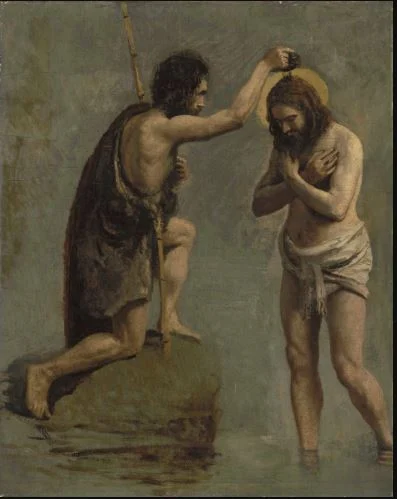
25 Where was John’s baptism from? Was it of heavenly or of human origin?” They discussed this among themselves and said, “If we say ‘Of heavenly origin,’ he will say to us, ‘Then why did you not believe him?’
26 But if we say, ‘Of human origin,’ we fear the crowd, for they all regard John as a prophet.”
27 So they said to Jesus in reply, “We do not know.” He himself said to them, “Neither shall I tell you by what authority I do these things.
23 Et cum venisset in templum, accesserunt ad eum docentem principes sacerdotum, et seniores populi, dicentes: In qua potestate hæc facis? et quis tibi dedit hanc potestatem?
24 Respondens Jesus dixit eis: Interrogabo vos et ego unum sermonem: quem si dixeritis mihi, et ego vobis dicam in qua potestate hæc facio.
25 Baptismus Joannis unde erat? e cælo, an ex hominibus? At illi cogitabant inter se, dicentes:
26 Si dixerimus, e cælo, dicet nobis: Quare ergo non credidistis illi? Si autem dixerimus, ex hominibus, timemus turbam: omnes enim habebant Joannem sicut prophetam.
27 Et respondentes Jesu, dixerunt: Nescimus. Ait illis et ipse: Nec ego dico vobis in qua potestate hæc facio.

A Daily Question from the Summa Theologica
Whether the baptism of John was from God? (Article 2 of 6 of Question 38. Of the Baptism of John from the Treatise on the Incarnation)
Objection 1: It would seem that the baptism of John was not from God. For nothing sacramental that is from God is named after a mere man: thus the baptism of the New Law is not named after Peter or Paul, but after Christ. But that baptism is named after John, according to Mat. 21:25: “The baptism of John . . . was it from heaven or from men?” Therefore the baptism of John was not from God.
Objection 2: Further, every doctrine that proceeds from God anew is confirmed by some signs: thus the Lord (Ex. 4) gave Moses the power of working signs; and it is written (Heb. 2:3, 4) that our faith “having begun to be declared by the Lord, was confirmed unto us by them that heard Him, God also bearing them witness by signs and wonders.” But it is written of John the Baptist (Jn. 10:41) that “John did no sign.” Therefore it seems that the baptism wherewith he baptized was not from God.
Objection 3: Further, those sacraments which are instituted by God are contained in certain precepts of Holy Scripture. But there is no precept of Holy Writ commanding the baptism of John. Therefore it seems that it was not from God.
On the contrary, It is written (Jn. 1:33): “He who sent me to baptize with water said to me: ‘He upon whom thou shalt see the Spirit,’” etc.
I answer that, Two things may be considered in the baptism of John—namely, the rite of baptism and the effect of baptism. The rite of baptism was not from men, but from God, who by an interior revelation of the Holy Ghost sent John to baptize. But the effect of that baptism was from man, because it effected nothing that man could not accomplish. Wherefore it was not from God alone, except in as far as God works in man.
Reply to Objection 1: By the baptism of the New Law men are baptized inwardly by the Holy Ghost, and this is accomplished by God alone. But by the baptism of John the body alone was cleansed by the water. Wherefore it is written (Mat. 3:11): “I baptize you in water; but . . . He shall baptize you in the Holy Ghost.” For this reason the baptism of John was named after him, because it effected nothing that he did not accomplish. But the baptism of the New Law is not named after the minister thereof, because he does not accomplish its principal effect, which is the inward cleansing.
Reply to Objection 2: The whole teaching and work of John was ordered unto Christ, who, by many miracles confirmed both His own teaching and that of John. But if John had worked signs, men would have paid equal attention to John and to Christ. Wherefore, in order that men might pay greater attention to Christ, it was not given to John to work a sign. Yet when the Jews asked him why he baptized, he confirmed his office by the authority of Scripture, saying: “I am the voice of one crying in the wilderness,” etc. as related, Jn. 1:23 (cf. Is. 40:3). Moreover, the very austerity of his life was a commendation of his office, because, as Chrysostom says, commenting on Matthew (Hom. x in Matth.), “it was wonderful to witness such endurance in a human body.”
Reply to Objection 3: The baptism of John was intended by God to last only for a short time, for the reasons given above (A[1]). Therefore it was not the subject of a general commandment set down in Sacred Writ, but of a certain interior revelation of the Holy Ghost, as stated above.
Continue reading the rest of the articles on Sacred Texts Archive website.
Scripture texts in this work are taken from the New American Bible, revised edition © 2010, 1991, 1986, 1970 Confraternity of Christian Doctrine, Washington, D.C.