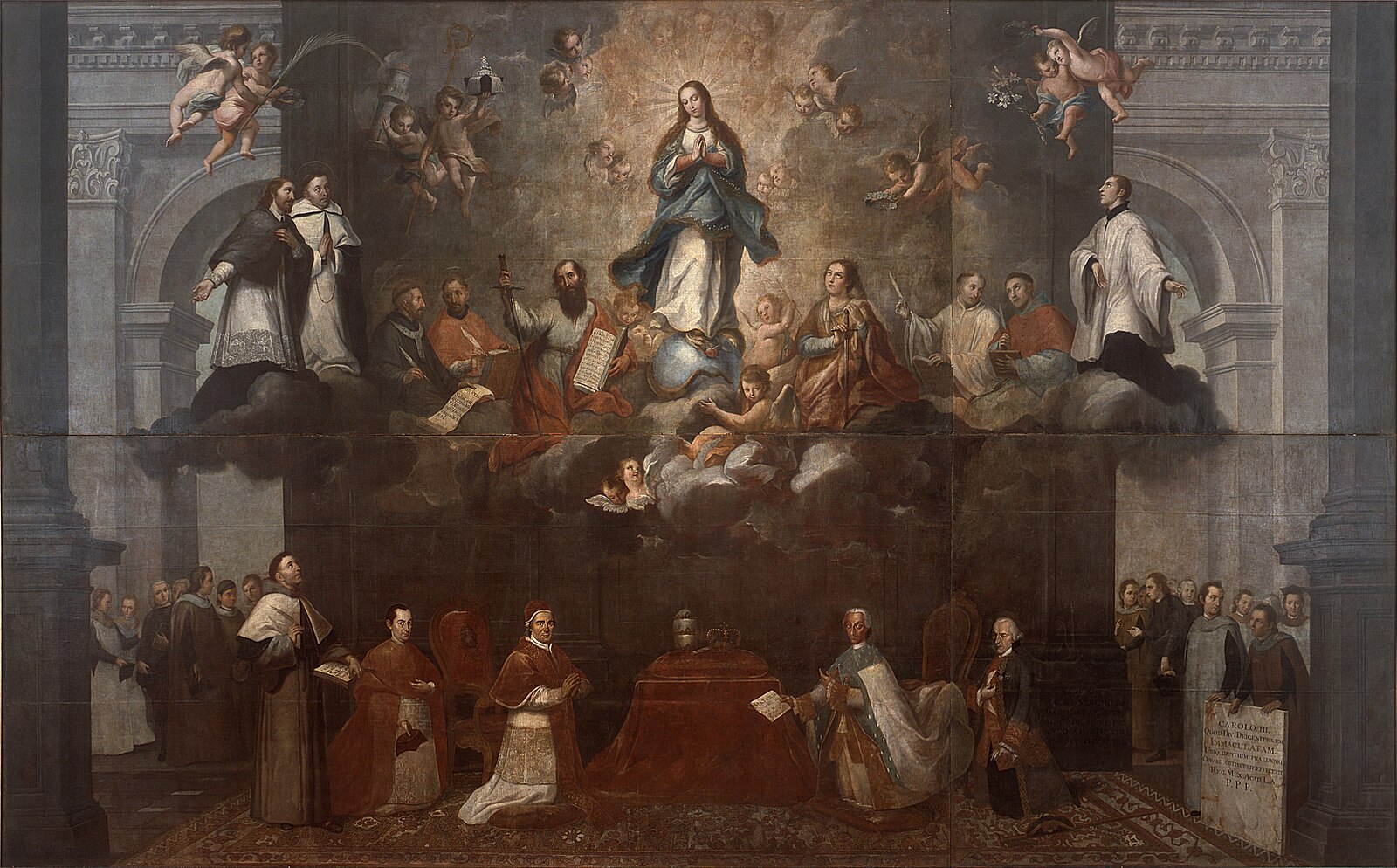
Feast of the Immaculate Conception of the Blessed Virgin Mary
Holy Day of Obligation
Liturgical Color: White
Rosary Mysteries: Joyful Mysteries

Daily Readings
First Reading: Genesis 3:9-15, 20
9 The LORD God then called to the man and asked him: Where are you?
10 He answered, “I heard you in the garden; but I was afraid, because I was naked, so I hid.”
11 Then God asked: Who told you that you were naked? Have you eaten from the tree of which I had forbidden you to eat?
12 The man replied, “The woman whom you put here with me—she gave me fruit from the tree, so I ate it.”
13 The LORD God then asked the woman: What is this you have done? The woman answered, “The snake tricked me, so I ate it.”
14Then the LORD God said to the snake:
Because you have done this,
cursed are you
among all the animals, tame or wild;
On your belly you shall crawl,
and dust you shall eat
all the days of your life.
15 I will put enmity between you and the woman,
and between your offspring and hers;
They will strike at your head,
while you strike at their heel.
20 The man gave his wife the name “Eve,” because she was the mother of all the living.
9 Vocavitque Dominus Deus Adam, et dixit ei: Ubi es?
10 Qui ait: Vocem tuam audivi in paradiso, et timui, eo quod nudus essem, et abscondi me.
11 Cui dixit: Quis enim indicavit tibi quod nudus esses, nisi quod ex ligno de quo præceperam tibi ne comederes, comedisti?
12 Dixitque Adam: Mulier, quam dedisti mihi sociam, dedit mihi de ligno, et comedi.
13 Et dixit Dominus Deus ad mulierem: Quare hoc fecisti? Quæ respondit: Serpens decepit me, et comedi.
14 Et ait Dominus Deus ad serpentem:
[Quia fecisti hoc,
maledictus es inter omnia animantia, et bestias terræ:
super pectus tuum gradieris, et terram comedes cunctis diebus vitæ tuæ.
15 Inimicitias ponam inter te et mulierem,
et semen tuum et semen illius:
ipsa conteret caput tuum,
et tu insidiaberis calcaneo ejus.]
20 Et vocavit Adam nomen uxoris suæ, Heva: eo quod mater esset cunctorum viventium.
Second Reading: Ephesians 1:3-6, 11-12
The Father’s Plan of Salvation
3 Blessed be the God and Father of our Lord Jesus Christ, who has blessed us in Christ with every spiritual blessing in the heavens,
4 as he chose us in him, before the foundation of the world, to be holy and without blemish before him. In love
5 he destined us for adoption to himself through Jesus Christ, in accord with the favor of his will,
6 for the praise of the glory of his grace that he granted us in the beloved.
Inheritance through the Spirit
11 In him we were also chosen, destined in accord with the purpose of the One who accomplishes all things according to the intention of his will,
12 so that we might exist for the praise of his glory, we who first hoped in Christ.
3 Benedictus Deus et Pater Domini nostri Jesu Christi, qui benedixit nos in omni benedictione spirituali in cælestibus in Christo,
4 sicut elegit nos in ipso ante mundi constitutionem, ut essemus sancti et immaculati in conspectu ejus in caritate.
5 Qui prædestinavit nos in adoptionem filiorum per Jesum Christum in ipsum: secundum propositum voluntatis suæ,
6 in laudem gloriæ gratiæ suæ, in qua gratificavit nos in dilecto Filio suo.
11 in quo etiam et nos sorte vocati sumus prædestinati secundum propositum ejus qui operatur omnia secundum consilium voluntatis suæ:
12 ut simus in laudem gloriæ ejus nos, qui ante speravimus in Christo;
Gospel: Luke 1:26-38
Announcement of the Birth of Jesus
26 In the sixth month, the angel Gabriel was sent from God to a town of Galilee called Nazareth,
27 to a virgin betrothed to a man named Joseph, of the house of David, and the virgin’s name was Mary.
28 And coming to her, he said, “Hail, favored one! The Lord is with you.”
29 But she was greatly troubled at what was said and pondered what sort of greeting this might be.
30 Then the angel said to her, “Do not be afraid, Mary, for you have found favor with God.
31 Behold, you will conceive in your womb and bear a son, and you shall name him Jesus.
32 He will be great and will be called Son of the Most High, and the Lord God will give him the throne of David his father,
33 and he will rule over the house of Jacob forever, and of his kingdom there will be no end.”
34 But Mary said to the angel, “How can this be, since I have no relations with a man?”
35 And the angel said to her in reply, “The holy Spirit will come upon you, and the power of the Most High will overshadow you. Therefore the child to be born will be called holy, the Son of God.
36 And behold, Elizabeth, your relative, has also conceived a son in her old age, and this is the sixth month for her who was called barren;
37 for nothing will be impossible for God.”
38 Mary said, “Behold, I am the handmaid of the Lord. May it be done to me according to your word.” Then the angel departed from her.
26 In mense autem sexto, missus est angelus Gabriel a Deo in civitatem Galilææ, cui nomen Nazareth,
27 ad virginem desponsatam viro, cui nomen erat Joseph, de domo David: et nomen virginis Maria.
28 Et ingressus angelus ad eam dixit: Ave gratia plena: Dominus tecum: benedicta tu in mulieribus.
29 Quæ cum audisset, turbata est in sermone ejus, et cogitabat qualis esset ista salutatio.
30 Et ait angelus ei: Ne timeas, Maria: invenisti enim gratiam apud Deum.
31 Ecce concipies in utero, et paries filium, et vocabis nomen ejus Jesum:
32 hic erit magnus, et Filius Altissimi vocabitur, et dabit illi Dominus Deus sedem David patris ejus: et regnabit in domo Jacob in æternum,
33 et regni ejus non erit finis.
34 Dixit autem Maria ad angelum: Quomodo fiet istud, quoniam virum non cognosco?
35 Et respondens angelus dixit ei: Spiritus Sanctus superveniet in te, et virtus Altissimi obumbrabit tibi. Ideoque et quod nascetur ex te sanctum, vocabitur Filius Dei.
36 Et ecce Elisabeth cognata tua, et ipsa concepit filium in senectute sua: et hic mensis sextus est illi, quæ vocatur sterilis:
37 quia non erit impossibile apud Deum omne verbum.
38 Dixit autem Maria: Ecce ancilla Domini: fiat mihi secundum verbum tuum. Et discessit ab illa angelus.

A Daily Question from the Summa Theologica
Whether the Blessed Virgin was sanctified before animation? (Article 2 of 6 of Question 27. Of the Sanctification of the Blessed Virgin from the Treatise on the Incarnation)
Objection 1: It would seem that the Blessed Virgin was sanctified before animation. Because, as we have stated (A[1]), more grace was bestowed on the Virgin Mother of God than on any saint. Now it seems to have been granted to some, to be sanctified before animation. For it is written (Jer. 1:5): “Before I formed thee in the bowels of thy mother, I knew thee”: and the soul is not infused before the formation of the body. Likewise Ambrose says of John the Baptist (Comment. in Luc. i, 15): “As yet the spirit of life was not in him and already he possessed the Spirit of grace.” Much more therefore could the Blessed Virgin be sanctified before animation.
Objection 2: Further, as Anselm says (De Concep. Virg. xviii), “it was fitting that this Virgin should shine with such a purity that under God none greater can be imagined”: wherefore it is written (Canticles 4:7): “Thou art all fair, O my love, and there is not a spot in thee.” But the purity of the Blessed Virgin would have been greater, if she had never been stained by the contagion of original sin. Therefore it was granted to her to be sanctified before her flesh was animated.
Objection 3: Further, as it has been stated above, no feast is celebrated except of some saint. But some keep the feast of the Conception of the Blessed Virgin. Therefore it seems that in her very Conception she was holy; and hence that she was sanctified before animation.
Objection 4: Further, the Apostle says (Rom. 11:16): “If the root be holy, so are the branches.” Now the root of the children is their parents. Therefore the Blessed Virgin could be sanctified even in her parents, before animation.
On the contrary, The things of the Old Testament were figures of the New, according to 1 Cor. 10:11: “All things happened to them in figure.” Now the sanctification of the tabernacle, of which it is written (Ps. 45:5): “The most High hath sanctified His own tabernacle,” seems to signify the sanctification of the Mother of God, who is called “God’s Tabernacle,” according to Ps. 18:6: “He hath set His tabernacle in the sun.” But of the tabernacle it is written (Exod. 40:31, 32): “After all things were perfected, the cloud covered the tabernacle of the testimony, and the glory of the Lord filled it.” Therefore also the Blessed Virgin was not sanctified until after all in her was perfected, viz. her body and soul.
I answer that, The sanctification of the Blessed Virgin cannot be understood as having taken place before animation, for two reasons. First, because the sanctification of which we are speaking, is nothing but the cleansing from original sin: for sanctification is a “perfect cleansing,” as Dionysius says (Div. Nom. xii). Now sin cannot be taken away except by grace, the subject of which is the rational creature alone. Therefore before the infusion of the rational soul, the Blessed Virgin was not sanctified.
Secondly, because, since the rational creature alone can be the subject of sin; before the infusion of the rational soul, the offspring conceived is not liable to sin. And thus, in whatever manner the Blessed Virgin would have been sanctified before animation, she could never have incurred the stain of original sin: and thus she would not have needed redemption and salvation which is by Christ, of whom it is written (Mat. 1:21): “He shall save His people from their sins.” But this is unfitting, through implying that Christ is not the “Saviour of all men,” as He is called (1 Tim. 4:10). It remains, therefore, that the Blessed Virgin was sanctified after animation.
Reply to Objection 1: The Lord says that He “knew” Jeremias before he was formed in the womb, by knowledge, that is to say, of predestination: but He says that He “sanctified” him, not before formation, but before he “came forth out of the womb,” etc.
As to what Ambrose says, viz. that in John the Baptist there was not the spirit of life when there was already the Spirit of grace, by spirit of life we are not to understand the life-giving soul, but the air which we breathe out [respiratus]. Or it may be said that in him as yet there was not the spirit of life, that is the soul, as to its manifest and complete operations.
Reply to Objection 2: If the soul of the Blessed Virgin had never incurred the stain of original sin, this would be derogatory to the dignity of Christ, by reason of His being the universal Saviour of all. Consequently after Christ, who, as the universal Saviour of all, needed not to be saved, the purity of the Blessed Virgin holds the highest place. For Christ did not contract original sin in any way whatever, but was holy in His very Conception, according to Lk. 1:35: “The Holy which shall be born of thee, shall be called the Son of God.” But the Blessed Virgin did indeed contract original sin, but was cleansed therefrom before her birth from the womb. This is what is signified (Job 3:9) where it is written of the night of original sin: “Let it expect light,” i.e. Christ, “and not see it”—(because “no defiled thing cometh into her,” as is written Wis. 7:25), “nor the rising of the dawning of the day,” that is of the Blessed Virgin, who in her birth was immune from original sin.
Reply to Objection 3: Although the Church of Rome does not celebrate the Conception of the Blessed Virgin, yet it tolerates the custom of certain churches that do keep that feast, wherefore this is not to be entirely reprobated. Nevertheless the celebration of this feast does not give us to understand that she was holy in her conception. But since it is not known when she was sanctified, the feast of her Sanctification, rather than the feast of her Conception, is kept on the day of her conception.
Reply to Objection 4: Sanctification is twofold. one is that of the whole nature: inasmuch as the whole human nature is freed from all corruption of sin and punishment. This will take place at the resurrection. The other is personal sanctification. This is not transmitted to the children begotten of the flesh: because it does not regard the flesh but the mind. Consequently, though the parents of the Blessed Virgin were cleansed from original sin, nevertheless she contracted original sin, since she was conceived by way of fleshly concupiscence and the intercourse of man and woman: for Augustine says (De Nup. et Concup. i): “All flesh born of carnal intercourse is sinful.”
Continue reading the rest of the articles on Sacred Texts Archive website.
Scripture texts in this work are taken from the New American Bible, revised edition © 2010, 1991, 1986, 1970 Confraternity of Christian Doctrine, Washington, D.C.