Weekday
Liturgical Color: Green
Rosary Mysteries: Joyful Mysteries

Daily Readings
First Reading: 1 Kings 8: 1-7, 9-13
1 Then all the ancients of Israel with the princes of the tribes, and the heads of the families of the children of Israel were assembled to king Solomon in Jerusalem: that they might carry the ark of the covenant of the Lord out of the city of David, that is, out of Sion.
2 And all Israel assembled themselves to king Solomon on the festival day in the month of Ethanim, the same is the seventh month.
3 And all the ancients of Israel came, and the priests took up the ark,
4 And carried the ark of the Lord, and the tabernacle of the covenant, and all the vessels of the sanctuary, that were in the tabernacle: and the priests and the Levites carried them.
5 And king Solomon, and all the multitude of Israel, that were assembled unto him went with him before the ark, and they sacrificed sheep and oxen that could not be counted or numbered.
6 And the priests brought in the ark of the covenant of the Lord into its place, into the oracle of the temple, into the holy of holies under the wings of the cherubims.
7 For the cherubims spread forth their wings over the place of the ark, and covered the ark, and the staves thereof above.
9 Now in the ark there was nothing else but the two tables of stone, which Moses put there at Horeb, when the Lord made a covenant with the children of Israel, when they came out of the land of Egypt.
10 And it came to pass, when the priests were come out of the sanctuary, that a cloud filled the house of the Lord,
11 And the priests could not stand to minister because of the cloud: for the glory of the Lord had filled the house of the Lord.
12 Then Solomon said: The Lord said that he would dwell in a cloud.
13 Building I have built a house for thy dwelling, to be thy most firm throne for ever.
1 Tunc congregati sunt omnes majores natu Israël cum principibus tribuum, et duces familiarum filiorum Israël, ad regem Salomonem in Jerusalem, ut deferrent arcam fœderis Domini de civitate David, id est, de Sion.
2 Convenitque ad regem Salomonem universus Israël in mense Ethanim, in solemni die: ipse est mensis septimus.
3 Veneruntque cuncti senes de Israël, et tulerunt arcam sacerdotes,
4 et portaverunt arcam Domini, et tabernaculum fœderis, et omnia vasa sanctuarii quæ erant in tabernaculo: et ferebant ea sacerdotes et Levitæ.
5 Rex autem Salomon, et omnis multitudo Israël quæ convenerat ad eum, gradiebatur cum illo ante arcam, et immolabant oves et boves absque æstimatione et numero.
6 Et intulerunt sacerdotes arcam fœderis Domini in locum suum, in oraculum templi, in Sanctum sanctorum, subter alas cherubim.
7 Siquidem cherubim expandebant alas super locum arcæ, et protegebant arcam, et vectes ejus desuper.
9 In arca autem non erat aliud nisi duæ tabulæ lapideæ quas posuerat in ea Moyses in Horeb, quando pepigit Dominus fœdus cum filiis Israël, cum egrederentur de terra Ægypti.
10 Factum est autem cum exissent sacerdotes de sanctuario, nebula implevit domum Domini,
11 et non poterant sacerdotes stare et ministrare propter nebulam: impleverat enim gloria Domini domum Domini.
12 Tunc ait Salomon: Dominus dixit ut habitaret in nebula.
13 Ædificans ædificavi domum in habitaculum tuum: firmissimum solium tuum in sempiternum.
Gospel: Mark 6: 53-56
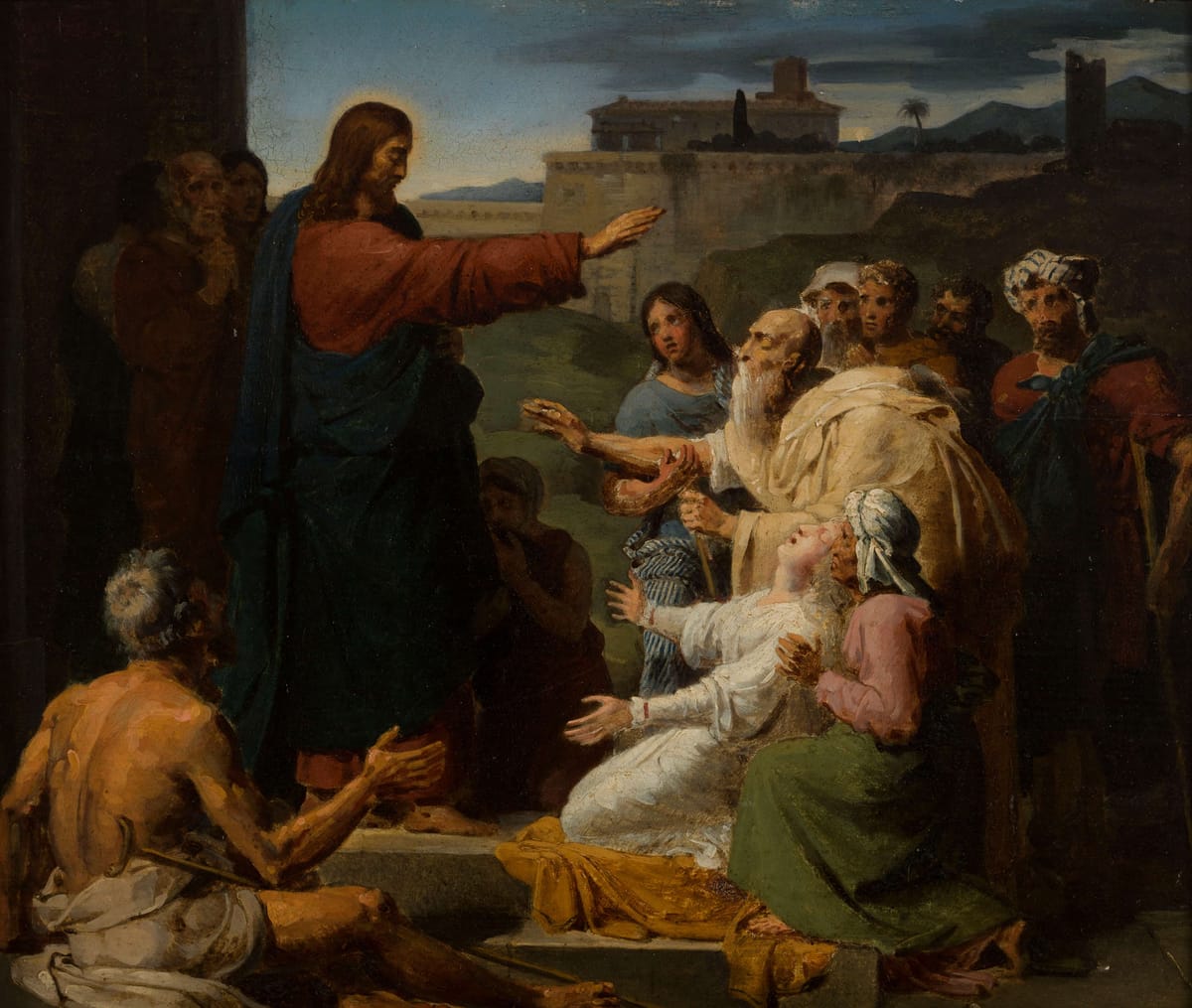
53 And when they had passed over, they came into the land of Genezareth, and set to the shore.
54 And when they were gone out of the ship, immediately they knew him:
55 And running through that whole country, they began to carry about in beds those that were sick, where they heard he was.
56 And whithersoever he entered, into towns or into villages or cities, they laid the sick in the streets, and besought him that they might touch but the hem of his garment: and as many as touched him were made whole.
53 Et cum transfretassent, venerunt in terram Genesareth, et applicuerunt.
54 Cumque egressi essent de navi, continuo cognoverunt eum:
55 et percurrentes universam regionem illam, cœperunt in grabatis eos, qui se male habebant, circumferre, ubi audiebant eum esse.
56 Et quocumque introibat, in vicos, vel in villas aut civitates, in plateis ponebant infirmos, et deprecabantur eum, ut vel fimbriam vestimenti ejus tangerent, et quotquot tangebant eum, salvi fiebant.

A Daily Question from the Summa Theologica
Whether a character is imprinted by each sacrament of the New Law? (Article 6 of 6 of Question 63. Of the Other Effect of the Sacrament Which is a Character from the Treatise on the Sacraments)
Objection 1: It seems that a character is imprinted by all the sacraments of the New Law: because each sacrament of the New Law makes man a participator in Christ’s Priesthood. But the sacramental character is nothing but a participation in Christ’s Priesthood, as already stated (AA[3],5). Therefore it seems that a character is imprinted by each sacrament of the New Law.
Objection 2: Further, a character may be compared to the soul in which it is, as a consecration to that which is consecrated. But by each sacrament of the New Law man becomes the recipient of sanctifying grace, as stated above (Q[62], A[1]). Therefore it seems that a character is imprinted by each sacrament of the New Law.
Objection 3: Further, a character is both a reality and a sacrament. But in each sacrament of the New Law, there is something which is only a reality, and something which is only a sacrament, and something which is both reality and sacrament. Therefore a character is imprinted by each sacrament of the New Law.
On the contrary, Those sacraments in which a character is imprinted, are not reiterated, because a character is indelible, as stated above (A[5]): whereas some sacraments are reiterated, for instance, penance and matrimony. Therefore not all the sacraments imprint a character.
I answer that, As stated above (Q[62], AA[1],5), the sacraments of the New Law are ordained for a twofold purpose, namely, as a remedy for sin, and for the Divine worship. Now all the sacraments, from the fact that they confer grace, have this in common, that they afford a remedy against sin: whereas not all the sacraments are directly ordained to the Divine worship. Thus it is clear that penance, whereby man is delivered from sin, does not afford man any advance in the Divine worship, but restores him to his former state.
Now a sacrament may belong to the Divine worship in three ways: first in regard to the thing done; secondly, in regard to the agent; thirdly, in regard to the recipient. In regard to the thing done, the Eucharist belongs to the Divine worship, for the Divine worship consists principally therein, so far as it is the sacrifice of the Church. And by this same sacrament a character is not imprinted on man; because it does not ordain man to any further sacramental action or benefit received, since rather is it “the end and consummation of all the sacraments,” as Dionysius says (Eccl. Hier. iii). But it contains within itself Christ, in Whom there is not the character, but the very plenitude of the Priesthood.
But it is the sacrament of order that pertains to the sacramental agents: for it is by this sacrament that men are deputed to confer sacraments on others: while the sacrament of Baptism pertains to the recipients, since it confers on man the power to receive the other sacraments of the Church; whence it is called the “door of the sacraments.” In a way Confirmation also is ordained for the same purpose, as we shall explain in its proper place (Q[65], A[3]). Consequently, these three sacraments imprint a character, namely, Baptism, Confirmation, and order.
Reply to Objection 1: Every sacrament makes man of the a participator in Christ’s Priesthood, from the fact that it confers on him some effect thereof. But every sacrament does not depute a man to do or receive something pertaining to the worship of the priesthood of Christ: while it is just this that is required for a sacrament to imprint a character.
Reply to Objection 2: Man is sanctified by each of the sacraments, since sanctity means immunity from sin, which is the effect of grace. But in a special way some sacraments, which imprint a character, bestow on man a certain consecration, thus deputing him to the Divine worship: just as inanimate things are said to be consecrated forasmuch as they are deputed to Divine worship.
Reply to Objection 3: Although a character is a reality and a sacrament, it does not follow that whatever is a reality and a sacrament, is also a character. With regard to the other sacraments we shall explain further on what is the reality and what is the sacrament.
Continue reading the rest of the articles on Sacred Texts Archive website.