Weekday
Liturgical Color: Green
Rosary Mysteries: Joyful Mysteries

Daily Readings
First Reading: 1 Samuel 1: 1-8
1 There was a man of Ramathaimsophim, of mount Ephraim, and his name was Elcana, the son of Jeroham, the son of Eliu, the son of Thohu, the son of Suph, an Ephraimite:
2 And he had two wives, the name of one was Anna, and the name of the other Phenenna. Phenenna had children: but Anna had no children.
3 And this man went up out of his city upon the appointed days, to adore and to offer sacrifice to the Lord of hosts in Silo. And the two sons of Heli, Ophni and Phinees, were there priests of the Lord.
4 Now the day came, and Elcana offered sacrifice, and gave to Phenenna his wife, and to all her sons and daughters, portions:
5 But to Anna he gave one portion with sorrow, because he loved Anna. And the Lord had shut up her womb.
6 Her rival also afflicted her, and troubled her exceedingly, insomuch that she upbraided her, that the Lord had shut up her womb:
7 And thus she did every year, when the time returned that they went up to the temple of the Lord: and thus she provoked her: but Anna wept, and did not eat.
8 Then Elcana her husband said to her: Anna, why weepest thou? and why dost thou not eat? And why dost thou afflict thy heart? Am not I better to thee than ten children?
1 Fuit vir unus de Ramathaimsophim, de monte Ephraim, et nomen ejus Elcana, filius Jeroham, filii Eliu, filii Thohu, filii Suph, Ephrathæus:
2 et habuit duas uxores, nomen uni Anna, et nomen secundæ Phenenna. Fueruntque Phenennæ filii: Annæ autem non erant liberi.
3 Et ascendebat vir ille de civitate sua statutis diebus, ut adoraret et sacrificaret Domino exercituum in Silo. Erant autem ibi duo filii Heli, Ophni et Phinees, sacerdotes Domini.
4 Venit ergo dies, et immolavit Elcana, deditque Phenennæ uxori suæ, et cunctis filiis ejus et filiabus, partes:
5 Annæ autem dedit partem unam tristis, quia Annam diligebat. Dominus autem concluserat vulvam ejus.
6 Affligebat quoque eam æmula ejus, et vehementer angebat, in tantum ut exprobraret quod Dominus conclusisset vulvam ejus:
7 sicque faciebat per singulos annos: cum redeunte tempore ascenderent ad templum Domini, et sic provocabat eam: porro illa flebat, et non capiebat cibum.
8 Dixit ergo ei Elcana vir suus: Anna, cur fles? et quare non comedis? et quam ob rem affligitur cor tuum? numquid non ego melior tibi sum, quam decem filii?
Gospel: Mark 1: 14-20
14 And after that John was delivered up, Jesus came into Galilee, preaching the gospel of the kingdom of God,
15 And saying: The time is accomplished, and the kingdom of God is at hand: repent, and believe the gospel.
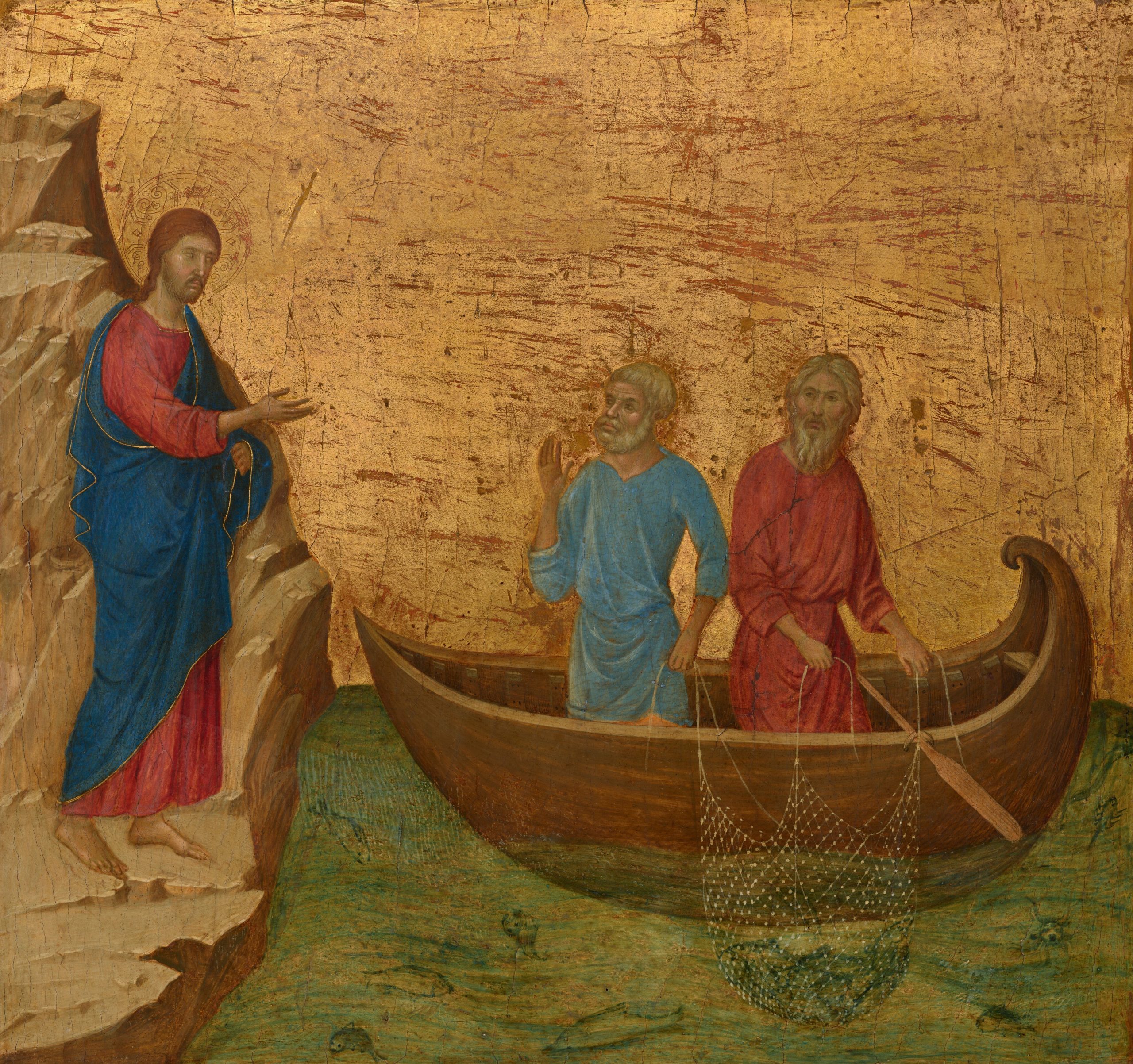
16 And passing by the sea of Galilee, he saw Simon and Andrew his brother, casting nets into the sea (for they were fishermen).
17 And Jesus said to them: Come after me, and I will make you to become fishers of men.
18 And immediately leaving their nets, they followed him.
19 And going on from thence a little farther, he saw James the son of Zebedee, and John his brother, who also were mending their nets in the ship:
20 And forthwith he called them. And leaving their father Zebedee in the ship with his hired men, they followed him.
14 Postquam autem traditus est Joannes, venit Jesus in Galilæam, prædicans Evangelium regni Dei,
15 et dicens: Quoniam impletum est tempus, et appropinquavit regnum Dei: pœnitemini, et credite Evangelio.
16 Et præteriens secus mare Galilææ, vidit Simonem, et Andream fratrem ejus, mittentes retia in mare (erant enim piscatores),
17 et dixit eis Jesus: Venite post me, et faciam vos fieri piscatores hominum.
18 Et protinus relictis retibus, secuti sunt eum.
19 Et progressus inde pusillum, vidit Jacobum Zebedæi, et Joannem fratrem ejus, et ipsos componentes retia in navi:
20 et statim vocavit illos. Et relicto patre suo Zebedæo in navi cum mercenariis, secuti sunt eum.

A Daily Question from the Summa Theologica
Whether those who had been baptized with John’s baptism had to be baptized with the baptism of Christ? (Article 6 of 6 of Question 38. Of the Baptism of John from the Treatise on the Incarnation)
Objection 1: It would seem that those who had been baptized with John’s baptism had not to be baptized with the baptism of Christ. For John was not less than the apostles, since of him is it written (Mat. 11:11): “There hath not risen among them that are born of women a greater than John the Baptist.” But those who were baptized by the apostles were not baptized again, but only received the imposition of hands; for it is written (Acts 8:16, 17) that some were “only baptized” by Philip “in the name of the Lord Jesus”: then the apostles—namely, Peter and John—“laid their hands upon them, and they received the Holy Ghost.” Therefore it seems that those who had been baptized by John had not to be baptized with the baptism of Christ.
Objection 2: Further, the apostles were baptized with John’s baptism, since some of them were his disciples, as is clear from Jn. 1:37.But the apostles do not seem to have been baptized with the baptism of Christ: for it is written (Jn. 4:2) that “Jesus did not baptize, but His disciples.” Therefore it seems that those who had been baptized with John’s baptism had not to be baptized with the baptism of Christ.
Objection 3: Further, he who is baptized is less than he who baptizes. But we are not told that John himself was baptized with the baptism of Christ. Therefore much less did those who had been baptized by John need to receive the baptism of Christ.
Objection 4: Further, it is written (Acts 19:1-5) that “Paul . . . found certain disciples; and he said to them: Have you received the Holy Ghost since ye believed? But they said to him: We have not so much as heard whether there be a Holy Ghost. And he said: In what then were you baptized? Who said: In John’s baptism.” Wherefore “they were” again “baptized in the name of our [Vulg.: ‘the’] Lord Jesus Christ.” Hence it seems that they needed to be baptized again, because they did not know of the Holy Ghost: as Jerome says on Joel 2:28 and in an epistle (lxix De Viro unius uxoris), and likewise Ambrose (De Spiritu Sancto). But some were baptized with John’s baptism who had full knowledge of the Trinity. Therefore these had no need to be baptized again with Christ’s baptism.
Objection 5: Further, on Rom. 10:8, “This is the word of faith, which we preach,” the gloss of Augustine says: “Whence this virtue in the water, that it touches the body and cleanses the heart, save by the efficacy of the word, not because it is uttered, but because it is believed?” Whence it is clear that the virtue of baptism depends on faith. But the form of John’s baptism signified the faith in which we are baptized; for Paul says (Acts 19:4): “John baptized the people with the baptism of penance, saying: That they should believe in Him who was to come after him—that is to say, in Jesus.” Therefore it seems that those who had been baptized with John’s baptism had no need to be baptized again with the baptism of Christ.
On the contrary, Augustine says (Super Joan., Tract. v): “Those who were baptized with John’s baptism needed to be baptized with the baptism of our Lord.”
I answer that, According to the opinion of the Master (Sent. iv, D, 2), “those who had been baptized by John without knowing of the existence of the Holy Ghost, and who based their hopes on his baptism, were afterwards baptized with the baptism of Christ: but those who did not base their hope on John’s baptism, and who believed in the Father, Son, and Holy Ghost, were not baptized afterwards, but received the Holy Ghost by the imposition of hands made over them by the apostles.”
And this, indeed, is true as to the first part, and is confirmed by many authorities. But as to the second part, the assertion is altogether unreasonable. First, because John’s baptism neither conferred grace nor imprinted a character, but was merely “in water,” as he says himself (Mat. 3:11). Wherefore the faith or hope which the person baptized had in Christ could not supply this defect. Secondly, because, when in a sacrament, that is omitted which belongs of necessity to the sacrament, not only must the omission be supplied, but the whole must be entirely renewed. Now, it belongs of necessity to Christ’s baptism that it be given not only in water, but also in the Holy Ghost, according to Jn. 3:5: “Unless a man be born of water and the Holy Ghost, he cannot enter into the kingdom of God.” Wherefore in the case of those who had been baptized with John’s baptism in water only, not merely had the omission to be supplied by giving them the Holy Ghost by the imposition of hands, but they had to be baptized wholly anew “in water and the Holy Ghost.”
Reply to Objection 1: As Augustine says (Super Joan., Tract. v): “After John, baptism was administered, and the reason why was because he gave not Christ’s baptism, but his own . . . That which Peter gave . . . and if any were given by Judas, that was Christ’s. And therefore if Judas baptized anyone, yet were they not rebaptized . . . For the baptism corresponds with him by whose authority it is given, not with him by whose ministry it is given.” For the same reason those who were baptized by the deacon Philip, who gave the baptism of Christ, were not baptized again, but received the imposition of hands by the apostles, just as those who are baptized by priests are confirmed by bishops.
Reply to Objection 2: As Augustine says to Seleucianus (Ep. cclxv), “we deem that Christ’s disciples were baptized either with John’s baptism, as some maintain, or with Christ’s baptism, which is more probable. For He would not fail to administer baptism so as to have baptized servants through whom He baptized others, since He did not fail in His humble service to wash their feet.”
Reply to Objection 3: As Chrysostom says (Hom. iv in Matth. [*From the supposititious Opus Imperfectum]): “Since, when John said, ‘I ought to be baptized by Thee,’ Christ answered, ‘Suffer it to be so now’: it follows that afterwards Christ did baptize John.” Moreover, he asserts that “this is distinctly set down in some of the apocryphal books.” At any rate, it is certain, as Jerome says on Mat. 3:13, that, “as Christ was baptized in water by John, so had John to be baptized in the Spirit by Christ.”
Reply to Objection 4: The reason why these persons were baptized after being baptized by John was not only because they knew not of the Holy Ghost, but also because they had not received the baptism of Christ.
Reply to Objection 5: As Augustine says (Contra Faust. xix), our sacraments are signs of present grace, whereas the sacraments of the Old Law were signs of future grace. Wherefore the very fact that John baptized in the name of one who was to come, shows that he did not give the baptism of Christ, which is a sacrament of the New Law.
Continue reading the rest of the articles on Sacred Texts Archive website.