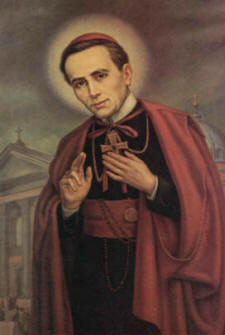
Memorial of St. John Neumann, Bishop
Liturgical Color: White
Rosary Mysteries: Joyful Mysteries
“Everyone who breathes, high and low, educated and ignorant, young and old, man and woman, has a mission, has a work. We are not sent into this world for nothing; we are not born at random; we are not here, that we may go to bed at night, and get up in the morning, toil for our bread, eat and drink, laugh and joke, sin when we have a mind, and reform when we are tired of sinning, rear a family and die. God sees every one of us; He creates every soul, . . . for a purpose. He needs, He deigns to need, every one of us. He has an end for each of us; we are all equal in His sight, and we are placed in our different ranks and stations, not to get what we can out of them for ourselves, but to labor in them for Him. As Christ has His work, we too have ours; as He rejoiced to do His work, we must rejoice in ours also.”
Saint John Neumann
March 28, 1811 – January 5, 1860
Patron of teachers, educators, sick children, and immigrants

Daily Readings
First Reading: 1 John 3: 22 – 4: 6
22 And whatsoever we shall ask, we shall receive of him: because we keep his commandments, and do those things which are pleasing in his sight.
23 And this is his commandment, that we should believe in the name of his Son Jesus Christ: and love one another, as he hath given commandment unto us.
24 And he that keepeth his commandments, abideth in him, and he in him. And in this we know that he abideth in us, by the Spirit which he hath given us.
1 Dearly beloved, believe not every spirit, but try the spirits if they be of God: because many false prophets are gone out into the world.
2 By this is the spirit of God known. Every spirit which confesseth that Jesus Christ is come in the flesh, is of God:
22 et quidquid petierimus, accipiemus ab eo: quoniam mandata ejus custodimus, et ea, quæ sunt placita coram eo, facimus.
23 Et hoc est mandatum ejus: ut credamus in nomine Filii ejus Jesu Christi: et diligamus alterutrum, sicut dedit mandatum nobis.
24 Et qui servat mandata ejus, in illo manet, et ipse in eo: et in hoc scimus quoniam manet in nobis, de Spiritu quem dedit nobis.
1 Carissimi, nolite omni spiritui credere, sed probate spiritus si ex Deo sint: quoniam multi pseudoprophetæ exierunt in mundum.
2 In hoc cognoscitur Spiritus Dei: omnis spiritus qui confitetur Jesum Christum in carne venisse, ex Deo est:
Gospel: Matthew 4: 12-17, 23-25
12 And when Jesus had heard that John was delivered up, he retired into Galilee:
13 And leaving the city Nazareth, he came and dwelt in Capharnaum on the sea coast, in the borders of Zabulon and Nephthalim;
14 That it might be fulfilled which was said by Isaias the prophet:
15 Land of Zabulon and land of Nephthalim, the way of the sea beyond the Jordan, Galilee of the Gentiles:
16 The people that sat in darkness, hath seen great light: and to them that sat in the region of the shadow of death, light is sprung up.
17 From that time Jesus began to preach, and to say: Do penance, for the kingdom of heaven is at hand.
23 And Jesus went about all Galilee, teaching in their synagogues, and preaching the gospel of the kingdom: and healing all manner of sickness and every infirmity, among the people.
24 And his fame went throughout all Syria, and they presented to him all sick people that were taken with divers diseases and torments, and such as were possessed by devils, and lunatics, and those that had palsy, and he cured them:
25 And much people followed him from Galilee, and from Decapolis, and from Jerusalem, and from Judea, and from beyond the Jordan.
12 Cum autem audisset Jesus quod Joannes traditus esset, secessit in Galilæam:
13 et, relicta civitate Nazareth, venit, et habitavit in Capharnaum maritima, in finibus Zabulon et Nephthalim:
14 ut adimpleretur quod dictum est per Isaiam prophetam:
15 [Terra Zabulon, et terra Nephthalim,
via maris trans Jordanem,
Galilæa gentium:
16 populus, qui sedebat in tenebris,
vidit lucem magnam:
et sedentibus in regione umbræ mortis,
lux orta est eis.]
17 Exinde cœpit Jesus prædicare, et dicere: Pœnitentiam agite: appropinquavit enim regnum cælorum.
23 Et circuibat Jesus totam Galilæam, docens in synagogis eorum, et prædicans Evangelium regni: et sanans omnem languorem, et omnem infirmitatem in populo.
24 Et abiit opinio ejus in totam Syriam, et obtulerunt ei omnes male habentes, variis languoribus, et tormentis comprehensos, et qui dæmonia habebant, et lunaticos, et paralyticos, et curavit eos:
25 et secutæ sunt eum turbæ multæ de Galilæa, et Decapoli, et de Jerosolymis, et de Judæa, et de trans Jordanem.

A Daily Question from the Summa Theologica
Whether Christ was becomingly presented in the temple? (Article 3 of 4 of Question 37. Of Christ’s Circumcision, and of the Other Legal Observances Accomplished in Regard to the Child Christ from the Treatise on the Incarnation)
Objection 1: It would seem that Christ was unbecomingly presented in the Temple. For it is written (Ex. 13:2): “Sanctify unto Me every first-born that openeth the womb among the children of Israel.” But Christ came forth from the closed womb of the Virgin; and thus He did not open His Mother’s womb. Therefore Christ was not bound by this law to be presented in the Temple.
Objection 2: Further, that which is always in one’s presence cannot be presented to one. But Christ’s humanity was always in God’s presence in the highest degree, as being always united to Him in unity of person. Therefore there was no need for Him to be presented to the Lord.
Objection 3: Further, Christ is the principal victim, to whom all the victims of the old Law are referred, as the figure to the reality. But a victim should not be offered up for a victim. Therefore it was not fitting that another victim should be offered up for Christ.
Objection 4: Further, among the legal victims the principal was the lamb, which was a “continual sacrifice” [Vulg.: ‘holocaust’], as is stated Num. 28:6: for which reason Christ is also called “the Lamb—Behold the Lamb of God” (Jn. 1: 29). It was therefore more fitting that a lamb should be offered for Christ than “a pair of turtle doves or two young pigeons.”
On the contrary is the authority of Scripture which relates this as having taken place (Lk. 2:22).
I answer that, As stated above (A[1]), Christ wished to be “made under the Law, that He might redeem them who were under the Law” (Gal. 4:4, 5), and that the “justification of the Law might be” spiritually “fulfilled” in His members. Now, the Law contained a twofold precept touching the children born. one was a general precept which affected all—namely, that “when the days of the mother’s purification were expired,” a sacrifice was to be offered either “for a son or for a daughter,” as laid down Lev. 12:6. And this sacrifice was for the expiation of the sin in which the child was conceived and born; and also for a certain consecration of the child, because it was then presented in the Temple for the first time. Wherefore one offering was made as a holocaust and another for sin.
The other was a special precept in the law concerning the first-born of “both man and beast”: for the Lord claimed for Himself all the first-born in Israel, because, in order to deliver the Israelites, He “slew every first-born in the land of Egypt, both men and cattle” (Exod. 12:12, 13, 29), the first-born of Israel being saved; which law is set down Ex. 13. Here also was Christ foreshadowed, who is “the First-born amongst many brethren” (Rom. 8:29).
Therefore, since Christ was born of a woman and was her first-born, and since He wished to be “made under the Law,” the Evangelist Luke shows that both these precepts were fulfilled in His regard. First, as to that which concerns the first-born, when he says (Luke 2:22, 23): “They carried Him to Jerusalem to present Him to the Lord: as it is written in the law of the Lord, ‘Every male opening the womb shall be called holy to the Lord.’” Secondly, as to the general precept which concerned all, when he says (Lk. 2:24): “And to offer a sacrifice according as it is written in the law of the Lord, a pair of turtle doves or two young pigeons.”
Reply to Objection 1: As Gregory of Nyssa says (De Occursu Dom.): “It seems that this precept of the Law was fulfilled in God incarnate alone in a special manner exclusively proper to Him. For He alone, whose conception was ineffable, and whose birth was incomprehensible, opened the virginal womb which had been closed to sexual union, in such a way that after birth the seal of chastity remained inviolate.” Consequently the words “opening the womb” imply that nothing hitherto had entered or gone forth therefrom. Again, for a special reason is it written “‘a male,’ because He contracted nothing of the woman’s sin”: and in a singular way “is He called ‘holy,’ because He felt no contagion of earthly corruption, whose birth was wondrously immaculate” (Ambrose, on Lk. 2:23).
Reply to Objection 2: As the Son of God “became man, and was circumcised in the flesh, not for His own sake, but that He might make us to be God’s through grace, and that we might be circumcised in the spirit; so, again, for our sake He was presented to the Lord, that we may learn to offer ourselves to God” [*Athanasius, on Lk. 2:23]. And this was done after His circumcision, in order to show that “no one who is not circumcised from vice is worthy of Divine regard” [*Bede, on Lk. 2:23].
Reply to Objection 3: For this very reason He wished the legal victims to be offered for Him who was the true Victim, in order that the figure might be united to and confirmed by the reality, against those who denied that in the Gospel Christ preached the God of the Law. “For we must not think,” says Origen (Hom. xiv in Luc.) “that the good God subjected His Son to the enemy’s law, which He Himself had not given.”
Reply to Objection 4: The law ofLev. 12:6, 8 “commanded those who could, to offer, for a son or a daughter, a lamb and also a turtle dove or a pigeon: but those who were unable to offer a lamb were commanded to offer two turtle doves or two young pigeons” [*Bede, Hom. xv in Purif.]. “And so the Lord, who, ‘being rich, became poor for our [Vulg.: ‘your’] sakes, that through His poverty we [you] might be rich,” as is written 2 Cor. 8:9, “wished the poor man’s victim to be offered for Him” just as in His birth He was “wrapped in swaddling clothes and laid in a manger” [*Bede on Lk. 1]. Nevertheless, these birds have a figurative sense. For the turtle dove, being a loquacious bird, represents the preaching and confession of faith; and because it is a chaste animal, it signifies chastity; and being a solitary animal, it signifies contemplation. The pigeon is a gentle and simple animal, and therefore signifies gentleness and simplicity. It is also a gregarious animal; wherefore it signifies the active life. Consequently this sacrifice signified the perfection of Christ and His members. Again, “both these animals, by the plaintiveness of their song, represented the mourning of the saints in this life: but the turtle dove, being solitary, signifies the tears of prayer; whereas the pigeon, being gregarious, signifies the public prayers of the Church” [*Bede, Hom. xv in Purif.]. Lastly, two of each of these animals are offered, to show that holiness should be not only in the soul, but also in the body.
Continue reading the rest of the articles on Sacred Texts Archive website.