Lenten Weekday
LITurgical Color: Violet
Rosary Mysteries: Joyful Mysteries

Daily Readings
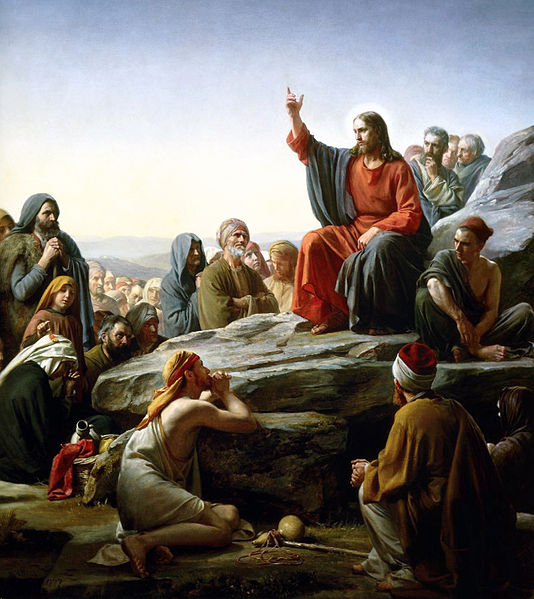
Gospel: Luke 6: 36-38
36 Be ye therefore merciful, as your Father also is merciful.
37 Judge not, and you shall not be judged. Condemn not, and you shall not be condemned. Forgive, and you shall be forgiven.
38 Give, and it shall be given to you: good measure and pressed down and shaken together and running over shall they give into your bosom. For with the same measure that you shall mete withal, it shall be measured to you again.
36 Estote ergo misericordes sicut et Pater vester misericors est.
37 Nolite judicare, et non judicabimini: nolite condemnare, et non condemnabimini. Dimitte, et dimittemini.
38 Date, et dabitur vobis: mensuram bonam, et confertam, et coagitatam, et supereffluentem dabunt in sinum vestrum. Eadem quippe mensura, qua mensi fueritis, remetietur vobis.
First Reading: Deuteronomy 9: 4-10
4 Say not in thy heart, when the Lord thy God shall have destroyed them in thy sight: For my justice hath the Lord brought me in to possess this land, whereas these nations are destroyed for their wickedness.
5 For it is not for thy justices, and the uprightness of thy heart that thou shalt go in to possess their lands: but because they have done wickedly, they are destroyed at thy coming in: and that the Lord might accomplish his word, which he promised by oath to thy fathers Abraham, Isaac, and Jacob.
6 Know therefore that the Lord thy God giveth thee not this excellent land in possession for thy justices, for thou art a very stiffnecked people.
7 Remember, and forget not how thou provokedst the Lord thy God to wrath in the wilderness. From the day that thou camest out of Egypt unto this place, thou hast always strove against the Lord.
8 For in Horeb also thou didst provoke him, and he was angry, and would have destroyed thee,
9 When I went up into the mount to receive the tables of stone, the tables of the covenant which the Lord made with you: and I continued in the mount forty days and nights, neither eating bread, nor drinking water.
10 And the Lord gave me two tables of stone written with the finger of God, and containing all the words that he spoke to you in the mount from the midst of the fire, when the people were assembled together.
4 ne dicas in corde tuo, cum deleverit eos Dominus Deus tuus in conspectu tuo: Propter justitiam meam introduxit me Dominus ut terram hanc possiderem, cum propter impietates suas istæ deletæ sint nationes.
5 Neque enim propter justitias tuas, et æquitatem cordis tui ingredieris, ut possideas terras earum: sed quia illæ egerunt impie, introëunte te deletæ sunt: et ut compleret verbum suum Dominus, quod sub juramento pollicitus est patribus tuis, Abraham, Isaac, et Jacob.
6 Scito ergo quod non propter justitias tuas Dominus Deus tuus dederit tibi terram hanc optimam in possessionem, cum durissimæ cervicis sis populus.
7 Memento, et ne obliviscaris, quomodo ad iracundiam provocaveris Dominum Deum tuum in solitudine. Ex eo die, quo egressus es ex Ægypto usque ad locum istum, semper adversum Dominum contendisti.
8 Nam et in Horeb provocasti eum, et iratus delere te voluit,
9 quando ascendi in montem, ut acciperem tabulas lapideas, tabulas pacti quod pepigit vobiscum Dominus: et perseveravi in monte quadraginta diebus ac noctibus, panem non comedens, et aquam non bibens.
10 Deditque mihi Dominus duas tabulas lapideas scriptas digito Dei, et continentes omnia verba quæ vobis locutus est in monte de medio ignis, quando concio populi congregata est.

A Daily Question from the Summa Theologica
Whether the Paschal Lamb was the chief figure of this sacrament? (Article 6 of 6 of Question 73. Of the Sacrifice of the Eucharist from the Treatise on the Sacraments)
Objection 1: It seems that the Paschal Lamb was not the chief figure of this sacrament, because (Ps. 109:4) Christ is called “a priest according to the order of Melchisedech,” since Melchisedech bore the figure of Christ’s sacrifice, in offering bread and wine. But the expression of likeness causes one thing to be named from another. Therefore, it seems that Melchisedech’s offering was the “principal” figure of this sacrament.
Objection 2: Further, the passage of the Red Sea was a figure of Baptism, according to 1 Cor. 10:2: “All . . . were baptized in the cloud and in the sea.” But the immolation of the Paschal Lamb was previous to the passage of the Red Sea, and the Manna came after it, just as the Eucharist follows Baptism. Therefore the Manna is a more expressive figure of this sacrament than the Paschal Lamb.
Objection 3: Further, the principal power of this sacrament is that it brings us into the kingdom of heaven, being a kind of “viaticum.” But this was chiefly prefigured in the sacrament of expiation when the “high-priest entered once a year into the Holy of Holies with blood,” as the Apostle proves in Heb. 9. Consequently, it seems that that sacrifice was a more significant figure of this sacrament than was the Paschal Lamb.
On the contrary, The Apostle says (1 Cor. 5:7, 8): “Christ our Pasch is sacrificed; therefore let us feast . . . with the unleavened bread of sincerity and truth.”
I answer that, We can consider three things in this sacrament: namely, that which is sacrament only, and this is the bread and wine; that which is both reality and sacrament, to wit, Christ’s true body; and lastly that which is reality only, namely, the effect of this sacrament. Consequently, in relation to what is sacrament only, the chief figure of this sacrament was the oblation of Melchisedech, who offered up bread and wine. In relation to Christ crucified, Who is contained in this sacrament, its figures were all the sacrifices of the Old Testament, especially the sacrifice of expiation, which was the most solemn of all. While with regard to its effect, the chief figure was the Manna, “having in it the sweetness of every taste” (Wis. 16:20), just as the grace of this sacrament refreshes the soul in all respects.
The Paschal Lamb foreshadowed this sacrament in these three ways. First of all, because it was eaten with unleavened loaves, according to Ex. 12:8: “They shall eat flesh . . . and unleavened bread.” As to the second because it was immolated by the entire multitude of the children of Israel on the fourteenth day of the moon; and this was a figure of the Passion of Christ, Who is called the Lamb on account of His innocence. As to the effect, because by the blood of the Paschal Lamb the children of Israel were preserved from the destroying Angel, and brought from the Egyptian captivity; and in this respect the Paschal Lamb is the chief figure of this sacrament, because it represents it in every respect.
From this the answer to the Objections is manifest.
Continue reading the rest of the articles on Sacred Texts Archive website.