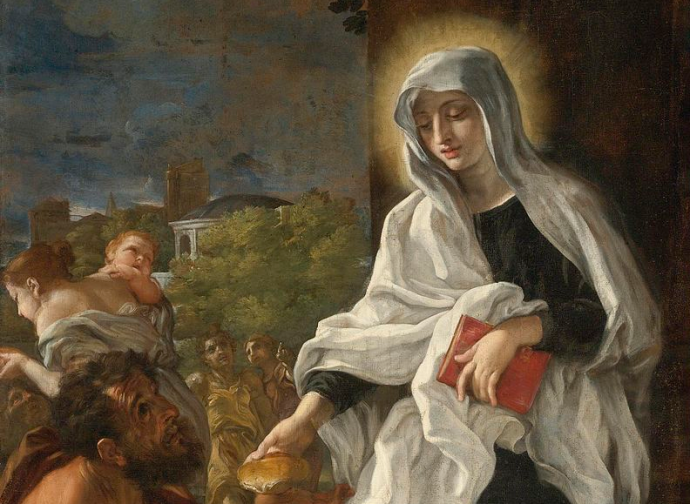
Optional Memorial of Saint Frances of Rome, Religious
LITurgical Color: Violet
Rosary Mysteries: Joyful Mysteries
“Hope every thing from the mercy of God; it is as boundless as His power”.
Saint Frances of Rome
1384 – March 9, 1440
Patron of widows, Benedictine oblates, and motorists

Daily Readings
Gospel: Luke 4: 24-30
24 And he said: Amen I say to you that no prophet is accepted in his own country.
25 In truth I say to You, there were many widows in the days of Elias in Israel, when heaven was shut up three years and six months, when there was a great famine throughout all the earth.
26 And to none of them was Elias sent, but to Sarepta of Sidon, to a widow woman.
27 And there were many lepers in Israel in the time of Eliseus the prophet: and none of them was cleansed but Naaman the Syrian.
28 And all they in the synagogue, hearing these things, were filled with anger.
29 And they rose up and thrust him out of the city: and they brought him to the brow of the hill whereon their city was built, that they might cast him down headlong.
30 But he passing through the midst of them, went his way.
24 Ait autem: Amen dico vobis, quia nemo propheta acceptus est in patria sua.
25 In veritate dico vobis, multæ viduæ erant in diebus Eliæ in Israël, quando clausum est cælum annis tribus et mensibus sex, cum facta esset fames magna in omni terra:
26 et ad nullam illarum missus est Elias, nisi in Sarepta Sidoniæ, ad mulierem viduam.
27 Et multi leprosi erant in Israël sub Eliseo propheta: et nemo eorum mundatus est nisi Naaman Syrus.
28 Et repleti sunt omnes in synagoga ira, hæc audientes.
29 Et surrexerunt, et ejecerunt illum extra civitatem: et duxerunt illum usque ad supercilium montis, super quem civitas illorum erat ædificata, ut præcipitarent eum.
30 Ipse autem transiens per medium illorum, ibat.
First Reading: 2 Kings 5: 1-15ab
1 Naaman, general of the army of the king of Syria, was a great man with his master, and honourable: for by him the Lord gave deliverance to Syria: and he was a valiant man and rich, but a leper.
2 Now there had gone out robbers from Syria, and had led away captive out of the land of Israel a little maid, and she waited upon Naaman’s wife.
3 And she said to her mistress: I wish my master had been with the prophet, that is in Samaria: he would certainly have healed him of the leprosy which he hath.
4 Then Naaman went in to his lord, and told him, saying: Thus and thus said tile girl from the land of Israel.
5 And the king of Syria sad to him: Go, and I will send a letter to the king of Israel. And he departed, and took with him ten talents of silver, and six thousand pieces of gold, and tell changes of raiment,
6 And brought the letter to the king of Israel, in these words: When thou shalt receive this letter, know that I have sent to thee Naaman my servant, that thou mayest heal him of his leprosy.
7 And when the king of Israel had read the letter, he rent his garments, and said: Am I God, to be able to kill and give life, that this man hath sent to me, to heal a man of his leprosy? mark, and see how he seeketh occasions against me.
8 And when Eliseus the man of God had heard this, to wit, that the king of Israel had rent his garments, he sent to him, saying: Why hast thou rent thy garments? let him come to me, and let him know that there is a prophet in Israel.
9 So Naaman came with Iris horses and chariots, and stood at the door of the house of Eliseus:
10 And Eliseus sent a messenger to him, saying: Go, and wash seven times in the Jordan, and thy flesh shall recover health, and thee shalt be clean.
11 Naaman was angry and went away, saying: I thought he would hare come out to me, and standing would hare invoked the name of the Lord his God, and touched with his hand the place of the leprosy, and healed me.
12 Are not the Abana, and the Pharphar, rivers of Damascus, better than all the waters of Israel, that I may wash in them, and be made clean? So as he turned, and was going away with indignation,
13 His servants came to him, and said to him: Father, if the prophet had bid thee do some great thing, surely thou shouldst have done it: how much rather what he now hath said to thee: Wash, and thou shalt he clean?
14 Then he went down, and washed in the Jordan seven times: according to the word of the man of God, and his flesh was restored, like the flesh of a little child, and he was made clean.
15 And returning to the man of God with all his train, be came, and stood before him, and said: In truth, I know there is no other God in all the earth, but only in Israel: I beseech thee therefore take a blessing of thy servant.
1 Naaman princeps militiæ regis Syriæ erat vir magnus apud dominum suum, et honoratus: per illum enim dedit Dominus salutem Syriæ: erat autem vir fortis et dives, sed leprosus.
2 Porro de Syria egressi fuerant latrunculi, et captivam duxerant de terra Israël puellam parvulam, quæ erat in obsequio uxoris Naaman:
3 quæ ait ad dominam suam: Utinam fuisset dominus meus ad prophetam qui est in Samaria, profecto curasset eum a lepra quam habet.
4 Ingressus est itaque Naaman ad dominum suum, et nuntiavit ei, dicens: Sic et sic locuta est puella de terra Israël.
5 Dixitque ei rex Syriæ: Vade, et mittam litteras ad regem Israël. Qui cum profectus esset, et tulisset secum decem talenta argenti, et sex millia aureos, et decem mutatoria vestimentorum,
6 detulit litteras ad regem Israël in hæc verba: Cum acceperis epistolam hanc, scito quod miserim ad te Naaman servum meum, ut cures eum a lepra sua.
7 Cumque legisset rex Israël litteras, scidit vestimenta sua, et ait: Numquid deus ego sum, ut occidere possim et vivificare, quia iste misit ad me ut curem hominem a lepra sua? animadvertite, et videte quod occasiones quærat adversum me.
8 Quod cum audisset Eliseus vir Dei, scidisse videlicet regem Israël vestimenta sua, misit ad eum, dicens: Quare scidisti vestimenta tua? veniat ad me, et sciat esse prophetam in Israël.
9 Venit ergo Naaman cum equis et curribus, et stetit ad ostium domus Elisei:
10 misitque ad eum Eliseus nuntium, dicens: Vade, et lavare septies in Jordane, et recipiet sanitatem caro tua, atque mundaberis.
11 Iratus Naaman recedebat, dicens: Putabam quod egrederetur ad me, et stans invocaret nomen Domini Dei sui, et tangeret manu sua locum lepræ, et curaret me.
12 Numquid non meliores sunt Abana et Pharphar fluvii Damasci, omnibus aquis Israël, ut laver in eis, et munder? Cum ergo vertisset se, et abiret indignans,
13 accesserunt ad eum servi sui, et locuti sunt ei: Pater, etsi rem grandem dixisset tibi propheta, certe facere debueras: quanto magis quia nunc dixit tibi: Lavare, et mundaberis?
14 Descendit, et lavit in Jordane septies juxta sermonem viri Dei: et restituta est caro ejus sicut caro pueri parvuli, et mundatus est.
15 Reversusque ad virum Dei cum universo comitatu suo, venit, et stetit coram eo, et ait: Vere scio quod non sit alius deus in universa terra, nisi tantum in Israël. Obsecro itaque ut accipias benedictionem a servo tuo.

A Daily Question from the Summa Theologica
Whether water should be mixed with the wine? (Article 6 of 8 of Question 74. Of the Matter of This Sacrament from the Treatise on the Sacraments)
Objection 1: It seems that water ought not to be mixed with the wine, since Christ’s sacrifice was foreshadowed by that of Melchisedech, who (Gn. 14:18) is related to have offered up bread and wine only. Consequently it seems that water should not be added in this sacrament.
Objection 2: Further, the various sacraments have their respective matters. But water is the matter of Baptism. Therefore it should not be employed as the matter of this sacrament.
Objection 3: Further, bread and wine are the matter of this sacrament. But nothing is added to the bread. Therefore neither should anything be added to the wine.
On the contrary, Pope Alexander I writes (Ep. 1 ad omnes orth.): “In the sacramental oblations which in mass are offered to the Lord, only bread and wine mixed with water are to be offered in sacrifice.”
I answer that, Water ought to be mingled with the wine which is offered in this sacrament. First of all on account of its institution: for it is believed with probability that our Lord instituted this sacrament in wine tempered with water according to the custom of that country: hence it is written (Prov. 9:5): “Drink the wine which I have mixed for you.” Secondly, because it harmonizes with the representation of our Lord’s Passion: hence Pope Alexander I says (Ep. 1 ad omnes orth.): “In the Lord’s chalice neither wine only nor water only ought to be offered, but both mixed because we read that both flowed from His side in the Passion.” Thirdly, because this is adapted for signifying the effect of this sacrament, since as Pope Julius says (Concil. Bracarens iii, Can. 1): “We see that the people are signified by the water, but Christ’s blood by the wine. Therefore when water is mixed with the wine in the chalice, the people is made one with Christ.” Fourthly, because this is appropriate to the fourth effect of this sacrament, which is the entering into everlasting life: hence Ambrose says (De Sacram. v): “The water flows into the chalice, and springs forth unto everlasting life.”
Reply to Objection 1: As Ambrose says (De Sacram. v), just as Christ’s sacrifice is denoted by the offering of Melchisedech, so likewise it is signified by the water which flowed from the rock in the desert, according to 1 Cor. 10:4: “But they drank of the spiritual rock which came after them.”
Reply to Objection 2: In Baptism water is used for the purpose of ablution: but in this sacrament it is used by way of refreshment, according to Ps. 22:3: “He hath brought me up on the water of refreshment.”
Reply to Objection 3: Bread is made of water and flour; and therefore, since water is mixed with the wine, neither is without water.
Continue reading the rest of the articles on Sacred Texts Archive website.