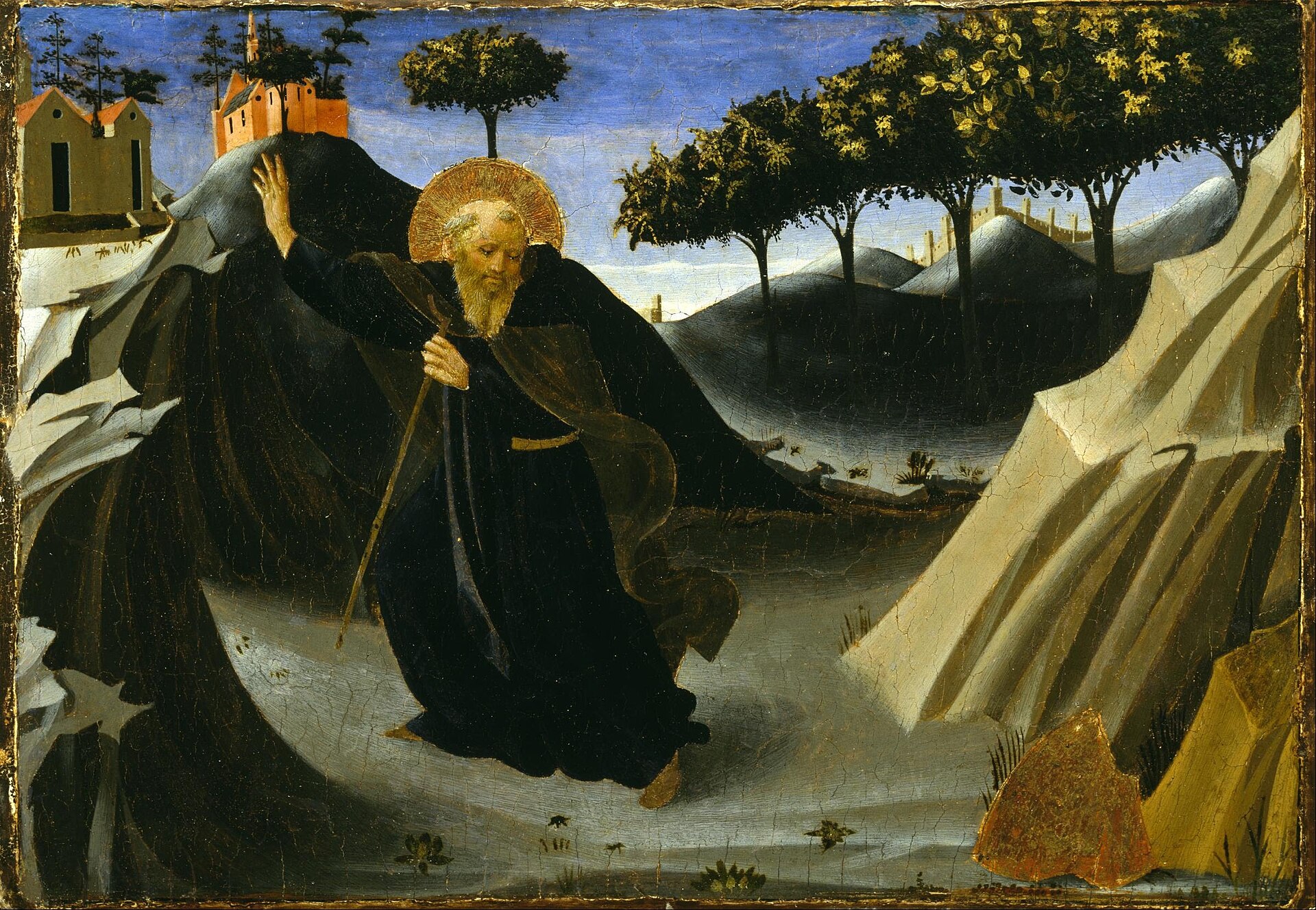
Memorial of Saint Anthony, Abbot
Liturgical Color: White
Rosary Mysteries: Joyful Mysteries
“The illusions of this world soon vanish, especially if a man arms himself with the Sign of the Cross. The devils tremble at the Sign of the Cross of our Lord, by which He triumphed over
Saint Anthony
and disarmed them.”
January 12, 251 – January 17, 356
Patron of animals and farmers

Daily Readings
First Reading: 1 Samuel 9: 1-4, 17-19; 10: 1a
1 Now there was a man of Benjamin whose name was Cis, the son of Abiel, the son of Seror, the son of Bechorath, the son of Aphia, the son of a man of Jemini, valiant and strong.
2 And he had a son whose name was Saul, a choice and goodly man, and there was not among the children of Israel a goodlier person than he: from his shoulders and upward he appeared above all the people.
3 And the asses of Cis, Sauls father, were lost: and Cis said to his son Saul: Take one of the servants with thee, and arise, go, and seek the asses. And when they had passed through mount Ephraim,
4 And through the land of Salisa, and had not found them, they passed also through the land of Salim, and they were not there: and through the land of Jemini, and found them not.
17 And when Samuel saw Saul, the Lord said to him: Behold the man, of whom I spoke to thee, this man shall reign over my people.
18 And Saul came to Samuel in the midst of the gate and said: Tell me, I pray thee, where is the house of the seer?
19 And Samuel answered Saul, saying: I am the seer, go up before me to the high place, that you may eat with me today, and I will let thee go in the morning: and tell thee all that is in thy heart.
1 And Samuel took a little vial of oil and poured it upon his head, and kissed him, and said: Behold, the Lord hath anointed thee to be prince over his inheritance, and thou shalt deliver his people out of the hands of their enemies, that are round about them. And this shall be a sign unto thee, that God hath anointed thee to be prince.
1 Et erat vir de Benjamin nomine Cis, filius Abiel, filii Seror, filii Bechorath, filii Aphia, filii viri Jemini, fortis robore.
2 Et erat ei filius vocabulo Saul, electus et bonus: et non erat vir de filiis Israël melior illo: ab humero et sursum eminebat super omnem populum.
3 Perierant autem asinæ Cis patris Saul: et dixit Cis ad Saul filium suum: Tolle tecum unum de pueris, et consurgens vade, et quære asinas. Qui cum transissent per montem Ephraim
4 et per terram Salisa, et non invenissent, transierunt etiam per terram Salim, et non erant: sed et per terram Jemini, et minime repererunt.
17 Cumque aspexisset Samuel Saulem, Dominus dixit ei: Ecce vir quem dixeram tibi: iste dominabitur populo meo.
18 Accessit autem Saul ad Samuelem in medio portæ, et ait: Indica, oro, mihi, ubi est domus videntis.
19 Et respondit Samuel Sauli, dicens: Ego sum videns: ascende ante me in excelsum, ut comedatis mecum hodie, et dimittam te mane: et omnia quæ sunt in corde tuo indicabo tibi.
1 Tulit autem Samuel lenticulam olei, et effudit super caput ejus: et deosculatus est eum, et ait: Ecce unxit te Dominus super hæreditatem suam in principem, et liberabis populum suum de manibus inimicorum ejus qui in circuitu ejus sunt. Et hoc tibi signum, quia unxit te Deus in principem.
Gospel: Mark 2: 13-17
13 And he went forth again to the sea side; and all the multitude came to him, and he taught them.
14 And when he was passing by, he saw Levi the son of Alpheus sitting at the receipt of custom; and he saith to him: Follow me. And rising up, he followed him.
15 And it came to pass, that as he sat at meat in his house, many publicans and sinners sat down together with Jesus and his disciples. For they were many, who also followed him.
16 And the scribes and the Pharisees, seeing that he ate with publicans and sinners, said to his disciples: Why doth your master eat and drink with publicans and sinners?
17 Jesus hearing this, saith to them: They that are well have no need of a physician, but they that are sick. For I came not to call the just, but sinners.
13 Et egressus est rursus ad mare, omnisque turba veniebat ad eum, et docebat eos.
14 Et cum præteriret, vidit Levi Alphæi sedentem ad telonium, et ait illi: Sequere me. Et surgens secutus est eum.
15 Et factum est, cum accumberet in domo illius, multi publicani et peccatores simul discumbebant cum Jesu et discipulis ejus: erant enim multi, qui et sequebantur eum.
16 Et scribæ et pharisæi videntes quia manducaret cum publicanis et peccatoribus, dicebant discipulis ejus: Quare cum publicanis et peccatoribus manducat et bibit Magister vester?
17 Hoc audito Jesus ait illis: Non necesse habent sani medico, sed qui male habent: non enim veni vocare justos, sed peccatores.

A Daily Question from the Summa Theologica
Whether it was becoming that Christ should be tempted? (Article 1 of 4 of Question 41. Of Christ’s Temptation from the Treatise on the Incarnation)
Objection 1: It would seem that it was not becoming for Christ to be tempted. For to tempt is to make an experiment, which is not done save in regard to something unknown. But the power of Christ was known even to the demons; for it is written (Lk. 4:41) that “He suffered them not to speak, for they knew that He was Christ.” Therefore it seems that it was unbecoming for Christ to be tempted.
Objection 2: Further, Christ was come in order to destroy the works of the devil, according to 1 Jn. 3:8: “For this purpose the Son of God appeared, that He might destroy the works of the devil.” But it is not for the same to destroy the works of a certain one and to suffer them. Therefore it seems unbecoming that Christ should suffer Himself to be tempted by the devil.
Objection 3: Further, temptation is from a threefold source—the flesh, the world, and the devil. But Christ was not tempted either by the flesh or by the world. Therefore neither should He have been tempted by the devil.
On the contrary, It is written (Mat. 4:1): “Jesus was led by the Spirit into the desert to be tempted by the devil.”
I answer that, Christ wished to be tempted; first that He might strengthen us against temptations. Hence Gregory says in a homily (xvi in Evang.): “It was not unworthy of our Redeemer to wish to be tempted, who came also to be slain; in order that by His temptations He might conquer our temptations, just as by His death He overcame our death.”
Secondly, that we might be warned, so that none, however holy, may think himself safe or free from temptation. Wherefore also He wished to be tempted after His baptism, because, as Hilary says (Super Matth., cap. iii.): “The temptations of the devil assail those principally who are sanctified, for he desires, above all, to overcome the holy. Hence also it is written (Ecclus. 2): Son, when thou comest to the service of God, stand in justice and in fear, and prepare thy soul for temptation.”
Thirdly, in order to give us an example: to teach us, to wit, how to overcome the temptations of the devil. Hence Augustine says (De Trin. iv) that Christ “allowed Himself to be tempted” by the devil, “that He might be our Mediator in overcoming temptations, not only by helping us, but also by giving us an example.”
Fourthly, in order to fill us with confidence in His mercy. Hence it is written (Heb. 4:15): “We have not a high-priest, who cannot have compassion on our infirmities, but one tempted in all things like as we are, without sin.”
Reply to Objection 1: As Augustine says (De Civ. Dei ix): “Christ was known to the demons only so far as He willed; not as the Author of eternal life, but as the cause of certain temporal effects,” from which they formed a certain conjecture that Christ was the Son of God. But since they also observed in Him certain signs of human frailty, they did not know for certain that He was the Son of God: wherefore (the devil) wished to tempt Him. This is implied by the words ofMatt. 4:2, 3saying that, after “He was hungry, the tempter” came “to Him,” because, as Hilary says (Super Matth., cap. iii), “Had not Christ’s weakness in hungering betrayed His human nature, the devil would not have dared to tempt Him.” Moreover, this appears from the very manner of the temptation, when he said: “If Thou be the Son of God.” Which words Ambrose explains as follows (In Luc. iv): “What means this way of addressing Him, save that, though he knew that the Son of God was to come, yet he did not think that He had come in the weakness of the flesh?”
Reply to Objection 2: Christ came to destroy the works of the devil, not by powerful deeds, but rather by suffering from him and his members, so as to conquer the devil by righteousness, not by power; thus Augustine says (De Trin. xiii) that “the devil was to be overcome, not by the power of God, but by righteousness.” And therefore in regard to Christ’s temptation we must consider what He did of His own will and what He suffered from the devil. For that He allowed Himself to be tempted was due to His own will. Wherefore it is written (Mat. 4:1): “Jesus was led by the Spirit into the desert, to be tempted by the devil”; and Gregory (Hom. xvi in Evang.) says this is to be understood of the Holy Ghost, to wit, that “thither did His Spirit lead Him, where the wicked spirit would find Him and tempt Him.” But He suffered from the devil in being “taken up” on to “the pinnacle of the Temple” and again “into a very high mountain.” Nor is it strange, as Gregory observes, “that He allowed Himself to be taken by him on to a mountain, who allowed Himself to be crucified by His members.” And we understand Him to have been taken up by the devil, not, as it were, by force, but because, as Origen says (Hom. xxi super Luc.), “He followed Him in the course of His temptation like a wrestler advancing of his own accord.”
Reply to Objection 3: As the Apostle says (Heb. 4:15), Christ wished to be “tempted in all things, without sin.” Now temptation which comes from an enemy can be without sin: because it comes about by merely outward suggestion. But temptation which comes from the flesh cannot be without sin, because such a temptation is caused by pleasure and concupiscence; and, as Augustine says (De Civ. Dei xix), “it is not without sin that ‘the flesh desireth against the spirit.’” And hence Christ wished to be tempted by an enemy, but not by the flesh.
Continue reading the rest of the articles on Sacred Texts Archive website.