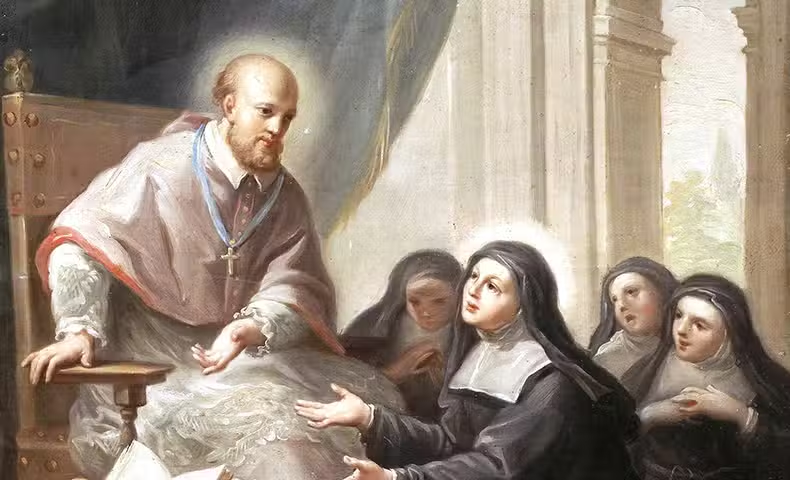
Memorial of Saint Francis de Sales, Bishop and Doctor of the Church
Liturgical Color: White
Rosary Mysteries: Joyful Mysteries
“Have patience with all things – but first with yourself. Never confuse your mistakes with your value as a human being. You are perfectly valuable, creative, worthwhile person simply because you exist. And no amount of triumphs or tribulations can ever change that.”
Saint Francis de Sales
August 21, 1567 – December 28, 1622
Patron of the deaf, journalists, adult education, and the Sisters of St. Joseph

Daily Readings
First Reading: 2 Samuel 1: 1-4, 11-12, 19, 23-27
1 Now it came to pass, after Saul was dead, that David returned from the slaughter of the Amalecites, and abode two days in Siceleg.
2 And on the third day, there appeared a man who came out of Saul’s camp, with his garments rent, and dust strewed on his head: and when he came to David, he fell upon his face, and adored.
3 And David said to him: From whence comest thou? And he said to him: I am fled out of the camp of Israel.
4 And David said unto him: What is the matter that is come to pass? tell me. He said: The people are fled from the battle, and many of the people are fallen and dead: moreover Saul and Jonathan his son are slain.
11 Then David took hold of his garments and rent them, and likewise all the men that were with him.
12 And they mourned, and wept, and fasted until evening for Saul, and for Jonathan his son, and for the people of the Lord, and for the house of Israel, because they were fallen by the sword.
19 The illustrious of Israel are slain upon thy mountains: how are the valiant fallen?
23 Saul and Jonathan, lovely, and comely in their life, even in death they were not divided: they were swifter than eagles, stronger than lions.
24 Ye daughters of Israel, weep over Saul, who clothed you with scarlet in delights, who gave ornaments of gold for your attire.
25 How are the valiant fallen in battle? Jonathan slain in the high places?
26 I grieve for thee, my brother Jonathan: exceeding beautiful, and amiable to me above the love of women. As the mother loveth her only son, so did I love thee.
27 How are the valiant fallen, and the weapons of war perished?
1 Factum est autem, postquam mortuus est Saul, ut David reverteretur a cæde Amalec, et maneret in Siceleg duos dies.
2 In die autem tertia apparuit homo veniens de castris Saul veste conscissa, et pulvere conspersus caput: et ut venit ad David, cecidit super faciem suam, et adoravit.
3 Dixitque ad eum David: Unde venis? Qui ait ad eum: De castris Israël fugi.
4 Et dixit ad eum David: Quod est verbum quod factum est? indica mihi. Qui ait: Fugit populus ex prælio, et multi corruentes e populo mortui sunt: sed et Saul et Jonathas filius ejus interierunt.
11 Apprehendens autem David, vestimenta sua scidit, omnesque viri qui erant cum eo,
12 et planxerunt, et fleverunt, et jejunaverunt usque ad vesperam super Saul, et super Jonathan filium ejus, et super populum Domini, et super domum Israël, eo quod corruissent gladio.
19 Inclyti Israël super montes tuos interfecti sunt:
quomodo ceciderunt fortes?
23 Saul et Jonathas amabiles, et decori in vita sua,
in morte quoque non sunt divisi:
aquilis velociores, leonibus fortiores.]
24 [Filiæ Israël, super Saul flete,
qui vestiebat vos coccino in deliciis,
qui præbebat ornamenta aurea cultui vestro.]
25 [Quomodo ceciderunt fortes in prælio?
Jonathas in excelsis tuis occisus est?
26 Doleo super te, frater mi Jonatha,
decore nimis, et amabilis super amorem mulierum.
Sicut mater unicum amat filium suum,
ita ego te diligebam.
27 Quomodo ceciderunt robusti,
et perierunt arma bellica?]
Gospel: Mark 3: 20-21
20 And they come to a house, and the multitude cometh together again, so that they could not so much as eat bread.
21 And when his friends had heard of it, they went out to lay hold on him. For they said: He is become mad.
20 Et veniunt ad domum: et convenit iterum turba, ita ut non possent neque panem manducare.
21 Et cum audissent sui, exierunt tenere eum: dicebant enim: Quoniam in furorem versus est.

A Daily Question from the Summa Theologica
Whether Christ should have committed His doctrine to writing? (Article 4 of 4 of Question 42. Of Christ’s Doctrine from the Treatise on the Incarnation)
Objection 1: It would seem that Christ should have committed His doctrine to writing. For the purpose of writing is to hand down doctrine to posterity. Now Christ’s doctrine was destined to endure for ever, according to Lk. 21:33: “Heaven and earth shall pass away, but My words shall not pass away.” Therefore it seems that Christ should have committed His doctrine to writing.
Objection 2: Further, the Old Law was a foreshadowing of Christ, according to Heb. 10:1: “The Law has [Vulg.: ‘having’] a shadow of the good things to come.” Now the Old Law was put into writing by God, according to Ex. 24:12: “I will give thee” two “tables of stone and the law, and the commandments which I have written.” Therefore it seems that Christ also should have put His doctrine into writing.
Objection 3: Further, to Christ, who came to enlighten them that sit in darkness (Lk. 1:79), it belonged to remove occasions of error, and to open out the road to faith. Now He would have done this by putting His teaching into writing: for Augustine says (De Consensu Evang. i) that “some there are who wonder why our Lord wrote nothing, so that we have to believe what others have written about Him. Especially do those pagans ask this question who dare not blame or blaspheme Christ, and who ascribe to Him most excellent, but merely human, wisdom. These say that the disciples made out the Master to be more than He really was when they said that He was the Son of God and the Word of God, by whom all things were made.” And farther on he adds: “It seems as though they were prepared to believe whatever He might have written of Himself, but not what others at their discretion published about Him.” Therefore it seems that Christ should have Himself committed His doctrine to writing.
On the contrary, No books written by Him were to be found in the canon of Scripture.
I answer that, It was fitting that Christ should not commit His doctrine to writing. First, on account of His dignity: for the more excellent the teacher, the more excellent should be his manner of teaching. Consequently it was fitting that Christ, as the most excellent of teachers, should adopt that manner of teaching whereby His doctrine is imprinted on the hearts of His hearers; wherefore it is written (Mat. 7:29) that “He was teaching them as one having power.” And so it was that among the Gentiles, Pythagoras and Socrates, who were teachers of great excellence, were unwilling to write anything. For writings are ordained, as to an end, unto the imprinting of doctrine in the hearts of the hearers.
Secondly, on account of the excellence of Christ’s doctrine, which cannot be expressed in writing; according to Jn. 21:25: “There are also many other things which Jesus did: which, if they were written everyone, the world itself, I think, would not be able to contain the books that should be written.” Which Augustine explains by saying: “We are not to believe that in respect of space the world could not contain them . . . but that by the capacity of the readers they could not be comprehended.” And if Christ had committed His doctrine to writing, men would have had no deeper thought of His doctrine than that which appears on the surface of the writing.
Thirdly, that His doctrine might reach all in an orderly manner: Himself teaching His disciples immediately, and they subsequently teaching others, by preaching and writing: whereas if He Himself had written, His doctrine would have reached all immediately.
Hence it is said of Wisdom (Prov. 9:3) that “she hath sent her maids to invite to the tower.” It is to be observed, however, that, as Augustine says (De Consensu Evang. i), some of the Gentiles thought that Christ wrote certain books treating of the magic art whereby He worked miracles: which art is condemned by the Christian learning. “And yet they who claim to have read those books of Christ do none of those things which they marvel at His doing according to those same books. Moreover, it is by a Divine judgment that they err so far as to assert that these books were, as it were, entitled as letters to Peter and Paul, for that they found them in several places depicted in company with Christ. No wonder that the inventors were deceived by the painters: for as long as Christ lived in the mortal flesh with His disciples, Paul was no disciple of His.”
Reply to Objection 1: As Augustine says in the same book: “Christ is the head of all His disciples who are members of His body. Consequently, when they put into writing what He showed forth and said to them, by no means must we say that He wrote nothing: since His members put forth that which they knew under His dictation. For at His command they, being His hands, as it were, wrote whatever He wished us to read concerning His deeds and words.”
Reply to Objection 2: Since the old Law was given under the form of sensible signs, therefore also was it fittingly written with sensible signs. But Christ’s doctrine, which is “the law of the spirit of life” (Rom. 8:2), had to be “written not with ink, but with the Spirit of the living God; not in tables of stone, but in the fleshly tables of the heart,” as the Apostle says (2 Cor. 3:3).
Reply to Objection 3: Those who were unwilling to believe what the apostles wrote of Christ would have refused to believe the writings of Christ, whom they deemed to work miracles by the magic art.
Continue reading the rest of the articles on Sacred Texts Archive website.