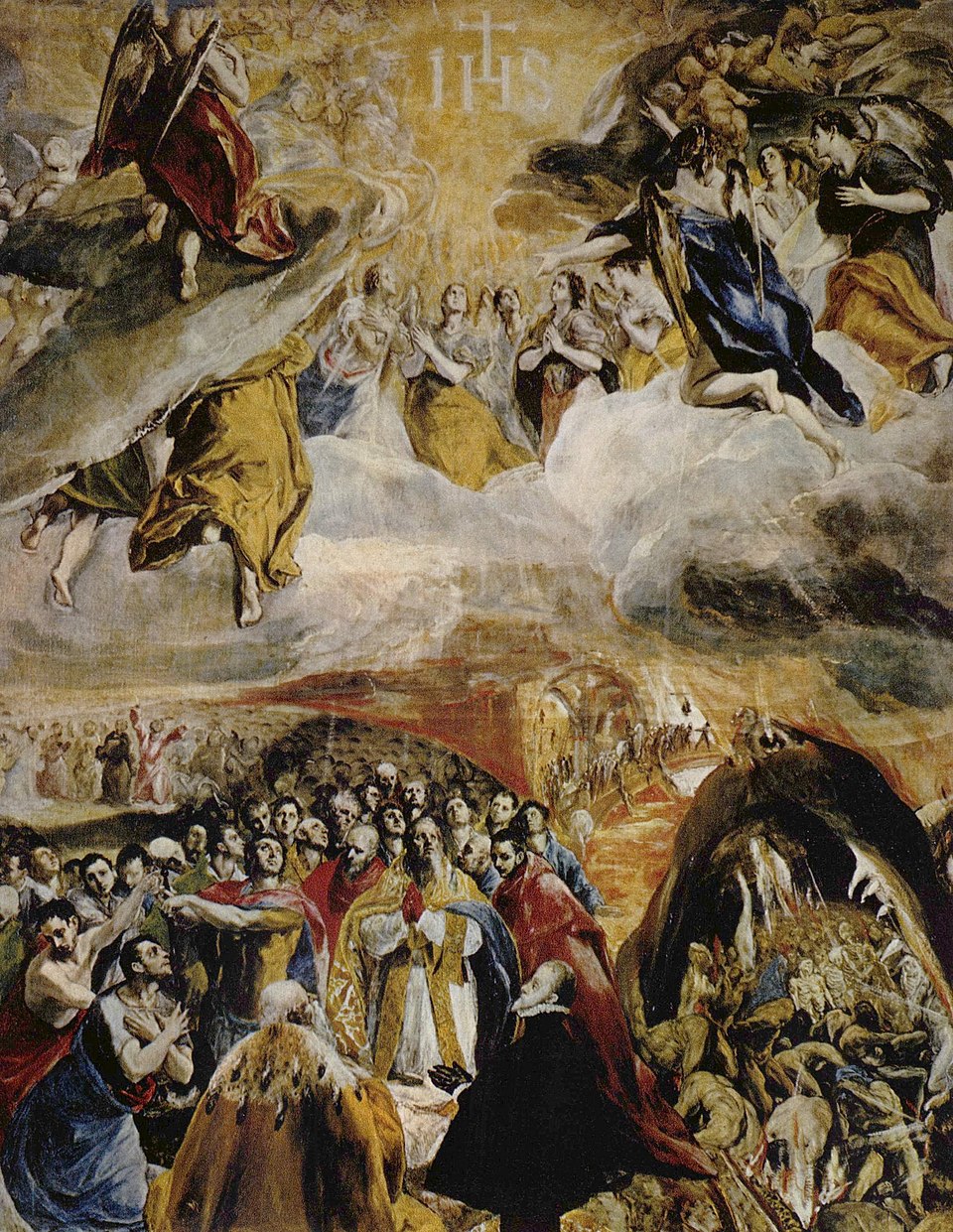
Optional memorial of The Most Holy Name of Jesus
Liturgical Color: White
Rosary Mysteries: Joyful Mysteries

Daily Readings
First Reading: 1 John 2: 29—3: 6
29 If you know, that he is just, know ye, that every one also, who doth justice, is born of him.
1 Behold what manner of charity the Father hath bestowed upon us, that we should be called, and should be the sons of God. Therefore the world knoweth not us, because it knew not him.
2 Dearly beloved, we are now the sons of God; and it hath not yet appeared what we shall be. We know, that, when he shall appear, we shall be like to him: because we shall see him as he is.
3 And every one that hath this hope in him, sanctifieth himself, as he also is holy.
4 Whosoever committeth sin committeth also iniquity; and sin is iniquity.
5 And you know that he appeared to take away our sins, and in him there is no sin.
6 Whosoever abideth in him, sinneth not; and whosoever sinneth, hath not seen him, nor known him.
29 Si scitis quoniam justus est, scitote quoniam et omnis, qui facit justitiam, ex ipso natus est.
1 Videte qualem caritatem dedit nobis Pater, ut filii Dei nominemur et simus. Propter hoc mundus non novit nos: quia non novit eum.
2 Carissimi, nunc filii Dei sumus: et nondum apparuit quid erimus. Scimus quoniam cum apparuerit, similes ei erimus: quoniam videbimus eum sicuti est.
3 Et omnis qui habet hanc spem in eo, sanctificat se, sicut et ille sanctus est.
4 Omnis qui facit peccatum, et iniquitatem facit: et peccatum est iniquitas.
5 Et scitis quia ille apparuit ut peccata nostra tolleret: et peccatum in eo non est.
6 Omnis qui in eo manet, non peccat: et omnis qui peccat, non vidit eum, nec cognovit eum.
Gospel: John 1: 29-34
29 The next day, John saw Jesus coming to him, and he saith: Behold the Lamb of God, behold him who taketh away the sin of the world.
30 This is he, of whom I said: After me there cometh a man, who is preferred before me: because he was before me.
31 And I knew him not, but that he may be made manifest in Israel, therefore am I come baptizing with water.
32 And John gave testimony, saying: I saw the Spirit coming down, as a dove from heaven, and he remained upon him.
33 And I knew him not; but he who sent me to baptize with water, said to me: He upon whom thou shalt see the Spirit descending, and remaining upon him, he it is that baptizeth with the Holy Ghost.
34 And I saw, and I gave testimony, that this is the Son of God.
29 Altera die vidit Joannes Jesum venientem ad se, et ait: Ecce agnus Dei, ecce qui tollit peccatum mundi.
30 Hic est de quo dixi: Post me venit vir qui ante me factus est: quia prior me erat:
31 et ego nesciebam eum, sed ut manifestetur in Israël, propterea veni ego in aqua baptizans.
32 Et testimonium perhibuit Joannes, dicens: Quia vidi Spiritum descendentem quasi columbam de cælo, et mansit super eum.
33 Et ego nesciebam eum: sed qui misit me baptizare in aqua, ille mihi dixit: Super quem videris Spiritum descendentem, et manentem super eum, hic est qui baptizat in Spiritu Sancto.
34 Et ego vidi: et testimonium perhibui quia hic est Filius Dei.

A Daily Question from the Summa Theologica
Whether Christ should have been circumcised? (Article 1 of 4 of Question 37. Of Christ’s Circumcision, and of the Other Legal Observances Accomplished in Regard to the Child Christ from the Treatise on the Incarnation)
Objection 1: It would seem that Christ should not have been circumcised. For on the advent of the reality, the figure ceases. But circumcision was prescribed to Abraham as a sign of the covenant concerning his posterity, as may be seen from Gn. 17. Now this covenant was fulfilled in Christ’s birth. Therefore circumcision should have ceased at once.
Objection 2: Further, “every action of Christ is a lesson to us” [*Innoc. III, Serm. xxii de Temp.]; wherefore it is written (Jn. 3:15): “I have given you an example, that as I have done to you, so you do also.” But we ought not to be circumcised; according to Gal. 5:2: “If you be circumcised, Christ shall profit you nothing.” Therefore it seems that neither should Christ have been circumcised.
Objection 3: Further, circumcision was prescribed as a remedy of original sin. But Christ did not contract original sin, as stated above (Q[14], A[3]; Q[15], A[1]). Therefore Christ should not have been circumcised.
On the contrary, It is written (Lk. 2:21): “After eight days were accomplished, that the child should be circumcised.”
I answer that, For several reasons Christ ought to have been circumcised. First, in order to prove the reality of His human nature, in contradiction to the Manicheans, who said that He had an imaginary body: and in contradiction to Apollinarius, who said that Christ’s body was consubstantial with His Godhead; and in contradiction to Valentine, who said that Christ brought His body from heaven. Secondly, in order to show His approval of circumcision, which God had instituted of old. Thirdly, in order to prove that He was descended from Abraham, who had received the commandment of circumcision as a sign of his faith in Him. Fourthly, in order to take away from the Jews an excuse for not receiving Him, if He were uncircumcised. Fifthly, “in order by His example to exhort us to be obedient” [*Bede, Hom. x in Evang.]. Wherefore He was circumcised on the eighth day according to the prescription of the Law (Lev. 12:3). Sixthly, “that He who had come in the likeness of sinful flesh might not reject the remedy whereby sinful flesh was wont to be healed.” Seventhly, that by taking on Himself the burden of the Law, He might set others free therefrom, according toGal. 4:4, 5: “God sent His Son . . . made under the Law, that He might redeem them who were under the Law.”
Reply to Objection 1: Circumcision by the removal of the piece of skin in the member of generation, signified “the passing away of the old generation” [*Athanasius, De Sabb. et Circumcis.]: from the decrepitude of which we are freed by Christ’s Passion. Consequently this figure was not completely fulfilled in Christ’s birth, but in His Passion, until which time the circumcision retained its virtue and status. Therefore it behooved Christ to be circumcised as a son of Abraham before His Passion.
Reply to Objection 2: Christ submitted to circumcision while it was yet of obligation. And thus His action in this should be imitated by us, in fulfilling those things which are of obligation in our own time. Because “there is a time and opportunity for every business” (Eccl 8:6).
Moreover, according to Origen (Hom. xiv in Luc.), “as we died when He died, and rose again when Christ rose from the dead, so were we circumcised spiritually through Christ: wherefore we need no carnal circumcision.” And this is what the Apostle says (Col. 2:11): “In whom,” [i.e. Christ] “you are circumcised with circumcision not made by hand in despoiling of the body of the flesh, but in the circumcision of” our Lord Jesus “Christ.”
Reply to Objection 3: As Christ voluntarily took upon Himself our death, which is the effect of sin, whereas He had no sin Himself, in order to deliver us from death, and to make us to die spiritually unto sin, so also He took upon Himself circumcision, which was a remedy against original sin, whereas He contracted no original sin, in order to deliver us from the yoke of the Law, and to accomplish a spiritual circumcision in us—in order, that is to say, that, by taking upon Himself the shadow, He might accomplish the reality.
Continue reading the rest of the articles on Sacred Texts Archive website.